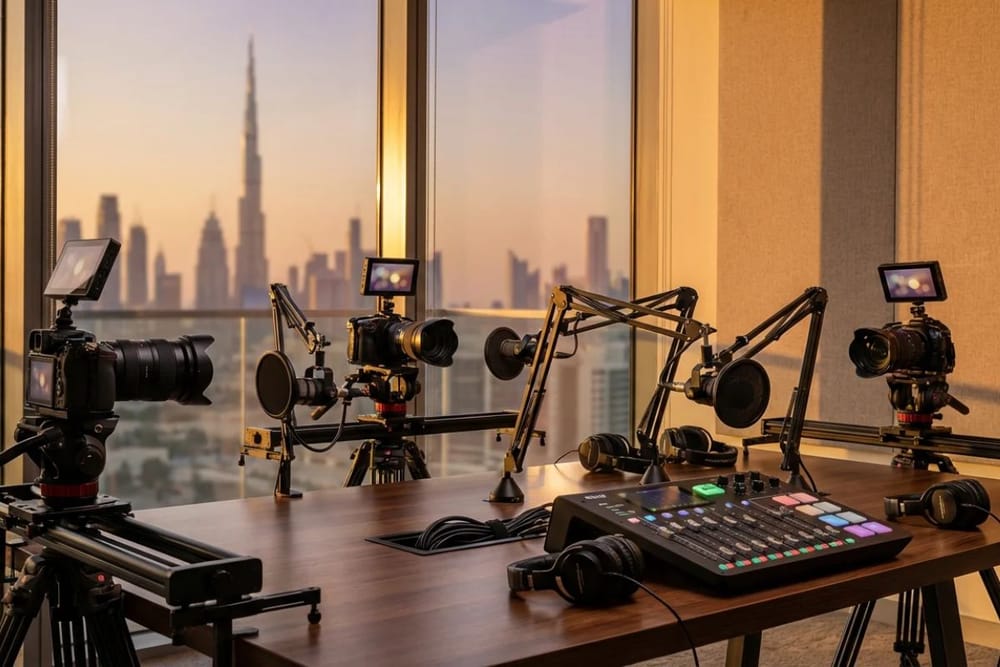
In the boardrooms of DIFC and the trendy co-working spaces of Al Quoz, a new pressure has emerged for the Dubai business owner. It is no longer enough to have a functional website, a high-converting sales funnel, or a vibrant Instagram presence. In 2026, the question being whispered in every marketing meeting is: “When are we launching our podcast?”
The allure is obvious. We see the "podcast bros" on LinkedIn, the sleek studio setups in Dubai Media City, and the viral clips of local founders sharing their "origin stories." It looks effortless, authoritative, and—most importantly—successful. But behind the glowing "On Air" signs lies a graveyard of abandoned shows, wasted marketing budgets, and founders who realized too late that podcasting is not a "hobby" or a "marketing hack." It is a grueling, long-term commitment.
Before you invest in audio equipment or sign a six-month contract with a local production studio, let’s look at whether this is actually your "cup of tea" or just a distraction from your bottom line.

The Dubai Hype Cycle vs. Operational Reality
Dubai is a city that thrives on the "New." Whether it’s the latest real estate development, a new AI-driven government initiative, or a social media trend, the city’s entrepreneurial ecosystem has a habit of jumping on the bandwagon at high speed. This has created what we can call the "Podcast Hype Cycle."
The cycle usually begins with a business owner noticing a competitor’s show. They see the polished video clips on TikTok and the high-profile guests appearing in the studio. They think, “I can talk for an hour. I know my industry. This will be easy.”
The Reality: Podcasting in 2026 is no longer just about audio. In the Dubai market, if your podcast isn't filmed in high-definition 4K, edited with professional captions, and distributed across at least four social platforms in short-form snippets, it effectively does not exist. A "simple podcast" is actually a complex content factory that requires:
- Pre-production (Guest sourcing, research, and scripting).
- Production (Technical setup, sound engineering, and lighting).
- Post-production (Editing the long-form video and audio).
- Micro-content creation (Turning that one hour into 10-15 vertical clips).
- Distribution (SEO-optimized show notes, LinkedIn articles, and email newsletters).
If your business does not have the "stomach" for this level of content manufacturing, the microphone will eventually become an expensive paperweight.
The "Nature of Business" Filter: Who Wins and Who Loses?
The most important question to ask is: What is the nature of your business? Not every industry benefits from the long-form conversational nature of a podcast. In fact, for some, it can actually dilute the brand.
The High-Ticket B2B & Consultancy Winners
If you are a lawyer, a tax consultant, a real estate specialist focusing on luxury villas, or a corporate trainer, a podcast is your greatest asset. Why? Because you are selling Trust and Expertise.
In Dubai, where the market is transient and competition is fierce, clients don't just buy a service; they buy the "brain" behind the service. A podcast allows a potential client to spend 30 to 60 minutes with you every week. They hear your tone, they understand your logic, and they witness your mastery of the subject. By the time they pick up the phone to book a consultation, the "sale" is already 80% complete. You aren't a stranger; you are a trusted advisor they’ve already "met" via their headphones.
The Low-Ticket Transactional Losers
Conversely, if you run a high-volume laundry service, a quick-service cafeteria, or a basic e-commerce site selling phone chargers, a podcast is likely a distraction. Your customers do not need to hear your "philosophy" on laundry. They need a clean shirt, delivered on time, at a fair price.
For these businesses, a AED 5,000 monthly podcast budget would be better spent on Google Maps optimization, localized SEO, or targeted Instagram ads. In these industries, the "friction" of a podcast—the time it takes to consume the content—outweighs the benefit.
The "Trojan Horse" Strategy: Networking in a City of Gatekeepers
One of the most powerful reasons to start a podcast in Dubai has nothing to do with the audience and everything to do with the guest.
Dubai is a city built on Wasta (influence and connections). However, the most influential people in the city—government officials, CEOs of multi-national firms, and high-net-worth investors—are guarded by a fortress of secretaries and gatekeepers. If you call them asking for a "sales meeting," the answer is a polite "No."
But if you invite them to be a guest on a professional podcast to share their expertise and their story? The doors swing open.
A podcast is a legitimate, high-value "Trojan Horse" that allows you to sit across the table from people you would never otherwise have access to. It builds a relationship based on mutual value rather than a cold pitch. Even if only 100 people listen to the episode, the 45 minutes you spent building rapport with that guest could result in a partnership worth millions. If your business relies on high-level networking, the podcast is your VIP pass.
When Do You Actually Need a Podcast?
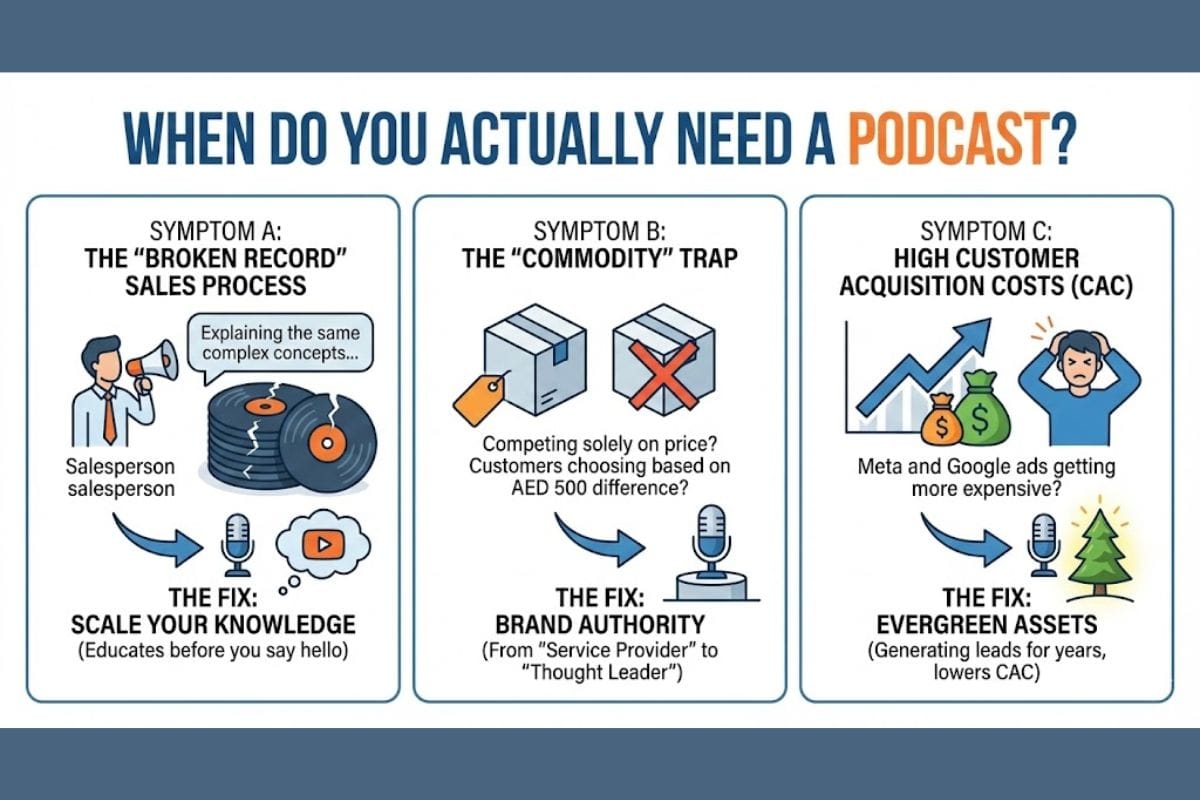
If you are still on the fence, look for these three "symptoms" in your business. If you recognize them, it’s time to consider the mic.
Symptom A: The "Broken Record" Sales Process
Are you constantly explaining the same complex concepts to every new lead? Do you find yourself repeating the same industry insights 20 times a month? The Fix: A podcast allows you to "scale your knowledge." You can record a deep dive on those specific topics and send the episodes to prospects before your meeting. It educates your lead before you even say hello.
Symptom B: The "Commodity" Trap
Are you being forced to compete solely on price? Are customers choosing your competitor just because they are AED 500 cheaper? The Fix: You have a brand authority problem. A podcast lifts you out of the commodity trap. It turns you from a "service provider" into a "thought leader." People pay a premium for authorities; they negotiate with commodities.
Symptom C: High Customer Acquisition Costs (CAC)
Are your Meta and Google ads getting more expensive every month? The Fix: Content is the only way to lower CAC over the long term. A podcast creates "Evergreen Assets." An episode you record today will still be generating leads for your Dubai business in 2028. Paid ads stop the moment you stop paying; a podcast keeps working while you sleep.
Is It Your "Cup of Tea"? The Founder’s Personality Test
Beyond the business metrics, there is the human element. Podcasting is an intimate medium. Unlike a scripted TV commercial or a polished Instagram photo, a podcast reveals the "real" you.
Dubai audiences are highly sophisticated. They can spot inauthenticity from a mile away. To succeed, the host (whether it’s the founder or a designated team member) needs:
- Curiosity over Ego: A great business podcast isn't about the host showing off; it’s about the host asking the questions the audience wants to hear. If you can't stop talking about yourself, your listeners will stop listening to you.
- Verbal Stamina: Can you maintain high energy for an hour? Can you keep a conversation flowing without awkward silences or over-reliance on a script?
- The "Cringe" Resistance: Your first 10 episodes will likely be average. You will hate the sound of your own voice. You will find your "ums" and "ahs" irritating. If you aren't willing to push through the "cringe" phase to get to the "mastery" phase, don't start.
The "Dubai Hybrid" Model: A Realistic Alternative
If you’ve read this far and realized that a weekly, perpetual podcast isn't for you, there is a middle ground that works exceptionally well in the UAE market: The Seasonal Lead Magnet.
Instead of committing to a "forever" show, commit to a 10-episode limited series.
- Title Example: "The 2026 Founder’s Guide to Dubai Mainland Setup."
- The Strategy: You record all 10 episodes in two days at a professional studio. You release them once a week for ten weeks.
- The Result: You now have a permanent library of high-value content. You’ve established your authority. You’ve met ten high-value guests. And then... you stop. You don't have the pressure of a weekly schedule, but you have all the benefits of the medium.
Does your business in Dubai need a podcast?
If you are selling a low-cost, fast-moving product, the answer is likely No. Invest your energy in shorter, more direct marketing.
But if you are in the business of Relationships, Authority, and Complex Sales, the answer is a resounding Yes—but only if you treat it as a core business function. In a city that never stops talking, the most successful businesses are those that have something worth saying. If you have the expertise, the patience, and the distribution strategy, the microphone might just be the most powerful tool in your office.
Also Read:
 Shahba Mayyeri
 Umema Arsiwala
 Ummulkiram Pardawala
 Umema Arsiwala
 Ummulkiram Pardawala