
Hiring your first employee represents a critical inflection point in any business journey. It signals growth, ambition, and the transition from solopreneur to business leader. Yet for many entrepreneurs and business managers in Dubai, this milestone brings as much anxiety as excitement. The decision involves financial commitment, legal compliance, strategic planning, and the fundamental responsibility of managing another person's livelihood.
This guide walks you through every stage of the hiring process—from assessing readiness through onboarding—to help you make an informed, confident decision and set your first hire up for success.
Part 1: Is Your Business Ready to Hire?

Before posting a job advertisement or drafting an employment contract, honestly assess whether your business is ready for an employee.
Signs It's Time to Hire
Several clear indicators suggest your business has reached the hiring stage:
You're turning away work. When potential clients or projects are declined due to capacity constraints, this is a strong signal that demand outpaces your ability to deliver. Growth is being limited, not by market demand but by your time and resources.
Customers are suffering. Response times have lengthened. Product or service quality is declining. Customers feel neglected. These aren't just operational problems—they're business-threatening issues that directly harm your reputation and retention.
You lack the required skill set. Your business needs expertise in areas outside your wheelhouse—whether that's bookkeeping, design, sales, or specialized technical knowledge. Bringing in someone with those skills allows your business to operate at a higher level.
Your financial management is slipping. You're unable to keep on top of accounts, invoices, or bookkeeping. Financial visibility is essential for any business, and if you lack the time to maintain it, your business is at risk.
You've developed a clear growth strategy. You have a documented plan to scale, which includes new revenue streams and clearly defined roles to support that growth.
You're experiencing burnout. Working 60+ hour weeks with minimal time off is unsustainable. Burnout reduces decision-making quality and increases health risks. If your business depends entirely on your presence, it's vulnerable.
Red Flags: When You're Not Ready
Conversely, several warning signs indicate that hiring may be premature:
You don't have consistent work to offer. If work is sporadic or seasonal, a full-time employee will face periods of underutilization or layoff. This is unfair to the employee and wasteful for your business.
Your cash flow is unpredictable. If you're uncertain whether you can reliably meet payroll in three or six months, hiring is risky. An employee depends on your business for their livelihood.
You lack systems and processes. If your business operates primarily in your head, an employee will struggle to work independently. You'll spend time managing rather than leveraging their talent.
You haven't calculated the true cost. Many entrepreneurs underestimate the financial burden of an employee, leading to cash flow problems and business strain.
Part 2: Understanding the Financial Reality
The True Cost of an Employee
A common misconception is that an employee costs only their salary. In reality, the total cost is significantly higher.
If you offer a base salary of AED 50,000 annually (approximately USD 13,600), the actual cost to your business is substantially more. Here's why:
Base Salary: AED 50,000
Payroll Taxes & Contributions: Approximately 7–15% of salary (depending on location and benefit structure)
Benefits (health insurance, leave, gratuity): AED 4,000–10,000 annually, depending on what you offer
Equipment & tools: AED 500–2,000 initially, plus ongoing monthly expenses
Recruitment and onboarding: Time and resources spent hiring, training, and integrating—often valued at AED 1,000–4,000
The realistic total cost approaches AED 65,000–75,000+ annually (approximately USD 17,700–20,400). This is substantially higher than the base salary alone.
For this reason, before hiring, carefully review your profit margins, cash flow projections, and expense tracking to confirm your business can sustain this investment even during revenue fluctuations.
Part 3: Legal and Compliance Requirements in UAE/Dubai

Hiring in the United Arab Emirates involves specific legal requirements that differ from many other jurisdictions. Compliance is essential and non-negotiable.
Essential Legal Steps
Obtain a Labour Establishment Card: Before you can legally employ anyone, your company must have a valid Labour Establishment Card from the Ministry of Human Resources and Emiratization (MoHRE). This card authorizes your business to sponsor and employ staff. Applications are made online or in person at MoHRE.
Employer Identification & Registration: Ensure your business is properly registered with Dubai authorities and has all necessary trade licenses and approvals.
Prepare a Comprehensive Employment Contract: The employment contract is a critical legal document that must comply with UAE Labour Law. It should be in writing and include:
- Job title and responsibilities
- Salary and payment schedule
- Working hours and shift timings
- Leave entitlements and benefits
- Probation period (typically 6 months for indefinite contracts)
- Termination procedures and notice periods
- Confidentiality and non-compete clauses (if applicable)
Both employer and employee must sign the contract, and each retains a copy.
Visa and Work Permit: For expatriate employees (non-UAE nationals), you must sponsor their work visa and residency permit. This requires:
- A valid employment contract
- Passport copies and medical fitness certificates
- A bank guarantee (typically AED 3,000 per sponsored employee)
The work permit is initially valid for 60 days, after which the employee can apply for an Emirates ID and labour card number from MoHRE.
Emiratisation Compliance: If you're hiring UAE nationals, specific notification requirements apply. You must inform MoHRE in writing within 15 days of employment. For companies with more than 100 employees, additional Emiratisation requirements come into play.
Consult a Labour Lawyer
Given the complexity and consequences of non-compliance, consulting a labour law specialist familiar with UAE regulations is highly advisable. The cost of professional guidance is far outweighed by the risk of legal violations.
Part 4: Defining the Role and Finding the Right Candidate

Step 1: Clarify the Role Requirements
Before advertising, spend time clearly defining what you need. Document:
- Specific responsibilities: What will this person do day-to-day?
- Required skills and experience: What technical qualifications are non-negotiable?
- Reporting structure: Who will they report to? Who will they manage (if anyone)?
- Cultural fit: What values and work style align with your business?
- Full-time, part-time, or contract status?
This clarity prevents vague hiring and streamlines the interview process.
Step 2: Craft a Compelling Job Description
Your job description is your first recruiting tool. It should be clear, specific, and compelling. Include:
- Job title and overview
- Key responsibilities (3–5 bullet points)
- Required qualifications and skills
- Preferred qualifications
- Compensation range (optional but often appreciated by candidates)
- A brief description of your company and culture
Step 3: Source Candidates
Use multiple channels to find talent:
- Your professional network: Personal referrals often yield the best candidates, as existing connections can speak to cultural fit and capability
- LinkedIn and job boards: Post on platforms like LinkedIn, Bayt.com (popular in the Middle East), and industry-specific job boards
- Local recruitment agencies: Dubai has many reputable agencies that specialize in placing candidates
- Social media and your website: Share the opportunity on your business's social channels
Step 4: Screen and Interview Candidates
Conduct a fair, standardized interview process. Ask all candidates the same core questions to ensure consistent evaluation. Consider:
- Multiple rounds of interviews (phone screen, in-person, final meeting with key decision-makers)
- Skills assessments or work assignments relevant to the role
- Reference checks from previous employers
Avoid illegal questions. In the UAE and many jurisdictions, you cannot ask about age, gender, religion, disability status, or family plans. Focus exclusively on job-relevant qualifications.
Assess cultural and values fit alongside skills. Your first hire will significantly influence your company culture. Prioritize candidates whose values align with your business vision.
Step 5: Make an Offer
Once you've identified the right candidate, prepare a formal offer letter that includes all key terms of the employment contract. This offer should be clear, comprehensive, and comply with UAE Labour Law. Both parties should review and sign before employment begins.
Part 5: Onboarding and Setting Your First Hire Up for Success
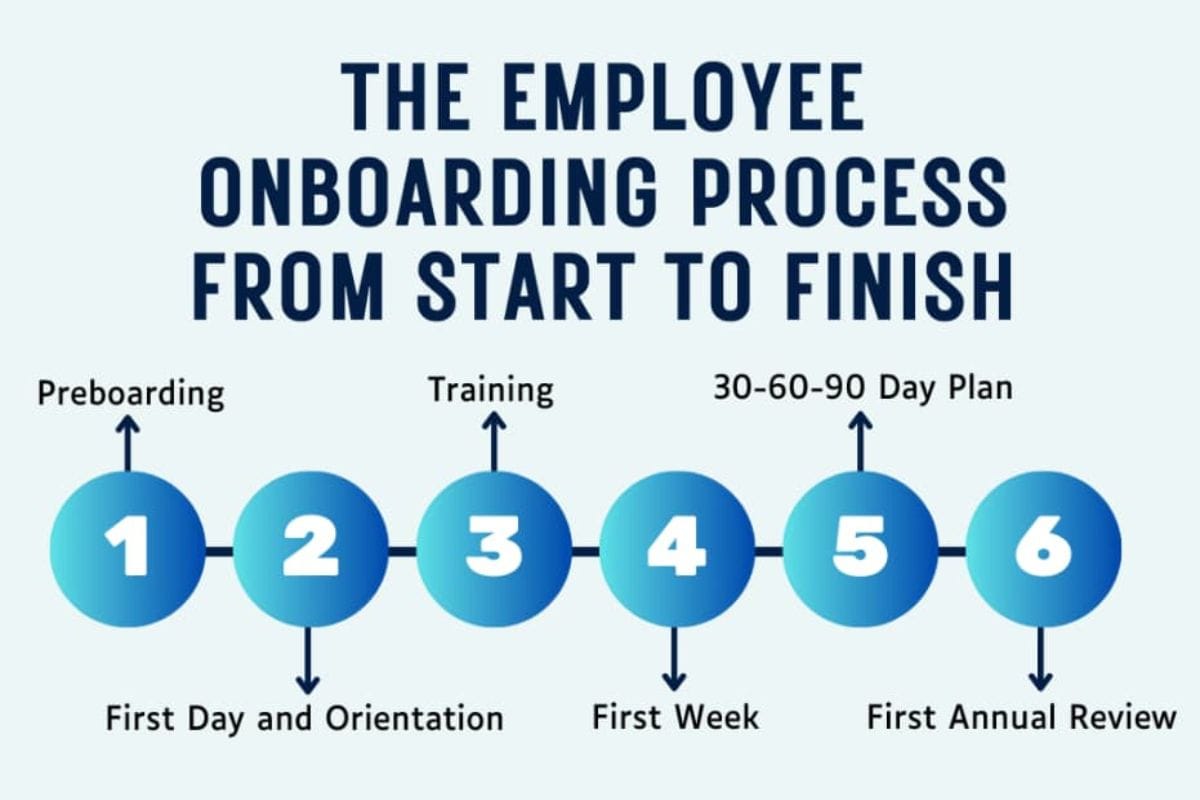
Pre-Onboarding (Before Day One)
Preparation before the employee arrives significantly impacts their integration and productivity:
- Prepare their workspace: Desk, computer, software access, and necessary tools
- Set up payroll and HR systems: Ensure they're registered in your payroll system
- Create an onboarding schedule: Plan training sessions, meetings, and milestones for their first 30–90 days
- Gather necessary documentation: Employment contract, tax forms, confidentiality agreements, employee handbook
First Day Onboarding
- Welcome the employee and provide a tour of your office or facilities
- Introduce them to their supervisor, team members, and key colleagues
- Explain company culture, mission, and values
- Set up all technology access and logins
- Conduct a brief one-on-one to discuss expectations and answer questions
Structured Training and Integration (First 30–90 Days)
- Assign an onboarding buddy or mentor to facilitate integration
- Provide role-specific training on tools, processes, and systems
- Schedule regular check-ins with their manager (weekly for the first month, bi-weekly thereafter)
- Set clear short-term goals and performance expectations
- Provide access to company policies and employee handbook
- Include the employee in relevant meetings and team activities early on
Create a Positive Work Environment
From day one, foster a supportive, inclusive culture:
- Communicate openly and welcome questions
- Provide regular feedback, not just formal reviews
- Show appreciation for their contributions
- Ensure they feel included and valued as a team member
A strong onboarding experience reduces turnover, accelerates productivity, and builds loyalty.
Part 6: Common Pitfalls to Avoid
- Hiring too quickly without proper vetting: A bad hiring decision costs at least 30% of that employee's projected first-year earnings when factoring in recruitment, training, and lost productivity.
- Unclear role definition: Employees who don't understand expectations become frustrated and unproductive.
- Inadequate financial planning: Underestimating the true cost of employment strains cash flow.
- Poor onboarding: Insufficient training and integration lead to longer ramp-up times and higher turnover.
- Neglecting legal compliance: Non-compliance with UAE labour laws exposes your business to penalties and disputes.
Hiring your first employee is both an exciting milestone and a significant responsibility. By carefully assessing readiness, understanding true costs, ensuring legal compliance, and conducting a thoughtful hiring process, you set the foundation for a successful partnership that benefits both your business and your employee.
Take the time to do it right. Your first hire will shape your company culture, influence future hiring, and contribute significantly to your business's trajectory. The investment in getting this decision right pays dividends for years to come.
Also Read:
 Shahba Mayyeri
 Ummulkiram Pardawala
 Shahba Mayyeri
 HiDubai Newswire