
Dubai offers one of the world's most diverse education landscapes: over 209 private international schools serving more than 387,000 students, with 17 different curricula and annual fees ranging from AED 12,000 to over AED 110,000. For expatriate and local families, this abundance of choice can feel overwhelming rather than empowering. Where do you even begin when faced with British, American, IB, Indian, French, and numerous other curriculum options?
This guide provides a practical eight-step framework for making confident school decisions that match your child's needs, your family budget, and your long-term plans—without getting lost in marketing materials or endless online forums.
Step 1: Set Your Non-Negotiables First
Before researching "top schools" or impressive facilities, establish your practical boundaries. These constraints will immediately narrow your options from 200+ to a manageable shortlist.
Budget Reality
Dubai school fees vary dramatically. Budget schools start under AED 15,000 annually, mid-tier schools range from AED 35,000-60,000, and premium schools exceed AED 100,000 by senior years. Beyond tuition, factor in:
- Application, registration, and assessment fees (AED 500-1,000 per school)
- Uniforms, books, and equipment (AED 2,000-5,000 annually)
- School transport (AED 5,000-15,000 annually if using bus services)
- Extracurricular activities and school trips
- Annual fee increases tied to the Education Cost Index
Financial advisors recommend shortlisting schools comfortably within your budget, not at the absolute maximum. This allows for future fee rises and the possibility of siblings joining later.
Location and Commute
Geography matters significantly in Dubai due to traffic patterns and the city's spread-out communities. Consider:
- Door-to-door travel time during peak hours (7-8am and 2-3pm)
- Whether your child will use school bus, private car, or potentially metro
- Proximity to home and ideally to at least one parent's workplace
A "perfect" school that adds three hours of daily commuting may prove unsustainable long-term, affecting both your child's energy levels and family quality time.
Visa and Future Plans
Some families, particularly those on company sponsorship or planning to relocate, should prioritize curricula aligning with future destinations:
- Where might you live next? (UK, US, India, elsewhere)
- Likely university destinations for your child
- Language or exam requirements in potential future locations
These considerations will significantly shape your curriculum choice.
Step 2: Choose Your Curriculum Pathway
Dubai offers 17+ curricula. Rather than starting with school brand names, begin by selecting 1-2 curriculum pathways that align with your family's trajectory.
British Curriculum (GCSE/A-Level)
Best for: Families targeting UK universities or those who value structured, exam-focused progression
Characteristics: Clear stages with national examinations (GCSEs at age 16, A-Levels at 18), strong subject specialization in final years, widely recognized internationally
Typical fees in Dubai: AED 35,000-100,000 annually
International Baccalaureate (IB)
Best for: Globally mobile families or those prioritizing inquiry-based, holistic education
Characteristics: Three programmes (PYP for primary, MYP for middle years, DP for diploma), emphasizes critical thinking and international-mindedness, rigorous academic standards
Typical fees in Dubai: AED 55,000-105,000 annually
American Curriculum
Best for: Families targeting US universities or preferring flexible, continuous assessment
Characteristics: Credit-based system, Advanced Placement (AP) courses for university credit, less emphasis on single high-stakes exams
Typical fees in Dubai: AED 50,000-90,000 annually
Indian Curriculum (CBSE/ICSE)
Best for: Families planning to return to India or seeking value-focused, academically rigorous education
Characteristics: Structured, exam-oriented, strong STEM foundation, alignment with Indian entrance exams
Typical fees in Dubai: AED 15,000-45,000 annually
Some schools offer hybrid models (British with IB diploma option, for example), providing flexibility as children progress.
Step 3: Use KHDA Ratings as Your Quality Filter
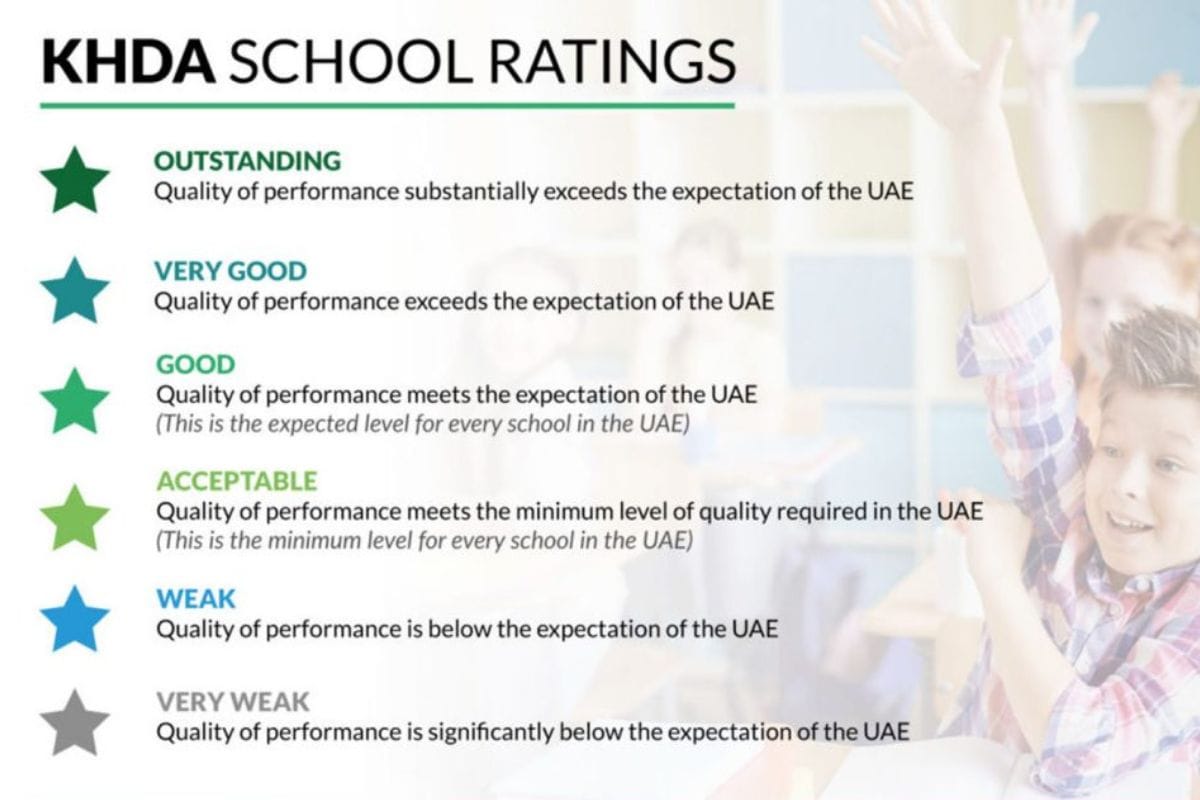
The Knowledge and Human Development Authority (KHDA) inspects all Dubai schools annually, providing transparent quality ratings that are invaluable for initial filtering.
Understanding the Rating System
Schools receive ratings ranging from Outstanding (highest) to Weak (lowest). Recent inspection data shows:
- 23 schools rated Outstanding
- 48 schools rated Very Good
- 85 schools rated Good
- 51 schools rated Acceptable
- Only 2 schools rated Weak
- Approximately 81% of students attend schools rated Good or better
How to Use KHDA Ratings
Baseline standard: Aim for Good, Very Good, or Outstanding ratings as your starting point.
Read beyond the label: KHDA provides detailed inspection reports on khda.gov.ae covering teaching quality, student progress, wellbeing, inclusion, and innovation. These reports reveal nuances that single ratings can't capture.
Context for newer schools: Recently opened schools may receive Good ratings on their first full inspection, which represents a strong start.
Balance with other factors: An Outstanding school requiring a 90-minute each-way commute may be less suitable than a Good-rated school 15 minutes from home. Ratings provide quality assurance but shouldn't override practical family considerations.
Step 4: Frame Your Child's Specific Needs
Moving beyond general quality, assess fit across three dimensions:
Academic Fit
Evaluate:
- Class sizes and student-teacher ratios (ideally under 15:1 in primary years)
- Teacher qualifications and experience
- Progress data showing how students improve, not just raw attainment scores
- Subject options from middle and senior school years
- University placement track records for older students
Some schools emphasize academic rigor and competitive exam results. Others prioritize personalized learning and future skills over traditional exam pressure. Neither is inherently better—the question is which matches your child's learning style and your family values.
Social and Wellbeing Environment
KHDA now places strong emphasis on student wellbeing, with 83% of schools rated Good or better in this area. Look for:
- Pastoral care structures and house systems
- Anti-bullying policies and how they're actually enforced
- Student leadership opportunities
- Diversity and inclusion—does the community welcome your child's background and personality?
If possible, visit during regular school hours and observe corridor interactions, playground dynamics, and how staff engage with students naturally.
Special Educational Needs and Support
For children requiring learning support, enrichment, or language assistance, verify:
- Inclusion and SEN (Special Educational Needs) policies highlighted in KHDA reports
- English as an Additional Language (EAL) support quality
- Gifted and talented provision
A school with Good academic ratings and strong inclusion may serve your child better than an academically intense environment without adequate support structures.
Step 5: Evaluate Cost Versus Value
Dubai hosts ultra-premium schools exceeding AED 100,000 annually and value-focused schools offering solid outcomes at modest prices. Neither extreme guarantees the right fit for your family.
Beyond Sticker Price
When comparing costs, examine:
- What's included in fees: activities, books, transport, learning support
- Inspection ratings and parent satisfaction relative to fee levels
- Teacher retention rates and qualifications
- Actual facilities usage versus showcase spaces
Some moderately priced schools deliberately position themselves around "value plus quality," highlighting teacher experience and exam outcomes relative to cost.
The Budget-Cut Test
Ask yourself: "If we had to cut our budget by 20%, which school would we choose and why?" This thought exercise reveals how much you're paying for brand recognition versus tangible educational value.
Step 6: Consider Location and Daily Logistics Seriously
Dubai's geography and traffic patterns make location a critical factor often underestimated during initial school searches.
Popular School Clusters
Schools concentrate in specific areas:
- Dubai Marina and JBR
- Arabian Ranches and surrounding communities
- Jumeirah areas
- Al Barsha and Al Quoz
- Dubai Silicon Oasis
Research schools within reasonable distance of your home or workplace. Use Google Maps during peak hours (7-8am) to assess realistic travel times.
Transport Considerations
School bus services cost AED 5,000-15,000 annually and add structure but also time to your child's day. Evaluate whether:
- Bus routes serve your area efficiently
- Journey times are reasonable for your child's age
- You prefer the flexibility of private transport
Step 7: Shortlist and Visit with a Structured Approach
Once you've filtered by budget, curriculum, KHDA rating, and location, narrow to 3-5 schools and visit them with a simple observation checklist.
During School Visits
Observe and ask:
- How do staff speak to students in corridors and informal settings?
- Is leadership visible and approachable?
- How does the school communicate with parents (apps, emails, meeting frequency)?
- Are facilities like labs, libraries, and sports areas actively used or primarily for show?
- How does the school handle transitions: new joiners, movement between key stages, exam years?
Take notes immediately after each visit. Impressions blur quickly when visiting multiple schools.
Timeline for 2026-2027 Admissions
For September 2026 entry, applications typically open October-December 2025. Many popular schools already have active waitlists. The process generally involves:
- Online application form plus AED 500-1,000 application fee
- Assessment or entrance test (for older year groups)
- Interview or school visit
- Offer decision (can take weeks for competitive schools)
Required documents usually include passport copies, visa, birth certificate, and previous school reports. Apply to 4-6 schools to ensure options.
Step 8: Make Your Decision Using a Clear Framework
Rather than relying on gut feeling alone, score each shortlisted school across key dimensions:
Academic fit (30%): Teaching quality, progress data, pathway alignment
Wellbeing and culture (25%): How it feels for your child's daily experience
Logistics (20%): Commute, timings, transport practicality
Cost and value (15%): Fees versus quality indicators
Long-term path (10%): Support for your likely next 5-8 years
This scoring exercise often reveals trade-offs you're making—accepting a Good school with excellent wellbeing over an Outstanding school with difficult logistics, for example.
Don't Underestimate Soft Signals
Beyond data and tours, pay attention to:
- How current parents discuss the school in community groups
- How the school responded during challenging periods (distance learning, policy changes)
- Whether your child feels comfortable and curious after visiting
The "right" school for one family may be completely wrong for another with a different child, different circumstances, or different values.
Choosing a school in Dubai feels overwhelming because the options are genuinely diverse and the stakes feel high. However, this abundance also means there's likely an excellent fit for your specific family circumstances, you simply need a systematic approach to find it.
By establishing non-negotiables first, choosing your curriculum pathway, using KHDA ratings as quality filters, assessing your child's specific needs, evaluating value beyond price, considering logistics seriously, visiting purposefully, and scoring options clearly, you transform an intimidating decision into a manageable process.
There is no universally "perfect" school. But there is a school that's right for your child, your budget, your location, and your family's future plans. This framework helps you identify it with confidence.
Also Read:
 Shahba Mayyeri
 Shahba Mayyeri
 Shahba Mayyeri
 Shahba Mayyeri