
As early February 2026 approaches, Dubai's business community prepares for one of its most significant annual transitions. Ramadan fundamentally reshapes the operational rhythm of the entire city. For small and medium enterprises (SMEs), this period presents a unique challenge: how to honor the spiritual significance of the month, maintain full compliance with UAE labor law, and sustain business momentum during a critical growth phase.
In 2026, with Dubai's D33 economic agenda advancing and businesses operating in an increasingly globalized environment, the traditional notion of a Ramadan "slowdown" is being replaced by what forward-thinking companies call a "strategic pivot." This guide provides SME owners with the legal framework, operational models, and practical strategies needed to navigate reduced working hours while maintaining—and in some cases enhancing—team productivity.
Understanding the Legal Framework: The Two-Hour Reduction Rule
Any effective Ramadan strategy must begin with legal compliance. Under UAE Federal Decree-Law No. 33 of 2021, working hours for private sector employees are reduced by two hours per day throughout Ramadan.
Universal Application
A critical point that often causes confusion: the law applies universally to all employees, regardless of their religion or whether they are personally observing the fast.
- Standard working day: If your typical workday is eight hours, it becomes six hours during Ramadan
- No salary reduction: Employers are strictly prohibited from reducing salaries to compensate for shorter hours
- All employees included: Both Muslim and non-Muslim staff are entitled to the reduced schedule
This universal application prevents discrimination, maintains team cohesion, and ensures equitable workload distribution.
Free Zone Considerations
SMEs operating in financial free zones such as DIFC or ADGM should verify their specific employment regulations. While some free zones historically applied reduced hours only to fasting employees, the prevailing business culture in 2026 increasingly favors a unified approach. Consult your free zone authority's employment guidelines to ensure full compliance.
Three Operational Models for the Six-Hour Workday
Rather than defaulting to a rigid 9:00 AM to 3:00 PM schedule, successful SMEs are implementing one of three distinct operational models.
Model A: The Morning Sprint
Many fasting employees experience peak mental clarity immediately after Suhoor (the pre-dawn meal). This model capitalizes on that natural productivity window.
- Implementation: Shift the entire workday earlier, typically from 7:30 am to 1:30 pm.
- Advantages: Employees complete demanding cognitive work before the afternoon energy decline, avoid the 2:00 PM to 4:00 PM slump when dehydration peaks, and experience reduced traffic exposure during the hottest hours.
- Best suited for: Knowledge workers, creative agencies, financial services firms, and businesses where morning focus delivers the highest value.
Model B: The Staggered Shift
For client-facing businesses requiring continuous coverage, having the entire office close at 2:00 PM creates unacceptable service gaps.
- Implementation: Divide your team into two shifts: Early Shift: 7:00 am to 1:00 pm | Mid Shift: 11:00 am to 5:00 pm
- Advantages: Maintains business responsiveness across an eight to ten-hour window, allows real-time support for international clients, and ensures every employee receives their legally mandated reduction.
- Best suited for: Technology companies with international clients, customer service operations, logistics firms, and businesses requiring continuous coverage.
- Implementation note: Rotate shift assignments weekly or bi-weekly to ensure fairness.
Model C: The Remote-First Hybrid
Many progressive SMEs are adopting remote-first policies for Ramadan's duration, requiring office presence only for essential meetings.
- Implementation: All non-essential work is conducted remotely.
- Advantages: Eliminates the physical toll of midday commuting, allows fasting employees to conserve energy, provides flexibility in structuring schedules, and reduces office overhead costs.
- Best suited for: Digital marketing agencies, consulting firms, software development teams, and businesses where outputs are easily measurable regardless of location.
- Success factors: This model requires robust project management systems, clear communication protocols, and a results-oriented management culture.
Maintaining Productivity: A Shift from Hours to Impact
Data from recent years indicates that when working hours are reduced, efficiency frequently increases—provided management approaches change accordingly.
Protecting Deep Work Windows
- The No-Afternoon-Meeting Policy: Institute a firm rule that internal meetings conclude by 12:00 PM. Reserve afternoon hours for lower-cognitive-load activities such as email correspondence, administrative tasks, and routine updates.
- The 45-Minute Meeting Standard: Shorten standard meeting duration from 60 minutes to 45—or even 30—minutes. This enforces clarity, focuses discussion, and respects the compressed workday.
- Meeting-Free Days: Consider designating certain days as entirely meeting-free, allowing staff to engage in extended periods of focused work.
Conducting a Ramadan Efficiency Audit
The transition to reduced hours creates an ideal opportunity to examine operations critically. Ask each team member to identify:
- Tasks that consume significant time but deliver minimal business value
- Processes that could be automated or streamlined
- Activities that could be postponed until after Eid
- Redundant approval steps or unnecessary reporting
By systematically eliminating low-value work, many SMEs discover they can fit eight hours of meaningful output into a six-hour legal window.
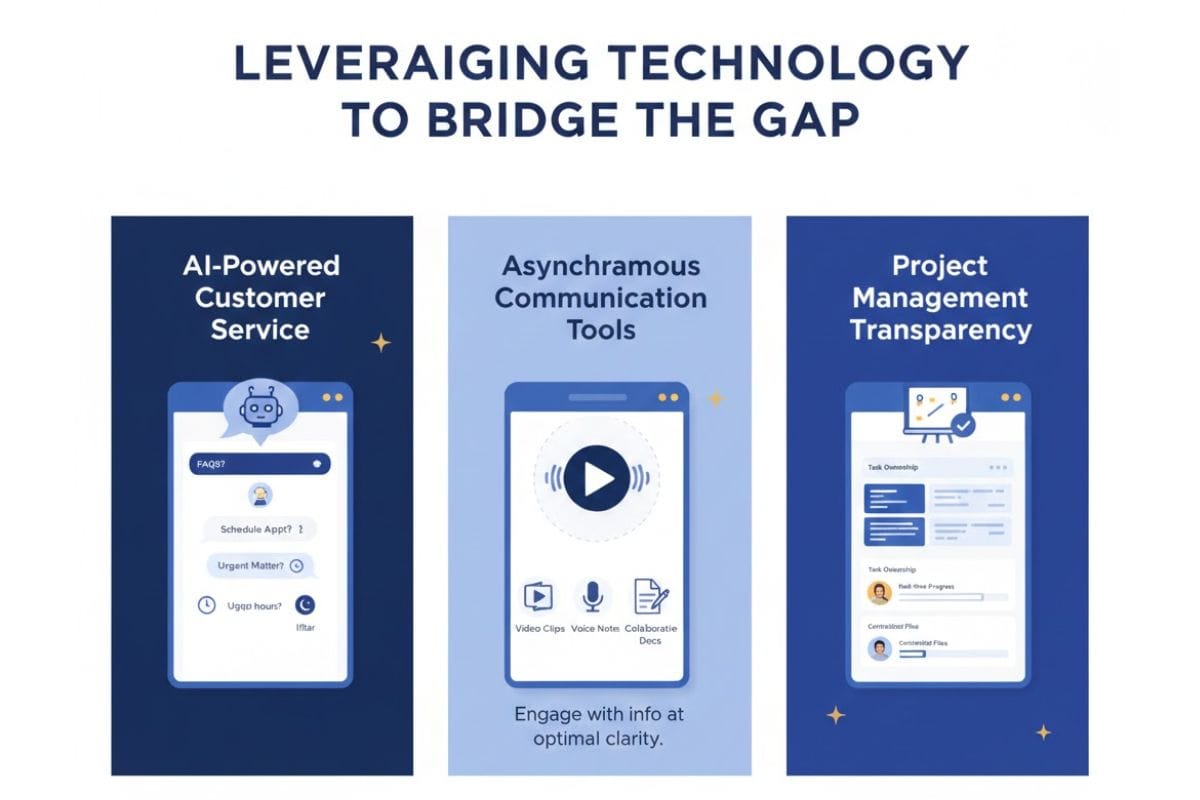
Leveraging Technology to Bridge the Gap
If you're reducing human working hours by approximately 20%, technology must compensate for that capacity.
AI-Powered Customer Service
Ensure your chatbots and automated response systems handle inquiries during the "gap hours"—between when your office closes and when most people break their fast at Iftar. These systems should answer FAQs, schedule appointments, collect information for follow-up, and escalate urgent matters appropriately.
Asynchronous Communication Tools
Implement video messaging platforms (Loom, Slack Clips), detailed written briefs, collaborative documents, and voice notes. This approach respects different energy levels and allows employees to engage with information when they have optimal mental clarity.
Project Management Transparency
Your project management system—Monday.com, Asana, Trello, or similar—must serve as the single source of truth with clear task ownership, real-time progress visibility, centralized file storage, and automated status reminders. If information doesn't exist in your shared system, it effectively doesn't exist.
Client Communication: Proactive Transparency
One of the greatest sources of workplace stress during Ramadan is the tension between reduced internal hours and external expectations.
The Pre-Ramadan Communication
Approximately two weeks before Ramadan begins, send a professional communication to all active clients including:
- Your revised operating hours with specific start and end times
- Modified response time expectations
- Emergency contact protocols for urgent matters
- A brief, respectful explanation of Ramadan's cultural significance
- Assurance of your continued commitment to service quality
Frame this as a "Focused Productivity Initiative" rather than as a limitation. Most clients familiar with Dubai will be supportive, but they appreciate advance notice.
Managing International Expectations
Clients unfamiliar with Ramadan may need additional context. As the business owner or account manager:
- Front-load project milestones in the weeks leading up to Ramadan
- Position the Ramadan period as a time for execution rather than major launches
- Build buffer time into all February and March deadlines
- Clearly communicate any potential delays well in advance
Cultural Stewardship and Workplace Etiquette
Managing a multicultural team during Ramadan requires emotional intelligence and cultural sensitivity.
Supporting Fasting Employees
- The adjustment period: The first three to four days are physiologically challenging. Avoid scheduling high-stress deadlines or performance reviews during this initial window.
- Prayer facilities: Ensure there is a clean, quiet, private space available for prayer in your office.
- Flexibility: Recognize that fasting employees may occasionally need brief moments to rest, particularly during the final hours before Iftar.
Supporting Non-Fasting Staff
- Eating and drinking etiquette: Remind non-fasting employees to exercise discretion. Most offices designate a specific closed-door room for lunch and refreshments.
- Inclusion in cultural observance: Host a corporate Iftar for the entire team—one of the most effective team-building activities available in the UAE. It fosters understanding and creates shared experience that extends beyond the month itself.
- Education without pressure: Consider organizing a brief, optional session before Ramadan where Muslim colleagues can share the month's significance.
Performance Measurement During Reduced Hours
In a six-hour workday, traditional productivity metrics fail. The shift must be toward outcome-based evaluation.
Transitioning to Milestone-Based Reviews
Evaluate team members based on "Milestones Hit" rather than "Time Spent."
Examples:
- A social media manager assessed on content published and engagement metrics achieved—not on being "online" from 9:00 AM to 3:00 PM
- A software developer evaluated on features shipped and code quality—not on hours in the office
- An account manager measured by client satisfaction scores and issues resolved—not by meeting attendance
This outcome-oriented approach maintains accountability during Ramadan and often proves more effective year-round.
Wage Protection System Compliance
The UAE Ministry of Human Resources and Emiratisation maintains stringent digital monitoring of the Wage Protection System (WPS).
Critical compliance points:
- Reduced hours do not justify delayed salary payments
- Process payroll earlier than usual, particularly as Eid Al Fitr holidays approach
- Bank processing times may vary during the Eid period—plan accordingly
- Any payment delays can result in substantial fines
The Opportunity Within the Challenge
When approached with the right mindset, Ramadan represents far more than a period of reduced hours to be endured. It offers SMEs a valuable opportunity to examine operations, eliminate inefficiencies, test new working models, and demonstrate cultural intelligence.
Employees who feel respected in their faith and supported in their wellbeing demonstrate significantly higher loyalty, engagement, and long-term productivity. The goodwill generated by thoughtful Ramadan management extends far beyond the month itself.
Moreover, the skills you develop—running efficient meetings, measuring outcomes over presence, leveraging technology for asynchronous work—strengthen your business regardless of season.
Managing staff productivity during Ramadan 2026 is fundamentally about precision. It requires recognizing that a well-structured six-hour workday, powered by clarity, respect, and appropriate technology, can often outperform an unfocused eight-hour day driven by caffeine and constant interruptions.
Good management during this period creates lasting benefits: stronger team cohesion, improved operational efficiency, deeper client trust, and a workplace culture that values substance over appearance. These are competitive advantages that will serve your business long after the crescent moon of Eid appears in the sky.
Also Read:
 Shahba Mayyeri
 Ummulkiram Pardawala
 Shahba Mayyeri
 Ummulkiram Pardawala
 Shahba Mayyeri