Most entrepreneurs don’t start with a perfect business plan—they start with a moment. A difficult client, a broken system, a late‑night conversation that makes you say, “If no one else is fixing this, maybe I should.” Over time, those moments add up to something bigger: a personal journey that explains why your brand exists and what it stands for.
That journey is easy to overlook when you’re busy running the day‑to‑day, but in marketing, it’s pure gold. A well‑told origin story helps customers remember you, understand your values, and feel like they’re choosing a person, not just a logo.
In this article, we’ll look at how to uncover the most meaningful parts of your story, shape them into a focused narrative, and weave that narrative into your website, social media, and sales conversations—without oversharing or sounding overly dramatic.
Why Your Origin Story Is a Marketing Asset
People remember stories much more than facts, prices, or features. A clear founder story helps potential customers understand not just what you sell, but why you started and what you stand for.
An origin story can help you:
- Build trust by showing real motivations, struggles, and values.
- Create differentiation in crowded markets where products look similar.
- Strengthen loyalty, because customers feel like they know the person behind the brand.
Think of how often you hear about brands that “started in a garage”, “grew from a kitchen table”, or “came from one unsolved problem”. Those aren’t random details; they are carefully chosen stories that humanize the business.
The Core Ingredients of a Strong Origin Story
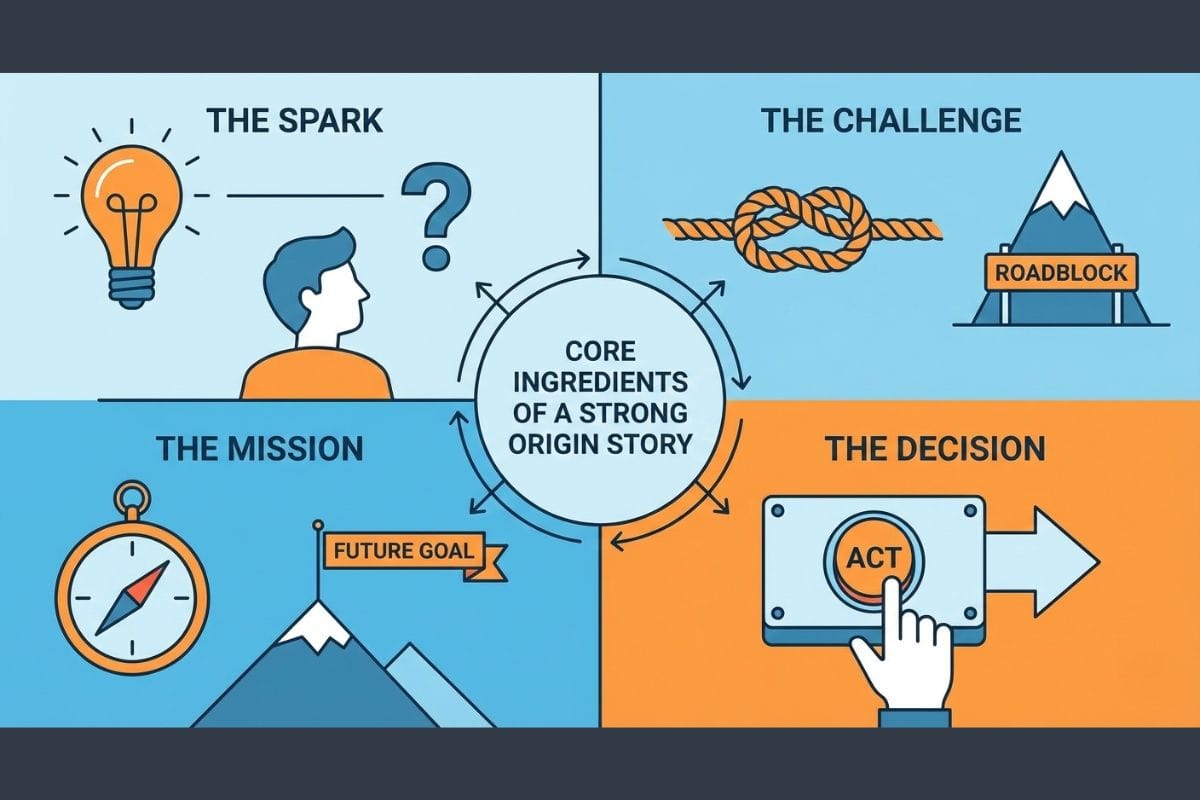
A good founder story is not your full life history. It’s a focused narrative that connects a specific moment in your journey to the problem your business now solves.
You can build it around four simple elements:
- The Spark (Moment of Realisation)
- What did you see, experience, or struggle with that made you think, “There has to be a better way”?
- This can be a frustrating customer experience, your own pain point, or a pattern you noticed in your industry.
- The Challenge (Obstacle or Tension)
- What made it difficult to solve that problem?
- It could be lack of money, confidence, support, or existing solutions that didn’t work.
- This part makes your story relatable and shows you didn’t “just get lucky”.
- The Decision (Choosing to Act)
- When did you decide to stop complaining and start building something?
- This is where you shift from passive observer to active founder.
- The Mission (What You’re Trying to Change Now)
- How does your business today reflect that original moment?
- What do you want customers to experience differently because your brand exists?
If you cover these four points, you already have a strong, usable origin story.
Keeping It Honest (Without Oversharing)
A founder story works because it feels authentic, not manufactured. That doesn’t mean you must expose everything about your personal life.
Use these guidelines:
- Be specific, not dramatic.
Instead of “I was completely broken and lost”, say, “I was juggling two jobs and still couldn’t find a service that respected my time.” Specifics feel truer and are easier for readers to connect with. - Share struggle, but show responsibility.
You can mention failures or mistakes, but avoid blaming everyone else. Position them as lessons that shaped your standards today. - Protect your boundaries.
You don’t need to mention names, sensitive family details, or anything that violates your privacy. The goal is clarity, not confession. - Avoid exaggeration.
If you say you started “with nothing”, but your audience knows you had some backing, it may harm trust later. It’s better to say, “We started lean, with a small budget and a very clear idea.”
Turning Your Story into Clear Marketing Messages
Once your story is written, the next step is to translate it into simple phrases and content you can reuse.
Here’s how to break it down:
- One-line origin hook
- Example: “This business started because I was tired of watching busy parents lose deposits over small maintenance mistakes.”
- This line works on your website, in pitches, and in interviews.
- Short paragraph version (3–5 sentences)
- Use it in your About page, LinkedIn summary, or directory listings.
- Focus on the spark, the problem, your decision to act, and what you do now.
- Longer version (400–600 words)
- Ideal for blog posts, media profiles, podcasts, or “Our Story” pages.
- Here you can add a little more detail: early experiments, first customers, what changed as you grew.
The key is consistency: different formats, same core story.
Where to Use Your Origin Story
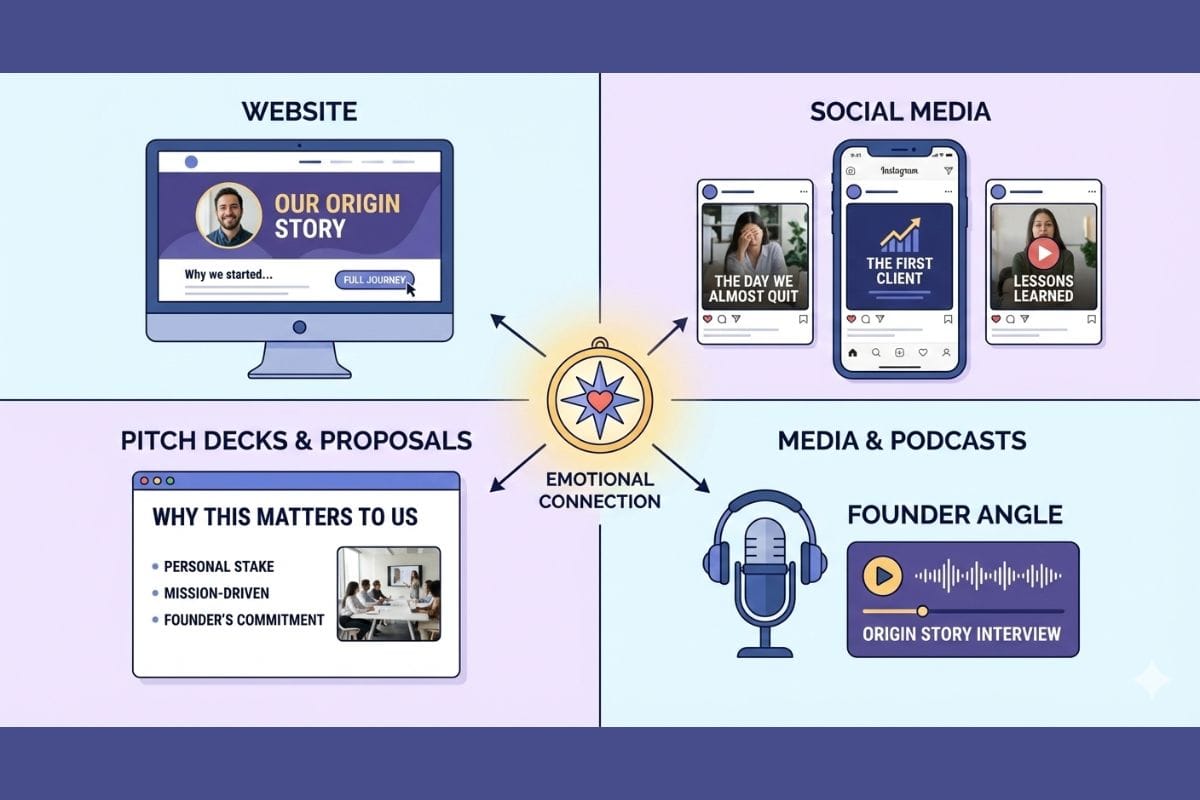
Your journey shouldn’t live only on a single “About” page. It can support almost every major touchpoint:
- Website:
- Feature a short version above the fold (“Why we started”) and a more detailed story on a dedicated page.
- Social media:
- Turn parts of your story into content: “the day we almost quit”, “the first client who trusted us”, “what we wish we’d known before starting”.
- Pitch decks and proposals:
- A slide or short section on “why this matters to us personally” can make you more memorable in B2B deals.
- Media and podcasts:
- Journalists and hosts often look for a founder angle; a clear origin story increases your chances of being featured.
By reusing and adapting your story, you ensure new people always have a way to emotionally connect with your brand.
Adapting the Story for Different Audiences
The same story can be told differently depending on who is listening:
- For customers:
- Emphasise the pain point you solve and how your personal journey makes you care about their experience.
- Focus on empathy and understanding.
- For partners or investors:
- Highlight your resilience, learning curve, and insight into the market.
- Focus on how your background gives you an advantage in serving this niche.
- For team members (current or future):
- Talk about the values that emerged from your journey—respect, quality, service, innovation.
- Show them what they are joining, beyond a job.
The core events stay the same, but what you highlight shifts slightly to match what each audience cares about most.
Common Mistakes to Avoid
When founders first start using their story in marketing, a few patterns often weaken the impact:
- Making the founder the hero instead of the customer.
Your journey matters, but the story should end with how it helps them—not just how impressive you are. - Telling the story once and then burying it.
For many new followers, your latest post is their first impression. Reintroduce your story regularly in new ways. - Using vague clichés.
Phrases like “I wanted to make a difference” or “I’ve always been passionate about X” feel generic. Replace them with concrete scenes and moments. - Ignoring visuals.
Old photos, screenshots, or even simple timeline graphics make your story more tangible and memorable.
A Simple Template You Can Use
You can draft your origin story by literally filling in blanks:
- “For years, I struggled with / noticed that __________________________.”
- “The moment I realised something had to change was when _____________.”
- “I looked for solutions, but everything felt __________________________.”
- “So, I decided to create ____________________, starting with ____________.”
- “Today, we help ___________________ by _____________________________.”
- “We exist because we believe _________________________________.”
Write this in your own words, then refine it until it sounds like how you really speak.
Most entrepreneurs underestimate how powerful their own journey is because they live it every day; it stops feeling special. But for someone discovering your brand for the first time, your origin story is often the difference between “just another option” and “this feels like the right fit”.
By shaping your experience into a clear narrative, deciding what to share, and weaving it consistently into your marketing, you turn your path as a founder into something bigger than yourself: a reason for people to trust you, root for you, and choose you.
Also Read:
 Ummulkiram Pardawala
 Umema Arsiwala
 Shahba Mayyeri
 Ummulkiram Pardawala
 Umema Arsiwala