For much of the past three decades, the dominant logic in business sourcing was simple: buy from wherever it is cheapest to produce. Global supply chains stretched across continents, optimised relentlessly for cost, and delivered remarkable efficiencies. That model still exists, but it is no longer the only model, and for a growing number of business owners and entrepreneurs, it is no longer the preferred one.
Hyper-local sourcing is gaining serious traction, and the reasons behind its rise are practical, strategic, and in many cases, commercially compelling.
What Hyper-Local Sourcing Actually Means
Hyper-local sourcing refers to the practice of procuring goods, materials, ingredients, or services from suppliers within a defined geographic proximity, typically the same city, region, or country as the business itself. It goes further than general 'local sourcing' by placing a premium on tight geographic boundaries and direct supplier relationships, often prioritising community-level or regional producers over national distributors.
The concept is not new, before globalisation, most businesses sourced locally by necessity. What is new is the deliberate, strategic choice to return to that model in an era when global alternatives remain readily available. Businesses adopting hyper-local sourcing are doing so with intent, and increasingly, with measurable results.
Why It Is Gaining Momentum Now
Several converging forces have pushed hyper-local sourcing from a niche preference to a mainstream business consideration.
Supply chain fragility has been one of the most significant drivers. The disruptions of recent years, from global logistics bottlenecks to geopolitical tensions affecting trade routes, exposed just how vulnerable extended supply chains can be. Businesses that relied on single-source, long-distance suppliers found themselves unable to fulfil orders, absorbing unexpected cost spikes, or scrambling to find alternatives under pressure. Hyper-local sourcing shortens the chain and reduces the number of potential failure points.
Consumer expectations have also shifted. Across a wide range of sectors, buyers, whether they are end consumers or business purchasers, are paying increasing attention to where products come from and under what conditions they are made. Provenance has become a differentiator. For business owners, being able to speak credibly about the origin of their inputs, the conditions at their suppliers, and their contribution to the local economy is no longer just a marketing angle. It is a genuine purchasing consideration for a meaningful segment of the market.
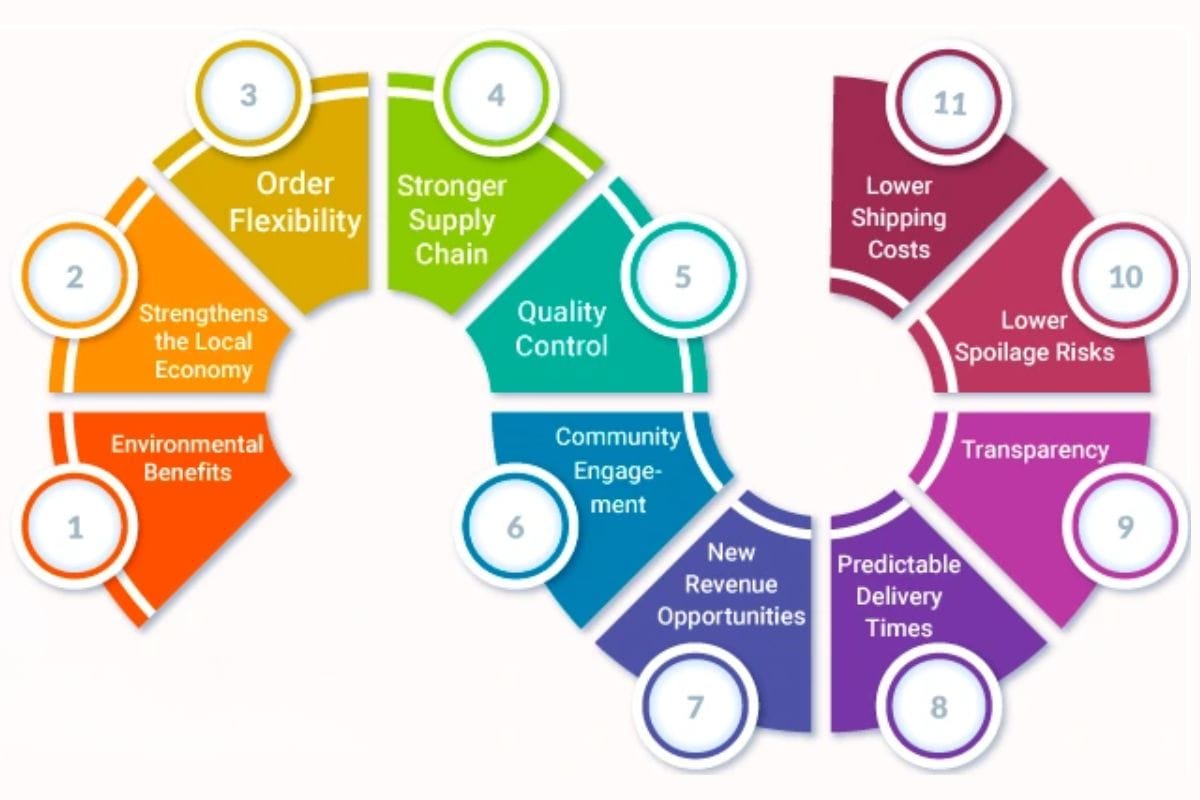
Sustainability pressures are a third factor. Reduced transportation distances translate directly into lower carbon emissions associated with logistics. As businesses face growing scrutiny; from customers, partners, investors, and in some jurisdictions, regulators; over their environmental footprint, sourcing locally offers a tangible and relatively straightforward way to reduce supply chain emissions without overhauling the entire operation.
The Business Case: Where the Advantages Are Real
The appeal of hyper-local sourcing goes beyond values and optics. There are concrete operational advantages that business owners are finding worth the tradeoffs involved.
- Speed and responsiveness. Shorter supply chains mean faster lead times. When demand shifts quickly or a production issue arises, working with a local supplier allows for faster communication, quicker adjustments, and less exposure to the delays inherent in international logistics.
- Stronger supplier relationships. Proximity enables more direct, personal relationships with suppliers. This often translates into greater flexibility, the ability to negotiate bespoke arrangements, adjust order volumes at shorter notice, or collaborate on product development in ways that are harder to achieve at a distance.
- Quality visibility. When your supplier is nearby, visiting their facility is straightforward. This makes it significantly easier to maintain quality standards, conduct due diligence, and identify issues before they become problems, without the cost and complexity of international inspections.
- Reduced currency and logistics risk. Sourcing locally eliminates or reduces exposure to foreign exchange fluctuations and international freight cost volatility, two variables that can substantially erode the cost advantages of overseas sourcing, particularly in uncertain economic environments.
The Honest Tradeoffs
Hyper-local sourcing is not without its challenges, and a balanced view requires acknowledging them directly.
Cost is the most obvious. In many product categories, local producers simply cannot match the unit price achievable through large-scale overseas manufacturing. For cost-sensitive businesses or those operating on thin margins, this differential can be difficult to absorb, especially if the premium cannot be passed on to customers or offset by operational savings elsewhere.
Capacity constraints are another consideration. Local suppliers may not be able to scale at the pace a growing business requires. If demand increases sharply, a hyper-local supply chain may struggle to keep up in ways that a larger, more industrialised supply base would not. Businesses need to assess whether their local suppliers have the production capacity and financial resilience to grow alongside them.
Availability is not guaranteed. For certain materials, components, or specialised inputs, local supply simply may not exist at the required specification or volume. Hyper-local sourcing works best when there is a viable local supply base to draw on, and that is not always the case, depending on the industry and geography.
The practical reality for most businesses is a hybrid approach: sourcing locally where it makes operational and commercial sense and maintaining longer-distance supplier relationships where local alternatives are genuinely not viable. The goal is not ideological purity but a more considered, resilient supply strategy.
How to Start Thinking About It Strategically
For business owners considering a shift toward hyper-local sourcing, the starting point is a clear audit of the current supply chain. Mapping where each key input comes from, what the associated risks and costs are, and where local alternatives might exist gives a much clearer picture of where changes are worth pursuing.
From there, it is worth distinguishing between strategic inputs; those critical to your product quality or business continuity, and commodity inputs where cost is the primary driver. Hyper-local sourcing tends to deliver the greatest value when applied to strategic inputs, where the benefits of proximity, relationship quality, and reduced risk outweigh the potential cost premium.
Connecting with local trade associations, regional business networks, and industry groups is often the most efficient way to identify viable local suppliers. Many regions have active directories of local producers and manufacturers that are not always visible through standard procurement channels.
The Bigger Picture
Hyper-local sourcing is best understood not as a rejection of global trade, but as a recalibration of supply chain strategy. The era of optimising purely for cost at the expense of resilience, transparency, and flexibility has given way to a more nuanced approach, one in which business owners are asking harder questions about where their inputs come from and what that means for their operations, their brand, and their risk profile.
For entrepreneurs building businesses with longevity in mind, the direction of travel is clear. Supply chains that are shorter, more transparent, and more deeply rooted in the communities a business operates within are not just strategically sounder, they are increasingly what customers, partners, and the broader market expect.
Also Read:
 Ummulkiram Pardawala
 Shahba Mayyeri
 Ummulkiram Pardawala
 Umema Arsiwala
 Ummulkiram Pardawala