In Dubai’s booming e-commerce landscape, last-mile delivery costs have become one of the biggest operational challenges for businesses. In many cases, last mile now accounts for up to 53% of total shipping expenses, driven by factors such as traffic congestion, high labour costs in dense areas, and failed delivery attempts.
This pressure intensifies when you look at today’s delivery expectations. According to a 2024 Dubai Department of Economic Development survey,
- 72% of residents expect same-day delivery,
- 48% prefer one-hour delivery windows, and
- consumers increasingly make purchase decisions based on speed rather than product alone.
For small businesses, this shift creates a critical question: How do you offer faster delivery without inflating costs?
This is exactly where micro-warehousing has moved from a niche idea to a strategic necessity. By placing compact fulfilment hubs closer to customers, businesses can cut transit time dramatically and reduce last-mile expenses by as much as 30–40%. For local online retailers, this suddenly levels the playing field—they can now compete with larger platforms without building enormous warehouses or fleets.
This transformation is also being driven by consumer behaviour shaped by major platforms. Careem (33+ million users in 2025), Noon, Talabat, and Amazon (including Amazon.ae and Amazon’s express delivery services) operate 24/7 and are used by all age groups across the UAE. UAE residents use these apps several times a week—whether for groceries, food, rides, or household items—creating an expectation that everything should arrive quickly and conveniently.
When customers receive groceries in minutes and retail items in hours, traditional next-day delivery no longer feels sufficient. Micro-warehousing gives businesses the operational capability to match the speed that Careem, Noon, Talabat, and Amazon have taught consumers to expect.
What Micro-Warehousing Actually Means in Dubai

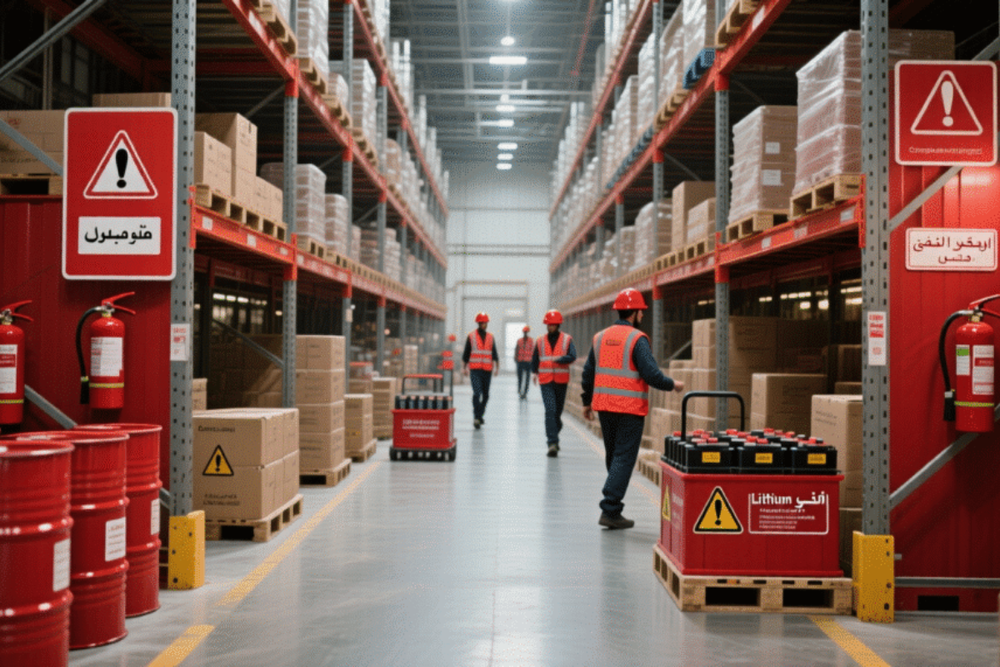
Micro-warehousing refers to small, strategically located fulfilment hubs—typically 3,000 to 10,000 sq ft—built to store fast-moving products close to customers. Instead of holding months of inventory, they hold 24–48 hours of high-demand stock, ensuring rapid turnover and quick access for riders.
Unlike traditional large warehouses (often 300,000+ sq ft) situated farther from the city, micro-warehouses prioritise proximity, automation, and speed. Areas like Al Quoz, JAFZA, and Dubai South are commonly used because they sit close to high-density delivery zones such as Marina, JLT, Business Bay, and Deira.
Inside these micro-hubs, high-density shelving maximises capacity, while streamlined pick-and-pack systems shorten processing time. Real-time inventory syncing ensures product availability is accurate across online platforms. Most importantly, these micro-warehouses integrate directly with last-mile fleets—including those used by Careem, Noon’s delivery network, Talabat riders, and Amazon’s logistics teams—so orders can be dispatched to nearby customers immediately.
The result is a fulfillment model built for speed, accuracy, and short delivery radii.
Why Dubai Is Perfectly Positioned for Micro-Warehousing Growth
Dubai’s e-commerce market reached USD 11.05 billion in 2025 and is on track to reach USD 20.54 billion by 2030. This rapid growth is matched by the structure of the city itself. Dubai is more than 92% urban, with dense clusters like Dubai Marina, JLT, Business Bay, and Deira generating massive daily delivery activity. Placing stock near these clusters naturally improves speed and reduces costs.
This model is reinforced by consumer behaviour. With 75% of UAE purchases made via mobile, residents are deeply accustomed to the seamless convenience offered by platforms like Careem, Noon, Talabat, and Amazon. These apps have created an expectation for reliable, predictable, and fast delivery across categories—groceries, meals, electronics, pharmacy essentials, and more.
Micro-warehousing also aligns with the UAE’s sustainability direction. By shortening delivery distances, businesses can rely more on electric bikes and low-emission fleets. This supports the country’s Net Zero 2050 goals while reducing operational cost at the same time.
Dubai’s geography, digital adoption, and sustainability agenda make it the ideal environment for micro-warehousing to thrive.
How Micro-Warehousing Cuts Last-Mile Costs by Up to 40%
Micro-warehousing transforms last-mile economics by eliminating inefficiencies caused by long distances and slow processing. When inventory is positioned close to customers, many cost drivers immediately shrink.
A delivery that previously required a 20 km trip from a warehouse on the outskirts can become a 2–5 km trip when stock sits in a micro-hub near Marina or JLT. Shorter routes reduce fuel consumption, labour hours, and the impact of congestion. Riders can complete more orders per hour, improving overall fleet productivity.
Faster deliveries also reduce the rate of failed attempts—a major cost factor in dense urban environments. When customers receive orders within narrow windows, cancellations and no-shows drop significantly. Returns become easier and more cost-efficient to process because items don’t need to travel back to distant warehouses.
Businesses using micro-warehousing often adopt a hybrid inventory strategy: fast-moving products stored in micro-hubs, slower items kept in larger, cheaper warehouses. Streamlined picking workflows supported by basic automation further reduce labour cost and processing time.
Altogether, these improvements allow many SMEs in Dubai to achieve 30–40% last-mile cost reductions, while offering faster fulfilment comparable to Careem, Noon, Talabat, and Amazon’s service levels.
Challenges & Realities Business Owners Must Consider
Despite its benefits, micro-warehousing requires thoughtful planning. Urban warehouse space can be expensive, especially in centrally located areas. Businesses must ensure that the savings from reduced delivery costs outweigh the higher rental rates. Shared micro-warehousing models or flexible leasing options often help SMEs manage costs.
Because micro-hubs store smaller quantities, stockouts can happen quickly without proper forecasting. Demand must be monitored closely, and replenishment cycles must be tighter. Regulatory requirements—such as zoning rules, loading access, and vehicle restrictions—must also be considered, particularly in dense districts.
Technology investment is another factor. Even basic Warehouse Management Systems or scanning tools come at an upfront cost, but greatly improve accuracy and efficiency. Finally, managing multiple locations introduces operational complexity. Many SMEs address this by partnering with third-party logistics providers that specialise in distributed fulfilment.
How Dubai Businesses Can Implement Micro-Warehousing in a Practical Way
Here is a simple, effective roadmap for SMEs to start:
Step 1: Analyse Your SKU Data
Begin by reviewing your sales and inventory data to identify which products are your fastest movers. Only these high-demand items should be placed in a micro-warehouse. Storing everything defeats the purpose—micro-hubs work best when they hold the products customers order most frequently.
Step 2: Map Out Customer Hotspots
Look at where your orders are coming from. Areas like Dubai Marina, Jumeirah Lakes Towers, Business Bay, and Deira often emerge as concentrated delivery zones. Use this information to select the most strategic location for your micro-warehouse. The goal is to place inventory as close as possible to your customers.
Step 3: Start Small With a Pilot Hub
Instead of launching multiple micro-warehouses at once, begin with a pilot. A unit between 3,000 and 5,000 sq ft is sufficient for most SMEs. This allows you to test the model, gather data, and understand operational needs before committing to a larger expansion.
Step 4: Design an Efficient Layout and Choose the Right Tools
Inside the micro-warehouse, focus on efficiency. Use vertical shelving to maximise space, set up clear picking paths, and equip your team with essential tools such as handheld scanners and a basic Warehouse Management System (WMS). If you handle temperature-sensitive products, add appropriate climate control.
Step 5: Integrate With a Reliable Delivery Fleet
Seamless connection between your micro-warehouse and your delivery partners is essential. Integrating your system through APIs allows orders to flow instantly to fleets such as Careem, Aramex, or other last-mile partners. This ensures riders can pick up and deliver orders without delay.
Step 6: Divide Inventory Strategically
Adopt a hybrid inventory model. Keep fast-moving SKUs in your micro-warehouse for quick access, while bulk stock remains in your main warehouse where storage costs are lower. This balance helps maintain efficiency without inflating overheads.
Step 7: Track Performance Consistently
Monitor the results closely. Track indicators like delivery times, cost per order, driver utilisation, stockout frequency, and customer satisfaction. Regular evaluation helps you understand whether the micro-warehouse is operating efficiently and delivering the expected benefits.
Step 8: Scale Based on Proven ROI
Only expand when the data supports it. Once your pilot micro-warehouse consistently delivers 20–30% cost savings and faster fulfilment times, you can confidently open additional micro-hubs in other high-demand areas.
The Role of Dubai’s “24/7 Super-Apps” in Accelerating Micro-Warehousing
Super-apps and major e-commerce platforms are redefining delivery expectations in the UAE. Careem’s ecosystem, Noon’s widespread fulfilment network, Talabat’s high-frequency meal and grocery deliveries, and Amazon’s same-day and next-day capabilities all contribute to a consumer environment built around speed.
When customers receive groceries in minutes and retail orders within hours, traditional fulfilment models become insufficient. Micro-warehousing helps smaller businesses align with the pace of these major platforms.
Through API integration and real-time order routing, micro-warehouses can dispatch orders immediately to nearby riders—whether the partner fleet belongs to Careem, Noon, Talabat, Amazon, or an independent delivery service. This creates a seamless fulfilment experience that mirrors the reliability customers expect.
Dubai’s micro-warehousing ecosystem is entering a new phase of innovation, driven by automation, cold-chain expansion, electric delivery fleets, and upcoming drone delivery capabilities. As AI-powered forecasting and smart routing become mainstream, fulfilment will only grow faster, more accurate, and more cost-efficient. In this environment, micro-warehousing is no longer just an operational upgrade—it’s becoming the backbone of modern logistics in Dubai.
By positioning inventory closer to customers, businesses can reduce delivery costs, accelerate fulfilment, and match the service levels set by platforms like Careem, Noon, Talabat, and Amazon. For SMEs, adopting micro-warehousing early offers a clear competitive edge and ensures they remain agile, relevant, and prepared for the future of urban commerce in the UAE.
Also read:
 Shahba Mayyeri
 Ummulkiram Pardawala
 Umema Arsiwala
 Ummulkiram Pardawala