If you've ever walked through the bustling corridors of a Dubai office building, you've likely heard conversations in half a dozen languages before reaching the elevator. This isn't just an anecdote—it's the reality of working in one of the world's most diverse cities. As of October 2025, Dubai's workforce is a stunning tapestry of over 200 nationalities, with expatriates making up nearly 90% of the population. It's the kind of diversity that most global cities can only dream of achieving.
But here's the thing about diversity: it's not a magic formula for success on its own. Without the right leadership approach, all that potential can remain locked away, or worse, become a source of friction rather than innovation. That's where inclusive leadership comes in—and in Dubai's context, it's not just a nice-to-have. It's absolutely essential.
The Beautiful Complexity of Dubai's Workforce
Think of Dubai as a living, breathing experiment in global collaboration. You've got Emirati traditions providing the cultural foundation, mixed with perspectives from India, the Philippines, Pakistan, the UK, Lebanon, Egypt, and literally hundreds of other countries. This creates an incredibly fertile ground for innovation—when teams bring together such varied experiences and viewpoints, the potential for creative problem-solving skyrockets.
By the Numbers: Dubai's Diversity Advantage
- Over 200 nationalities represented in the workforce
- Nearly 90% expatriate population creating a truly global environment
- 39% higher financial performance for diverse teams led inclusively
- Key sectors thriving on diversity: finance, technology, hospitality, and aviation
Cities like Dubai and Abu Dhabi have become true "melting pots" where this harmonious coexistence doesn't just make for interesting lunch conversations—it actually fuels economic growth. But let's be honest about the challenges too. When you bring together people from 200+ nationalities, you're also bringing together different communication styles, work expectations, cultural values, and unconscious biases.
The Challenges We Can't Ignore
- 63% of women report experiencing exclusion in UAE workplaces
- Cultural misunderstandings can erode trust and productivity
- Unconscious biases in hiring and management persist
- Language barriers and differing work style expectations
Without leaders who know how to navigate these differences thoughtfully, all that potential remains untapped.
What Makes Inclusive Leadership Different?
Inclusive leadership isn't about treating everyone exactly the same or pretending cultural differences don't exist. It's quite the opposite, actually. These leaders are characterized by three core qualities:
- Genuine empathy - Understanding and valuing different perspectives
- Cultural competence - Navigating how different cultures operate and communicate
- Equitable practices - Fair treatment in hiring, promotions, and daily interactions
In Dubai's context, this approach has become a strategic imperative, not just an ethical choice. The UAE government has made this clear through initiatives like Vision 2031 and Emiratisation, which aim to integrate local Emirati talent with the diverse expat workforce.
The Real Benefits: More Than Just Feeling Good
Let's talk about what inclusive leadership actually delivers, because the business case is compelling.
- Innovation and Adaptability
When you have team members who've lived and worked across continents, you're sitting on a goldmine of different perspectives.
What this means in practice:
- Multicultural teams generate unique ideas and solutions
- Diverse groups are more creative and resilient
- Critical advantage in navigating rapid changes like AI adoption and sustainability shifts
- Better problem-solving through varied approaches
- Employee Engagement and Retention
In a city where the expat workforce is inherently transient, retention is a constant challenge.
How inclusive practices help:
- Flexible policies respecting different cultural holidays boost morale
- Cultural training helps people understand each other's communication styles
- Employees who feel valued for who they are stick around longer
- Significantly reduces turnover costs in expat-heavy workforce
- Strategic Business Advantages
Here's something concrete that affects your bottom line:
- Companies with inclusive boards are more likely to secure government contracts
- Enhanced ability to attract foreign direct investment (FDI)
- Improved corporate reputation in global markets
- Better alignment with UAE's DEI initiatives opens doors
- Financial Performance
The numbers don't lie:
- McKinsey data: Ethnically diverse firms in the UAE are 39% more likely to excel financially
- Better decision-making when diverse voices are included
- Improved governance through varied perspectives
- Enhanced market adaptability
- Social Impact and Community
Beyond profits, there's genuine human value:
- Fosters empathy and strengthens community ties
- Particularly important in a city where many are far from their home countries
- Supports Emiratisation by creating genuine integration environments
- Leads to deeper market insights through cultural understanding
Making It Happen: Your Action Plan for Dubai
Alright, so inclusive leadership sounds great—but how do you actually implement it? Here's a comprehensive strategy broken down into actionable steps.
Strategy 1: Cultural Competence Training
What it involves:
Workshops on cross-cultural communication and bias awareness to build respect and reduce conflicts.
Dubai-specific implementation:
- Partner with local firms like ISM Training for sessions on UAE norms
- Focus on perspective-taking in teams with 200+ nationalities
- Use real scenarios from your industry (aviation, hospitality, finance, etc.)
- Include role-playing exercises for different communication styles
Expected outcomes:
- Reduced cultural misunderstandings
- Improved team collaboration
- Better conflict resolution
Strategy 2: Bias-Free Hiring and Promotion
What it involves:
Using diverse interview panels and inclusive job descriptions to ensure equitable opportunities.
Dubai-specific implementation:
- Align with Emiratisation quotas meaningfully, not just checking boxes
- Focus on skills from varied backgrounds
- Learn from Emirates Group's success with 160+ nationality hires
- Implement structured interview scorecards to reduce bias
- Create diverse hiring slates as standard practice
Expected outcomes:
- Access to broader talent pools
- More innovative teams
- Compliance with government initiatives
Strategy 3: Inclusive Policies and Benefits
What it involves:
Offering flexible work arrangements, parental leave, and employee resource groups (ERGs) to support diverse needs.
Dubai-specific implementation:
- Draw inspiration from Dubai Holding's Gender Equity Framework
- Create networks for women and People of Determination
- Offer flexible schedules respecting different religious practices
- Implement financial literacy programs for all employee levels
- Establish ERGs for underrepresented groups
Examples of what to include:
- Parental leave policies for diverse family structures
- Work-from-home options respecting cultural needs
- Prayer room facilities
- Multi-cultural holiday recognition
- Mentorship programs pairing Emiratis with expats
Strategy 4: Leadership Development
What it involves:
Training managers to value authenticity and diverse viewpoints through coaching and sensitivity programs.
Dubai-specific implementation:
- Leverage programs like Heriot-Watt University's DEI programs for Middle East leaders
- Focus on empathy-building exercises
- Teach managers to adapt their style rather than expecting conformity
- Include coaching on psychological safety
- Provide ongoing support, not just one-time training
Key skills to develop:
- Active listening across cultural contexts
- Inclusive language and communication
- Creating safe spaces for vulnerability
- Recognizing and mitigating unconscious bias
- Facilitating diverse team dynamics
Strategy 5: Measurement and Accountability
What it involves:
Tracking DEI metrics and adjusting based on feedback and data.
Dubai-specific implementation:
- Use tools like Procapita Hub for GCC workforce insights
- Set clear targets (e.g., 15% lift in Belonging Index within 90 days)
- Implement weekly inclusion check-ins with managers
- Create DEI dashboards for leadership visibility
- Conduct anonymous pulse surveys quarterly
Metrics to track:
- Employee engagement scores by demographic group
- Retention rates across nationalities and genders
- Promotion rates and pipeline diversity
- Participation in ERGs and cultural events
- Feedback from exit interviews
Learning from Dubai's Success Stories
Some of Dubai's most successful organizations are already showing us what's possible. Let's dive into specific examples:
Emirates Group: Aviation Excellence Through Inclusion
What they've achieved:
- Employees from 160+ nationalities
- Gender-balanced teams twice as likely under female managers
- Driven innovation in aviation through diverse perspectives
Key initiatives:
- Inclusive hiring practices focusing on skills, not just cultural fit
- Women's leadership mentoring programs
- Cross-cultural communication training
- Career development pathways for all nationalities
Dubai Holding: Comprehensive Equity Framework
What makes them stand out:
- Gender Equity Initiative (GEI) Framework organization-wide
- Women's Network with 500+ members
- Financial literacy programs for blue-collar workers
Why it works:
- Initiatives touch every organizational level
- Focus on genuine belonging, not just representation
- Regular feedback loops and adjustments
- Top-down commitment with bottom-up engagement
Hospitality Sector: Balancing Local and Global
The challenge:
Serving guests from anywhere in the world with staff from equally diverse backgrounds.
Solutions implemented:
- Ethical leadership training
- Cultural sensitivity workshops
- Balance of local values with international standards
- Creating resilient, adaptable teams
Results:
- Enhanced guest satisfaction
- Lower staff turnover
- Stronger team cohesion
Etihad Airways and Enoc: Breaking Gender Barriers
Focus areas:
- Programs specifically targeting male-dominated roles
- Women empowerment initiatives
- Mentorship and sponsorship for female leaders
Impact:
- Organizational performance boosts
- Expanded talent pools
- Changed perceptions about gender roles in traditional sectors
Navigating the Challenges
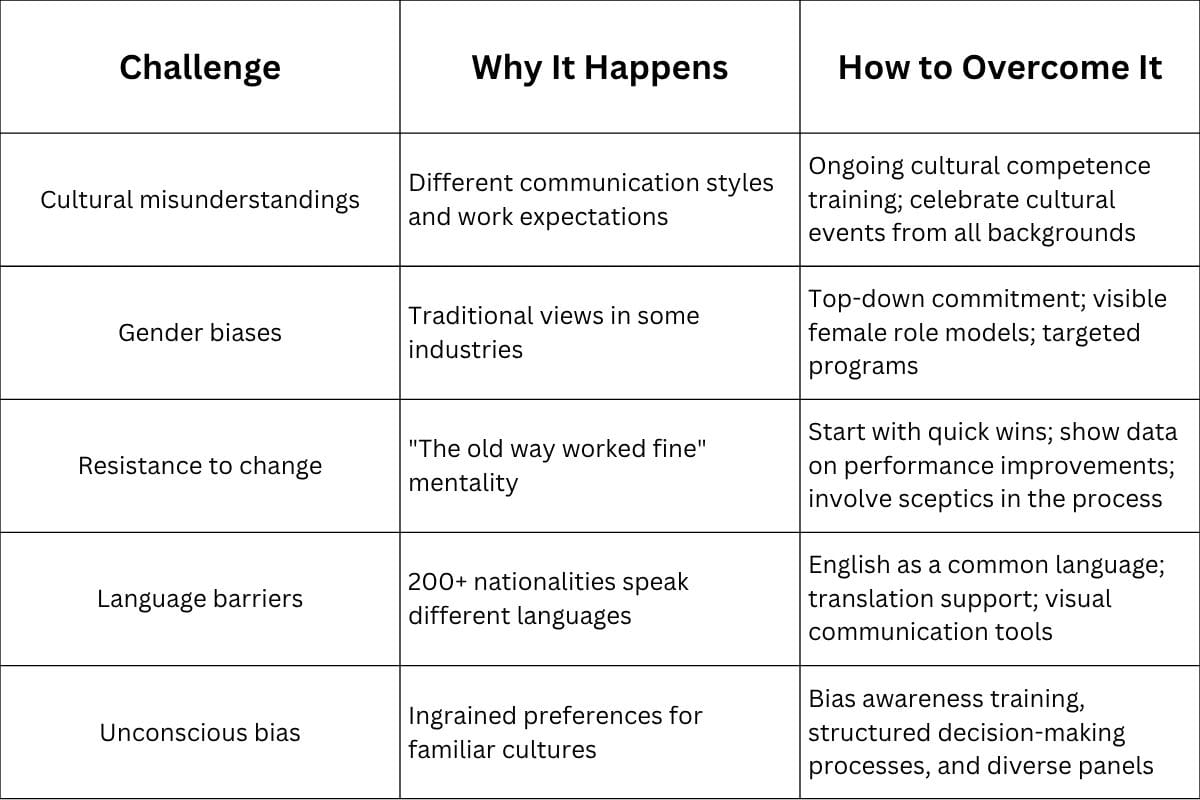
Let's not sugarcoat it: building inclusive leadership in Dubai comes with genuine challenges. But they're manageable with the right approach.
Common Obstacles and Solutions
Tips for Getting Started
Start small, think big:
- Begin with empathy-building exercises
- Pilot programs in one department before rolling out company-wide
- Celebrate early successes loudly
Build authentic buy-in:
- Integrate DEI into core company values
- Make it part of leadership evaluation
- Share stories of real impact, not just statistics
Ensure top-down commitment:
- Leadership must visibly participate
- Allocate real budget and resources
- Hold leaders accountable for DEI goals
Address merit concerns:
- Emphasize that inclusivity enhances merit-based decisions
- Show how bias actually prevents meritocracy
- Use data to demonstrate improved outcomes
The Path Forward
Ready to build more inclusive leadership in your organization? Here's your roadmap:
Phase 1: Assessment (Weeks 1-6)
- Conduct anonymous surveys on inclusion
- Map barriers across the employee journey
- Review hiring, promotion, and retention data by demographics
- Identify priority areas for intervention
Phase 2: Foundation Building (Months 2-4)
- Secure leadership commitment and budget
- Develop a clear DEI strategy aligned with business goals
- Launch initial cultural competence training
- Establish baseline metrics
Phase 3: Implementation (Months 4-9)
- Roll out training programs
- Implement policy changes
- Launch ERGs and mentorship programs
- Begin regular measurement and reporting
Phase 4: Scaling and Refinement (Months 9-12+)
- Expand successful initiatives
- Address gaps identified through data
- Share success stories
- Integrate into all business processes
The Bottom Line
Here's what it comes down to: Dubai's incredible diversity is either your greatest asset or a missed opportunity, and the difference is leadership. Inclusive leadership transforms all those different perspectives, experiences, and approaches from a potential source of confusion into a genuine competitive advantage.
For businesses operating in Dubai, this isn't about being progressive for its own sake (though that's a fine goal too). It's about survival and success in a globalized marketplace. Companies that embrace inclusive leadership practices aren't just complying with national goals like Vision 2031—they're positioning themselves to lead in an increasingly interconnected world.
The data is clear:
- Diverse teams led inclusively outperform others by 39% financially
- Innovation increases dramatically with multicultural perspectives
- Employee retention improves significantly
- Strategic advantages in securing contracts and FDI
- Enhanced reputation and market adaptability
So, whether you're a CEO, an HR professional, or a team leader, the question isn't whether to invest in inclusive leadership—it's how quickly you can get started. Because in a city of 200+ nationalities, the future belongs to those who can bring all those voices together in harmony.
Sources:
This article is based on UAE-specific DEI research and data as of October 2025. Workforce statistics reflect Dubai’s 200+ nationalities and 90% expatriate population, alongside UAE Vision 2031 and Emiratisation initiatives. McKinsey data shows ethnically diverse UAE firms outperform peers by 39%, with additional workplace exclusion and engagement metrics from regional DEI reports.
Case studies include Emirates Group, Dubai Holding, Etihad Airways, Enoc, and leading hospitality firms. Training and policy references draw on ISM Training, Heriot-Watt University, Procapita Hub, and MoHRE guidelines. Implementation insights reflect established UAE consulting frameworks and cultural compliance timelines.
Also Read:
 HiDubai Newswire
 Shahba Mayyeri
 Umema Arsiwala
 Shahba Mayyeri