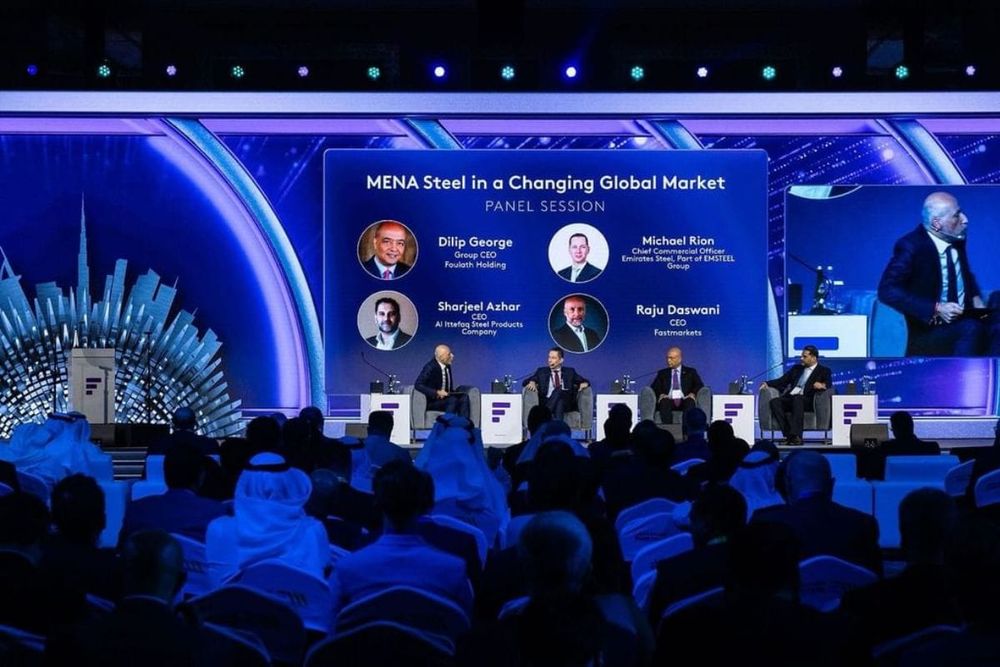
The 29th Middle East Iron and Steel (MEIS 2026) conference opened in Dubai on Monday, as new investments position the Middle East and North Africa (MENA) to play a greater role in global steel supply.
Organised by Fastmarkets, the event has drawn more than 700 delegates from over 40 countries and runs until November 18 at Madinat Jumeirah. It focuses on turning investments into competitive, lower-carbon capacity, with an emphasis on expanding direct reduced iron (DRI) and hot briquetted iron (HBI) production and supplying domestic and European markets.
Projects under discussion include Tosyalı SULB’s AED 9.2 billion investment in Libya, Ezz Steel’s AED 2.9 billion investment in Algeria and new capacity planned in Duqm, Oman. Delivering that growth will depend on reliable supplies of high-grade iron ore, scrap and energy, backed by efficient transport networks.
Saeed Ghumran Al Remeithi, Group CEO of EMSTEEL, the conference’s regional host sponsor, said the industry’s future rests on competitiveness, efficiency, innovation and lower emissions rather than production capacity alone. He added that the region has shown resilience and must now strengthen its readiness for future challenges.
Raju Daswani, CEO of Fastmarkets, said MENA has an opportunity to become a major supplier of the iron units needed for the next generation of steelmaking. Competitiveness, he noted, will depend on delivering reliable supplies at the right cost and with lower emissions.
Carbon rules are also shaping the outlook. As the European Union’s Carbon Border Adjustment Mechanism (CBAM) takes effect and free carbon allowances are phased out, emissions are becoming central to competitiveness. The region’s gas-based DRI production offers a potential advantage, though verified emissions, costs and trade measures will decide the outcome.
Fastmarkets analysts forecast that European trade measures could cut hot-rolled coil imports from about 30 percent of EU demand in 2025 to below 15 percent by 2035.
News Source: WAM