For early-stage startups, liquidity is not just a financial metric; it is the difference between staying operational and shutting down. Every dirham that remains in the business rather than leaving it as a regulatory payment is a dirham available for product development, team retention, customer acquisition, or simply covering the unexpected costs that every founder knows are coming.
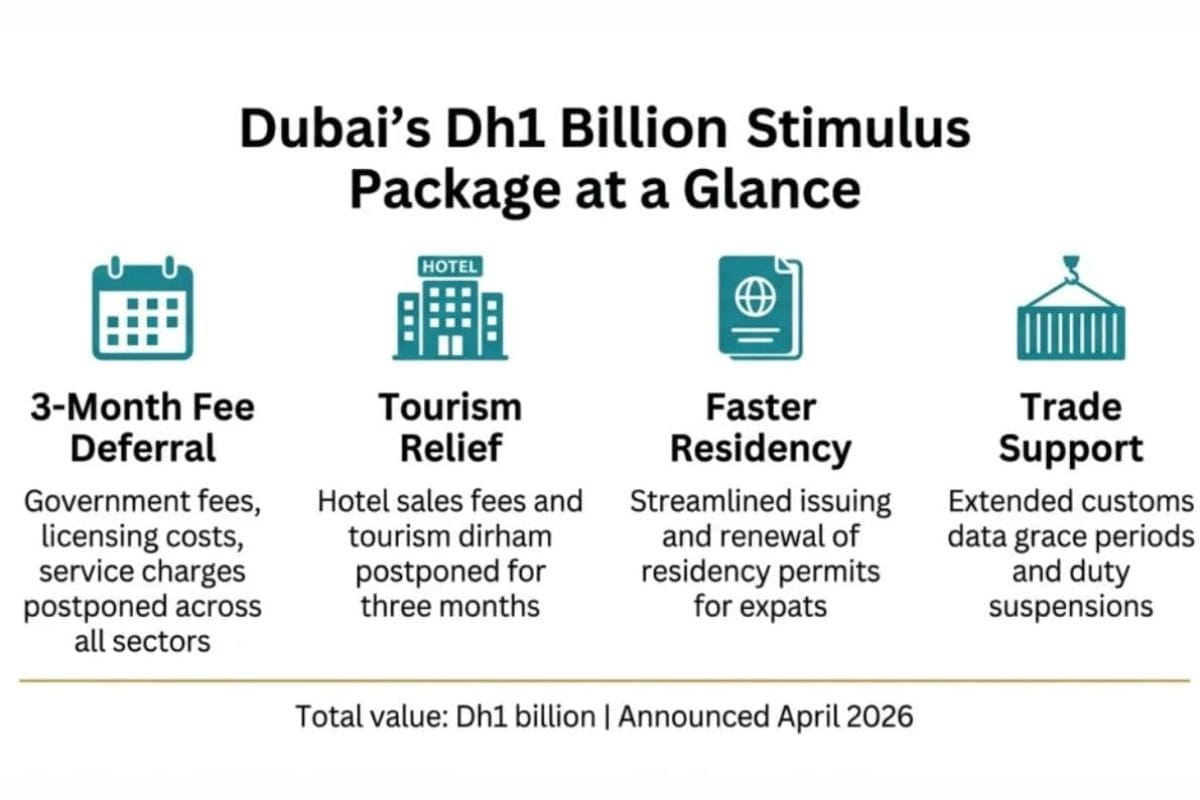
That is why Dubai's Dh1 billion economic stimulus packages, effective from 1 April 2026, deserve more than a passing glance from the startup community. For founders who understand how to use it strategically, it represents a meaningful and time-limited liquidity opportunity.
Understanding What Is Actually on the Table
Before a startup can deploy freed-up capital strategically, it needs to know precisely what it is working with. The government fee relief covers a specific and defined set of obligations, and understanding the boundaries matters as much as understanding the opportunity.
For mainland businesses, the Department of Economy and Tourism has confirmed that the 90-day relief applies to trade licence amendment fees, advertising and sales fees linked to trade licences, local service fees, and optional fees related to trade name reservations and registrations. Free zone businesses should engage directly with their specific authority — DMCC, DIFC, Dubai South, and Dubai Airport Freezone Authority are among those that have confirmed participation in the broader package, though the specific mechanics vary by zone.
One critical distinction to be clear about from the outset: the fee relief applies to payment timelines, not compliance deadlines. Businesses that miss regulatory requirements during the relief period can still face administrative penalties. The relief is financial, not operational, which means founders need to stay fully compliant on the governance side while enjoying the cash flow benefit on the payment side. These are not the same thing and conflating them is a risk.
For startups based at Dubai South's Business Park, a further layer of support is available beyond the general package. This includes rent-free incentives tied to contract renewals, flexible payment options, waiver of minor administrative penalties, and a commitment to maintain current rental rates during the relief period. For any startup operating within Dubai South, engaging with the free zone administration directly is an immediate priority. This additional support is not automatic and requires proactive engagement to access.
Calculating Your Actual Liquidity Gain
The first strategic step is straightforward but often skipped: calculate the actual cash flow benefit to your specific business before deciding how to deploy it. The value of the relief varies enormously depending on your stage, structure, and upcoming obligations. A startup facing a trade licence renewal in May 2026 gains a different quantum of relief from one whose renewal falls in September.
Map every government-related fee payable between April and September 2026: licence renewals, trade name fees, municipality charges, free zone fees, and any sector-specific levies. Assign each one a payment date and a value. The sum of the obligations falling within the April to June window represents your gross relief opportunity. That number, held in the business for an additional 90 days, is the working capital you now have to deploy.
For context, real estate entrepreneur Saba Patel, founder of Revantage Real Estate Brokerage, was facing a trade licence renewal of Dh32,000 before the package was announced. For a small business, that is a significant short-term cash flow release. Multiply this across multiple fees and obligations, and the total available liquidity for many early-stage businesses is material, not transformative, but meaningful in the context of a lean Q2 operating budget.
Five Strategic Ways to Deploy the Freed Capital
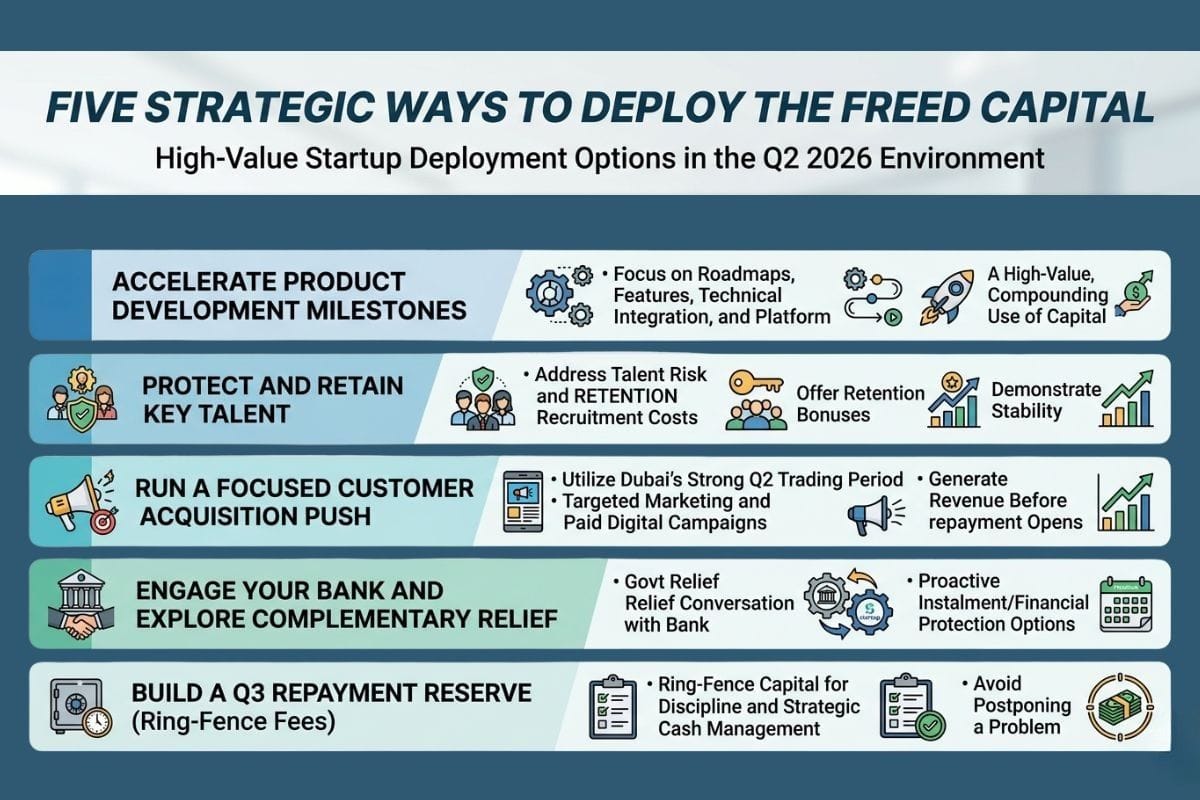
With the liquidity gain quantified, the strategic decision is how to use it. For startups, five deployment options stand out as particularly high-value in the current environment.
- Accelerate product development milestones
The most compounding use of temporary liquidity for an early-stage startup is almost always investment in the product. If your roadmap has a milestone, a feature release, a technical integration, or a platform upgrade that has been delayed by resource constraints, Q2 2026 is the window to push it forward. Revenue that follows a product milestone has a multiplying effect on the value of the original capital deployed; administrative payments that are simply postponed and absorbed into operations do not.
- Protect and retain key talent
In a period of regional uncertainty, talent retention is a genuine risk for startups. Your most capable people have options, and the cost of replacing a key hire in time, recruitment fees, and productivity loss, almost always exceeds the cost of retaining them. Using the Q2 liquidity window to offer retention bonuses, accelerate salary reviews, or simply demonstrate financial stability to your team is a deployment of capital that directly reduces a high-probability business risk.
- Run a focused customer acquisition push
Q2 is typically one of the stronger trading quarters in Dubai before the summer slowdown. A targeted marketing or sales push, paid digital campaigns, event participation, and direct outreach deployed with the liquidity freed up by the relief measures can generate revenue that more than offsets the postponed fees when they fall due in Q3. The timing logic here is sound: use the relief window to invest in revenue generation before the repayment window opens.
- Engage your bank and explore complementary relief
The stimulus package has catalysed complementary support from the banking sector. Emirates NBD, for instance, introduced instalment relief options of 30 to 60 days on request for the April to June 2026 period, along with financial protection options for eligible SME clients. Stacking government fee relief with bank-side payment flexibility multiplies the total liquidity gain, but this requires a proactive conversation with your relationship manager, not a passive wait for the bank to reach out.
- Use the window to build a Q3 repayment reserve.
This option is less exciting than the others but arguably the most important for long-term financial health. The postponed fees will arrive as a single block of obligations in Q3 2026. A startup that spends all of its Q2 freed-up cash on growth activities and then faces a concentrated repayment demand in July will find itself in a worse position than if it had simply paid the fees in April. The discipline of ring-fencing a portion of the freed capital as a repayment reserve and investing only the surplus is what separates strategic use of the relief from simply postponing a problem.
The Visa Processing Advantage for Startups Hiring in Q2
Beyond the fee relief measures themselves, the stimulus package includes a provision directly relevant to startups planning to grow their teams in Q2: streamlined processing of residency permits. New employment entry permits, mission visas, and dependent sponsorships filed through recognised corporate portals are now being issued within five working days, down from the standard fifteen. That is a 10-day reduction in the time a new hire waits for visa clearance before they can begin contributing to the business.
For a startup with two or three key hires in the pipeline, this acceleration is operationally significant. The cost of a delayed start in onboarding time, in the gap between offer acceptance and productivity, and in the risk that a strong candidate accepts a competing offer during a prolonged visa process, is real and often underestimated. If hiring is on your Q2 agenda, submitting those applications now, while the accelerated processing window is open, is straightforward and costs nothing beyond the standard visa fees.
The Q3 Payment Plan: Building It Now, Not Later
Every strategic use of the Q2 relief window needs to be anchored in a clear-eyed view of what Q3 looks like. The postponed obligations do not disappear; they consolidate. A startup that postpones Dh40,000 in Q2 government fees while also pursuing a focused sales push and a product milestone sprint needs to model, from today, what its Q3 cash position looks like when those fees fall due.
The practical approach is to revise your cash flow projections immediately, not at the end of June. Map the postponed amounts as firm Q3 obligations, assign them a payment date, and work backwards to determine what revenue or reserve needs to be in place by then. If the growth activities funded by the relief are expected to generate incremental revenue by Q3, model that conservatively. If they are not, if the investment is in product development with a longer payback horizon, ensure the repayment reserve is being built in parallel from existing revenue.
Dubai's Q2 2026 fee relief window is one of the most accessible and immediately actionable forms of business support available to startups in the emirate right now. It requires no application process for many of its components, no dilution of equity, and no new debt obligations. What it requires is the deliberate decision to treat it as a liquidity tool rather than a passive administrative convenience.
The startups that will extract the most value from this window are those that quantify their gain, deploy it with a clear purpose, engage their banks proactively, and plan their Q3 repayment position from day one. The relief is real. The strategy is what determines whether it makes a difference.
Also Read:
 Ummulkiram Pardawala
 Shahba Mayyeri
 Shahba Mayyeri
 Shahba Mayyeri