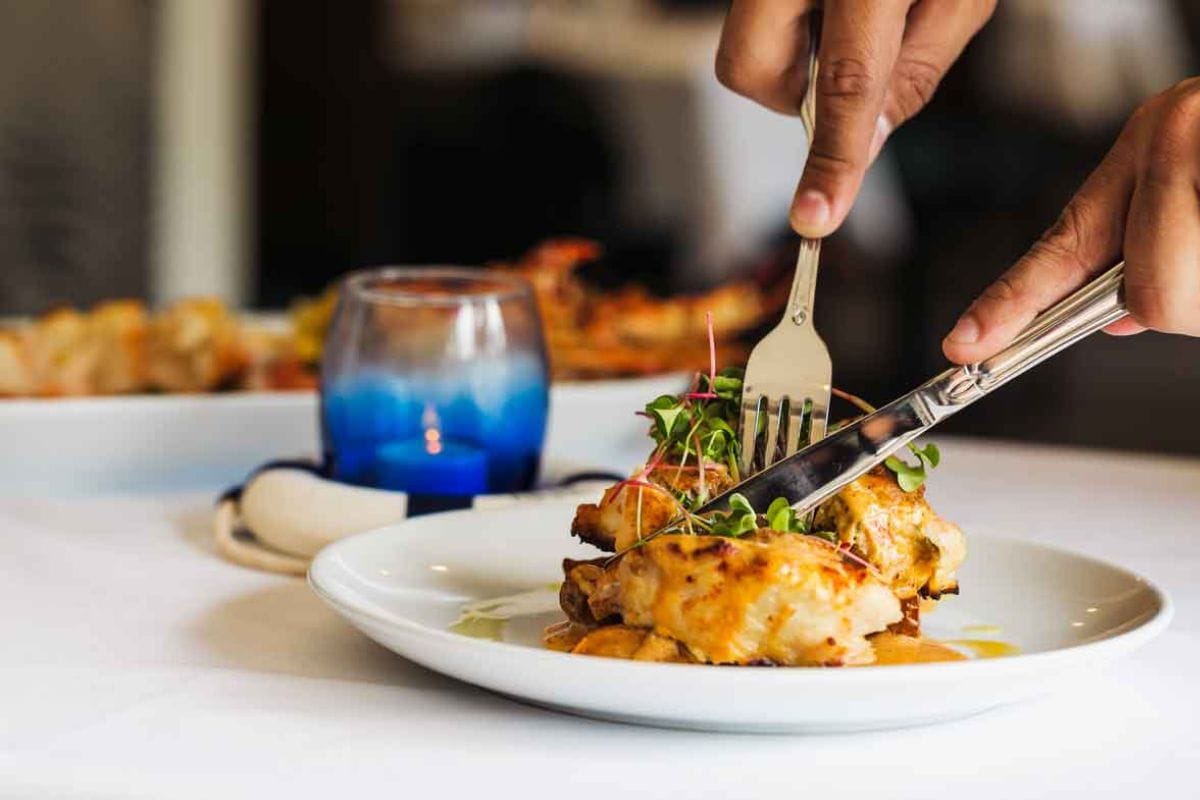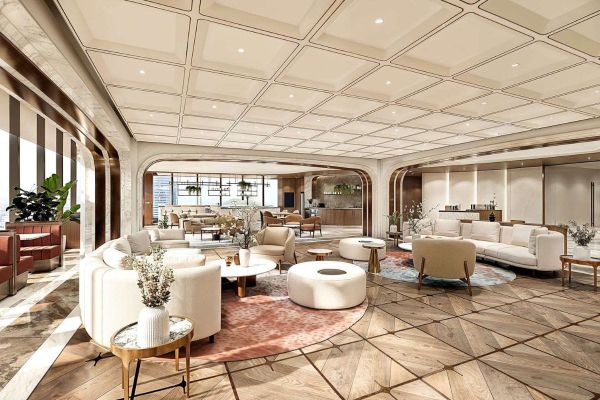
The dream of the Dubai culinary entrepreneur has undergone a profound structural shift. For decades, the ultimate marker of culinary success in the emirate followed a predictable, capital-intensive script: secure a premium commercial space in a high-footfall district like Dubai Marina, Jumeirah, or Downtown Dubai; take on substantial debt or investor capital to fund a multi-million Dirham fit-out; navigate months of multi-agency approvals; and launch a traditional brick-and-mortar restaurant.
Today, a new wave of culinary founders is actively rewriting this script. Rather than anchoring themselves to the heavy financial and operational realities of a traditional commercial kitchen, Dubai’s brightest culinary talents are pivoting to the micro-event model. Operating under the banner of "supper clubs," these intimate, ticketed, communal dining experiences are transforming from an underground trend into a sophisticated, lean business strategy.
By prioritizing agility, creative sovereignty, and deep community engagement over raw scale, these founders are demonstrating that in Dubai’s modern food and beverage (F&B) landscape, smaller is often significantly smarter.
The Financial Math: High Capital Expenditure vs. Operational Agility
To understand the economic allure of the supper club model, one must first look at the harsh financial landscape of traditional restaurant hospitality in the UAE. Opening a standard commercial restaurant in Dubai is a high-stakes financial gamble that requires substantial upfront capital.
The Cost Barrier of Brick-and-Mortar
A traditional restaurant footprint easily demands an initial investment ranging from AED 500,000 to well over AED 2,000,000. These upfront expenses are consumed by a complex web of necessities:
- Comprehensive civil and structural works.
- Commercial DEWA power upgrades to support industrial equipment.
- The installation of specialized grease traps and complex ventilation hoods.
- Compliance with strict municipal zoning, public health, and safety codes.
Once the doors open, the financial pressure intensifies. High fixed monthly overheads—driven by premium commercial rent, mandatory staff housing, corporate visas, and continuous utility bills—create a dangerously high break-even point. In this environment, a restaurant is forced to run a volume game, obsessing over table turnover and mass-market appeal simply to stay afloat.
The Supper Club Financial Architecture
The supper club model flips this traditional cost structure on its head. By shifting the culinary experience to private villas, creative loft spaces, or intimate, non-traditional venues, founders completely bypass the crushing burden of fixed retail rent and massive fit-out amortization.
The financial architecture transitions from a high-fixed-cost model to a highly efficient variable-cost operation. The chef only incurs significant expenses when a seat is booked and paid for in advance. Capital that would have been tied up in real estate deposits or commercial exhaust systems is instead directed entirely into premium raw ingredients, high-end tableware, and hyper-targeted community marketing.
Furthermore, because seats are strictly limited and booked ahead of time, food waste—one of the primary profit-killers in traditional restaurants—is reduced to nearly zero. The chef knows exactly how many portions of every component are required days before the first guest arrives, allowing for precision purchasing and optimized margins.
Creative Sovereignty and Breaking "Menu Fatigue"
Beyond the clear financial benefits, the move toward micro-events is fueled by a desire for absolute creative freedom. In the commercial restaurant sector, menu design is frequently compromised by commercial necessity. Chefs are often forced to cater to the lowest common denominator to ensure consistent, volume-driven sales, resulting in predictable menus across the city's dining districts.
Escaping the Static Menu
For a passionate culinary artisan, running a conventional restaurant can quickly lead to menu fatigue. The necessity of maintaining a static, year-round menu to satisfy regular customers and simplify kitchen inventory limits culinary exploration.
Supper clubs erase these artistic boundaries. Founders treat their menus like a dynamic capsule collection or an evolving art exhibition, frequently changing the offering every single weekend.
This agility allows chefs to respond instantly to seasonal changes, source hyper-limited ingredients from local organic farms in Al Ain or Ras Al Khaimah, and experiment with avant-garde culinary concepts that a traditional restaurant manager would deem too financially risky for mass consumption.
The Power of Micro-Menus: A supper club chef can dedicate an entire weekend's menu to exploring the complex history of a single ingredient, such as the regional variations of the date palm, or a modern reinterpretation of ancestral cooking techniques, without worrying whether the concept can scale to 200 covers a night.
Scarcity as a Brand Multiplier
In Dubai’s luxury-driven consumer market, exclusivity is a highly valued currency. When a culinary founder announces a supper club event that accommodates only 10 to 12 guests per evening, twice a week, it triggers immediate psychological scarcity.
The experience is no longer just a meal; it becomes an exclusive event. This natural scarcity drives rapid ticket sales and cultivates an organic social media buzz that traditional marketing budgets can rarely replicate. Consumers are no longer just paying for food—they are purchasing entry into a limited, temporary experience.
Social Currency: Selling Connection in a Digital Metropolis
Dubai is a dynamic global hub built on a highly ambitious, rapidly growing expatriate population. While the city boasts an incredible array of spectacular, visually stunning dining destinations with world-class design and dramatic skyline views, these spaces can occasionally feel socially transactional and isolated.
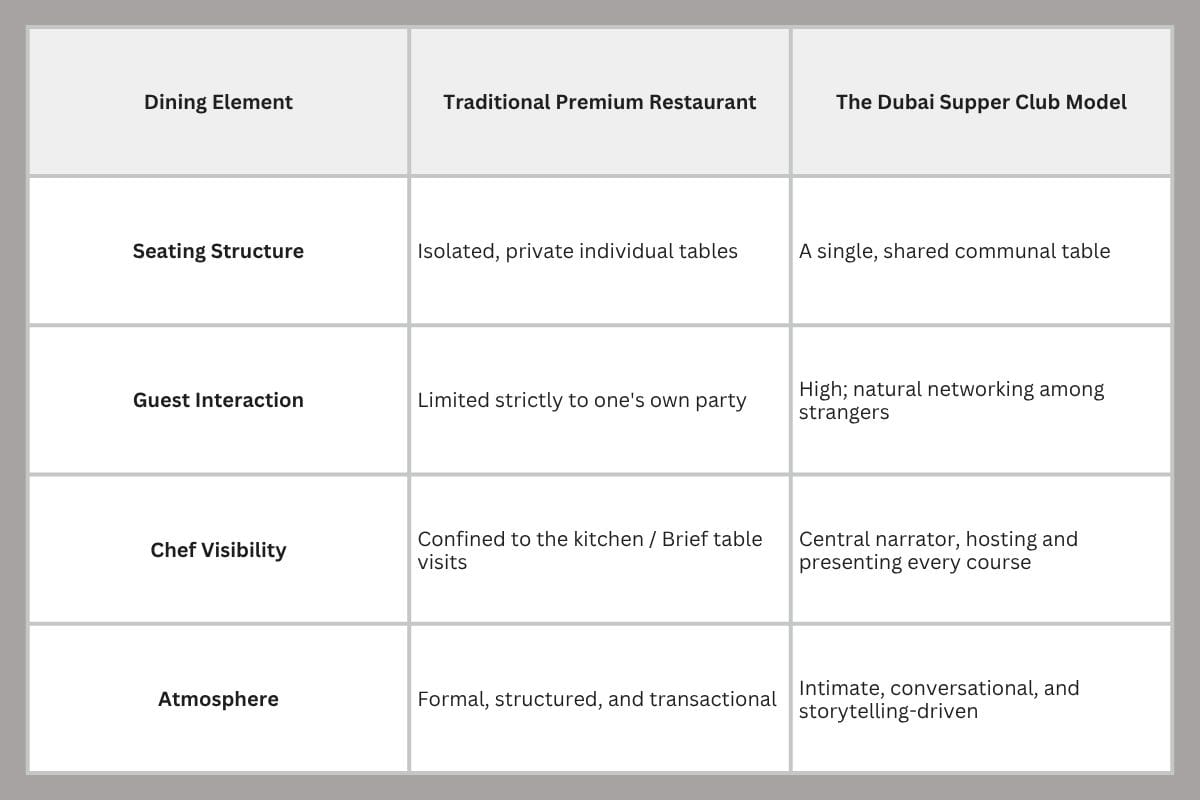
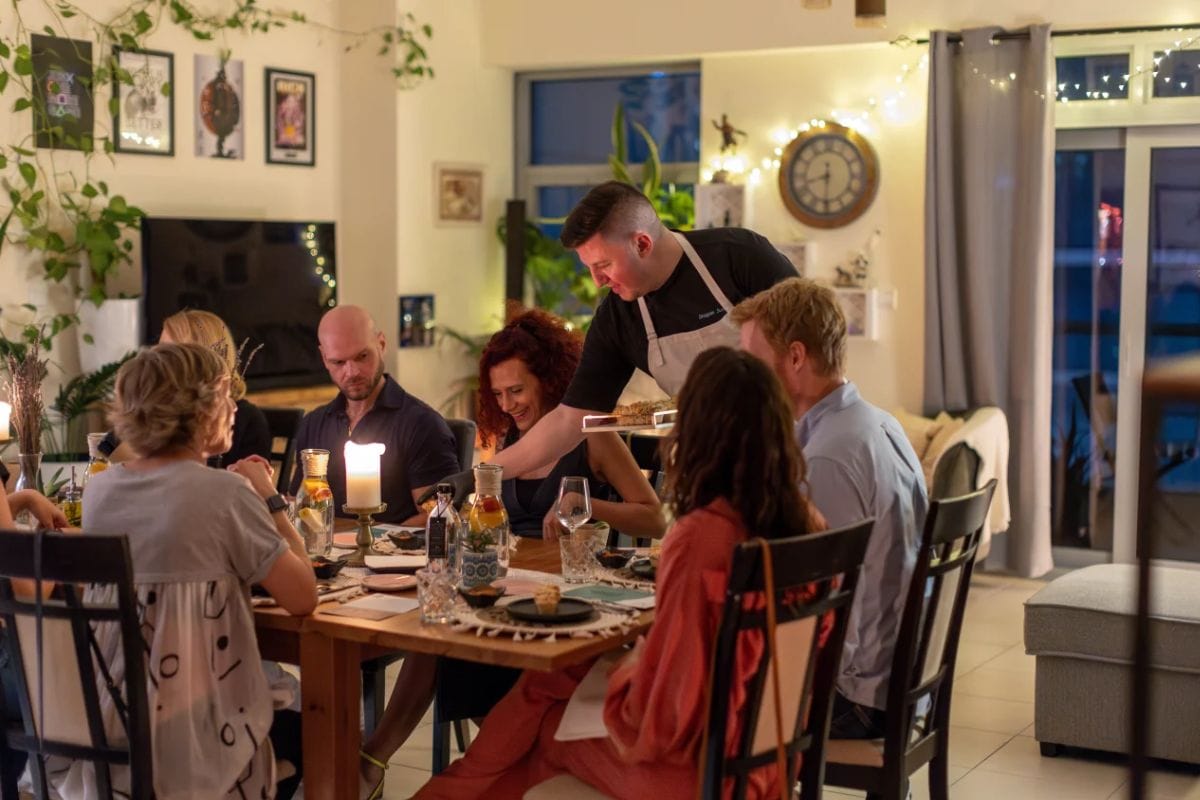
Supper clubs have flourished in Dubai because they address a deeply human need: the desire for genuine social connection. By replacing individual tables with a single, shared communal table, the environment encourages interaction. Strangers from completely different industries, cultures, and walks of life sit shoulder-to-shoulder, breaking bread together in an environment that feels more like an elegant home dinner party than a commercial establishment.
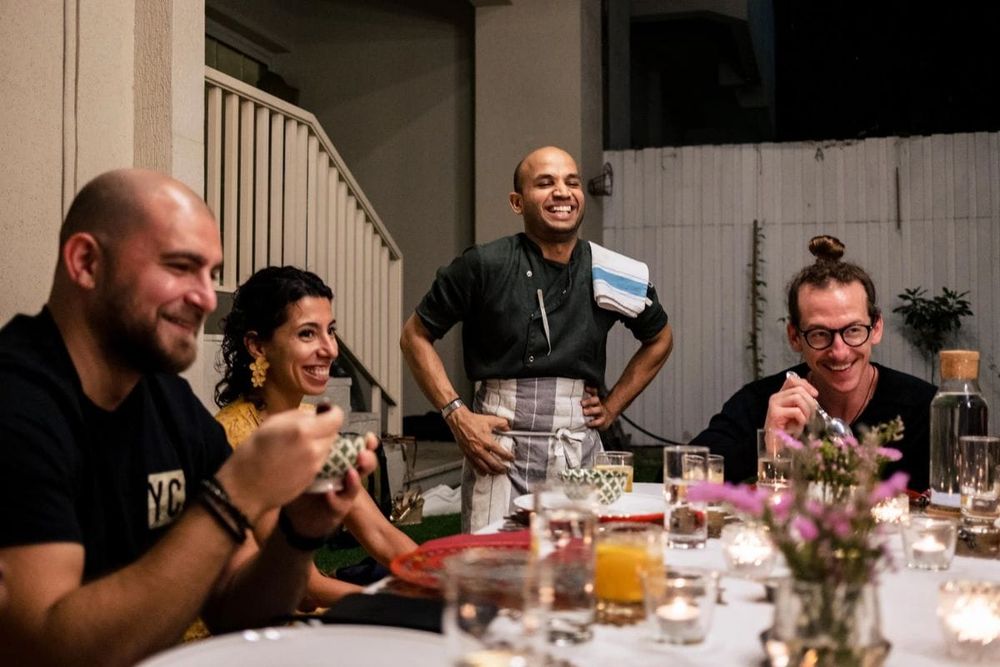
Crucially, the traditional barrier between the kitchen and the guest is entirely removed. The chef acts not just as a cook, but as a host and storyteller. They present each course personally, explaining the heritage behind a particular spice blend, sharing memories of the dishes that inspired the menu, and engaging directly with the diners. This direct access transforms the meal into an educational and emotional experience, building a loyal community of brand advocates.
Navigating the Regulatory Landscape: The Path to Sustainability
As Dubai’s micro-event ecosystem matures, navigating the local regulatory and licensing framework has become a central focus for culinary founders aiming for long-term business viability. Operating completely "under the radar" in private apartments is no longer a viable long-term strategy in a highly regulated market committed to public health and consumer safety.
The modern Dubai supper club entrepreneur treats the micro-event model as an incubator and a low-risk proof of concept. Forward-thinking chefs use these intimate gatherings to test flavor profiles, build a highly engaged digital community, and establish a clear brand identity.
Once the concept is proven and a stable stream of revenue is established, founders can transition into the formal market through several legal pathways:
- Securing specialized freelance or e-trader licenses available through the Department of Economy and Tourism (DET).
- Partnering with licensed, progressive pop-up spaces and boutique hotels that eagerly seek unique culinary activations to draw in discerning crowds.
- Utilizing licensed development hubs and cloud kitchens to manage prep work legally, ensuring full compliance with Dubai Municipality food safety guidelines while preserving the intimate charm of the final micro-event experience.
This structured progression allows entrepreneurs to scale their businesses at their own pace, moving into the market without absorbing the crushing debt that sinks so many traditional startups.
The rise of the supper club marks a significant evolution in Dubai’s F&B ecosystem. It proves that the success of a culinary startup is no longer measured solely by square footage, table count, or the luxury of a fit-out. By leaning into micro-events, Dubai’s culinary founders are discovering a sustainable balance between financial risk and creative fulfillment.
They are building resilient, agile, and highly profitable business models that celebrate human connection, culinary storytelling, and cultural heritage. For Focus HiDubai’s entrepreneurial audience, the supper club movement offers a clear, inspiring lesson: in a market as fast-moving as Dubai, innovation often comes from stripping away the corporate noise and returning to the fundamental magic of a shared table.
Also Read:
 Ummulkiram Pardawala
 Shahba Mayyeri
 Ummulkiram Pardawala
 Shahba Mayyeri