
You are standing in a place you cannot pronounce, holding a piece of paper with an address on it, and no one around you speaks your language. It is hot, or it is cold, or it is raining in a way it never rains at home. You have never felt so lost. You have never felt so alive.
This is where the story always begins, not with the postcard, not with the sunset, but with the moment the ground stops being familiar. Every traveler who has ever mattered to you has stood exactly where you're standing now: unmoored, unsure, and quietly, thrillingly awake.
What happens next is the part no guidebook can prepare you for. Because somewhere between that first disorientation and the flight home, something in a person quietly gives way. Not the trip, the vigilance. The habit of narrating your own life while you live it, of watching yourself from a careful distance to make sure everything goes according to plan. Out here, with no plan left to check, there is nothing left to do but actually be somewhere.
Most people never feel that particular kind of quiet anywhere else. This is the story of why.
Most of us never do this at home. We are, in a sense, permanent tourists of our own lives, half-present, already thinking about the next thing, measuring today against yesterday or tomorrow instead of simply standing in it. Travelers are forced out of that habit by circumstance. Strip away the routines that usually run your day for you, and there's nothing left to do but pay attention. To the light. To the stranger asking if you're lost. To the fact that you are, for once, exactly where you are.
This is why people come home from a trip talking less about what they saw and more about who they became for a while. Not a better person, necessarily, just a more awake one. And that particular kind of awakeness, it turns out, was never really about the distance traveled. It was about what distance made them finally notice.
What follows is an attempt to take that feeling apart to look closely at the small, ordinary habits of mind that travelers develop, almost by accident, and ask what it would mean to carry them home.
"One's destination is never a place, but a new way of seeing things." — Henry Miller
The Art of Arriving Empty-Handed
Every traveler eventually learns the same lesson: the plan is a suggestion. Flights get delayed, trains are missed, and the guidebook's "must-see" restaurant is closed for a family wedding nobody warned you about. What separates a miserable trip from a memorable one is rarely the itinerary; it's the willingness to let go of it.
There's a particular kind of traveler who never learns this, and you can spot them from across a train station: jaw tight, phone out, refreshing a delayed departure board as if glaring at it might change the outcome. They had a plan, and reality declined to cooperate, and now the whole day is ruined. Then there's the other kind — the one who shrugs, buys a coffee, and starts talking to the person next to them on the platform. Six months later, it's often that missed train they remember most fondly.
This is the traveler's first real skill, and it's less about optimism than about posture. It's the difference between meeting a closed door as an insult and meeting it as information. Somewhere along the way, seasoned travelers stop asking "why is this happening to me" and start asking "okay, given this, what now?" That single shift in phrasing is worth more than any packing list. Life, like travel, rewards those who can improvise gracefully when the map stops matching the terrain because the map was always going to stop matching the terrain eventually. It always does.
"A good traveler has no fixed plans and is not intent on arriving." — Lao Tzu
Strangers Are Just Friends You Haven't Argued With Yet

There's a reason hostel common rooms and long train rides produce some of the fastest, strangest friendships in the world. Travelers talk to people they'll never see again with more honesty than they'd offer a coworker of ten years. Something about impermanence loosens the tongue. When you know you'll never see someone again, you have nothing to protect, no reputation to manage, no relationship to preserve for next Tuesday. So you just talk. Really talk.
It's a strange kind of intimacy, built entirely on the absence of a future. A retired engineer tells a twenty-three-year-old backpacker things about his marriage he's never told his own children. Two strangers on a night bus end up discussing grief, or God, or why they really left their last job, purely because neither one will ever have to see the other's face again at a dinner party. There's a freedom in that impermanence that most of our permanent relationships never quite offer.
But it's not only the impermanence — it's the need. Travelers depend on strangers constantly, whether they want to or not. They need directions, recommendations, someone to watch a bag for five minutes, someone to explain what's actually on the menu. This constant, low-stakes asking for help does something to a person over time: it wears down the instinct toward self-sufficiency and replaces it with something more communal. You start to understand, on a gut level, that most people, most of the time, are glad to help a stranger who's a little lost. That's not naivety. It's data, collected one border crossing at a time.
This willingness to be open with strangers — to ask for directions, share a meal, trade stories in a broken shared vocabulary — is a quiet rebellion against the guardedness most of us carry through daily life. Travelers remind us that connection doesn't require history. Sometimes it just requires showing up, and being willing to be a little bit unguarded with someone who has no reason to hurt you and no reason not to.
"Wherever you go becomes a part of you somehow." — Anita Desai
Discomfort Is Not the Enemy
Ask a traveler about their favorite memory, and it's rarely the five-star hotel. It's the overnight bus with no air conditioning, the meal eaten with hands because there was no other way, the hike that went two hours longer than planned and left everyone soaked, exhausted, and laughing about it for years afterward. Discomfort, held briefly and voluntarily, has a way of becoming story and story has a way of becoming meaning.
There's a reason for this that goes beyond nostalgia. Comfort, by its nature, doesn't ask anything of you. It doesn't require adaptation, doesn't test what you're made of, doesn't produce the small, specific pride of having gotten through something. A trip spent entirely inside air-conditioned buses and reviewed restaurants is a trip with very little to say about it afterward, because nothing happened that required you to change, even slightly, in response.
Difficulty, on the other hand, leaves a mark. The traveler who gets hopelessly lost and has to piece together directions in a language they don't speak comes home slightly more resourceful than the one who didn't. The traveler who gets sick in an unfamiliar city and has to navigate a foreign pharmacy alone comes home slightly less afraid of being alone. None of this is comfortable in the moment. All of it is, in retrospect, exactly the part worth having gone through.
This is perhaps the most countercultural thing travelers model, in a culture that has increasingly optimized discomfort out of daily life: that ease is not the same as fulfillment. A life engineered entirely around comfort can end up strangely flat, like a story with no second act. A little friction, chosen on purpose, tends to be where the good stuff lives, not because suffering is noble, but because growth, almost by definition, requires something to push against.
Home Looks Different From a Distance
Perhaps the most disorienting part of any trip is the return. The traveler comes home to the same apartment, the same job, the same routines and finds them somehow rearranged, even though nothing physically moved. Distance has a way of clarifying what actually matters and what was just noise, and that clarity doesn't switch off the moment the plane lands.
Psychologists have a name for something adjacent to this: the phenomenon of noticing, upon return from any absence, how much of daily life was running on autopilot. The habitual argument with a partner suddenly looks smaller, more solvable, once you've spent three weeks solving unfamiliar problems in unfamiliar languages. The job that felt unbearable in June can look, by September, either genuinely wrong for you or, just as often, perfectly fine, once it's no longer being compared to nothing.
This is why so many people come back from a trip and quit a job, end a relationship, or start one. It isn't that travel plants new desires. It's that travel removes, temporarily, the fog of familiarity that usually keeps people from seeing their own lives clearly. Travel doesn't just show you the world; it shows you your own life from an angle you couldn't get standing still, and once you've seen it from that angle, it's hard to fully unsee it.
"Travel makes one modest. You see what a tiny place you occupy in the world." — Gustave Flaubert
Thinking About Travel Differently
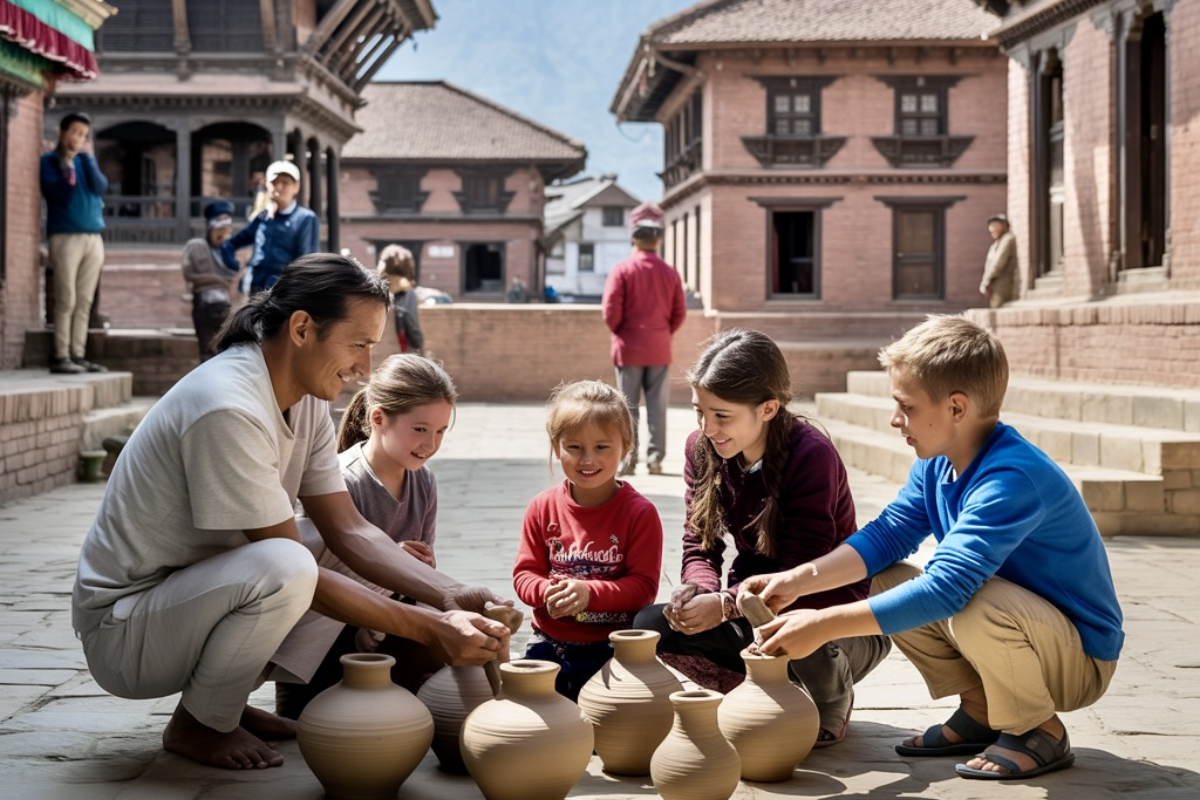
Most of us are trained to think about travel as consumption: a list of sights to acquire, a feed to fill, a country to "do" before moving on to the next one. It's a mindset borrowed from shopping: arrive, collect the highlights, check them off, leave satisfied that you got what you came for. And it isn't wrong, exactly. It's just thin. It produces photographs, not memory.
There's a different way to hold the same trip, and it doesn't require more time or money, just a change in what you're actually looking for.
Trade landmarks for encounters. The Eiffel Tower will look the same in every photograph ever taken of it. The conversation you have with the man selling roasted chestnuts beneath it will not. Plan less around what you'll see and more around what might happen to you if you stay open to it.
Trade itineraries for questions. Instead of asking "what should I see here," try asking "what is it like to live here." The second question can't be answered by a guidebook. It has to be asked of people, and it tends to lead somewhere the guidebook never would.
Trade certainty for curiosity about being wrong. Nearly every traveler arrives with some assumption about a place that gets quietly dismantled within a few days. The food isn't what they expected. The people aren't who the news made them out to be. Go looking for that dismantling on purpose — treat being wrong about a place as the actual point of visiting it, not an inconvenience along the way.
Trade the finish line for the texture. "Doing" a country in five days produces a checklist. Spending those same five days in one neighborhood, eating at the same three places, recognizing the same faces by day three — that produces something closer to a relationship. It's a shorter trip on paper and a much larger one in memory.
"The real voyage of discovery consists not in seeking new landscapes, but in having new eyes." — Marcel Proust
None of this requires an exotic destination. It requires deciding, before you go, that the point of the trip is not the sights but the shift — in attention, in assumption, in what you're willing to let surprise you.
You Don't Have to Leave to Travel Well
The deepest lesson travelers offer isn't about geography at all. It's a way of paying attention — noticing the unfamiliar detail, staying curious about people who see the world differently, treating uncertainty as interesting rather than threatening. You can practice all of it without a passport: in a new part of your own city, in a conversation with someone whose life looks nothing like yours, in the simple decision to take the long way home and see what's actually along it.
Try, for one ordinary day, treating your own neighborhood the way a traveler treats an unfamiliar city. Notice the building you walk past every day without seeing. Ask the person at the counter a real question instead of the automatic one. Take the street you've never taken. None of it requires a plane ticket, and almost all of it produces some small fraction of the same alertness that makes travel feel so alive — because the alertness was never really about the place. It was about the attention.
The traveler's real destination was never a place. It was a way of being awake to wherever they happened to be standing — and that particular skill, unlike a passport stamp, is available every single day, right where you already are.
Also read:
 Shahba Mayyeri
 Umema Arsiwala
 Umema Arsiwala