Every business owner in Dubai has a hiring story that did not go to plan. It might be the candidate who interviewed brilliantly but went quiet three months in, or the senior hire who looked perfect on paper but could not get along with the team. In other cases, it is the specialist brought from abroad on a generous package who turned out to be significantly less specialized than advertised. These stories are more common than most admit, and they are far more expensive than most people calculate.
Dubai's hiring market has specific characteristics that make a bad hire more costly than in other cities. Visa sponsorship ties both employer and employee to a formal legal relationship, and recruitment agency fees typically run at 15 to 20 percent of an annual salary. Onboarding a new employee from abroad, covering flights, Emirates ID, medical insurance, and a labor card, costs between AED 6,000 and AED 12,500 before the person has even sat at their desk.
When you factor in months of underperformance, management time absorbed, and the cost of running the process all over again, the true price of a hiring mistake is significant. For a mid-level hire, it is rarely less than the equivalent of three to four months of that person's salary, and it is often considerably more.
The Full Bill Nobody Adds Up
Most business owners calculate the cost of a bad hire as the salary paid during the period things did not work out, plus the recruitment fee to find a replacement. However, this significantly underestimates the real figure. The costs of a bad hire in Dubai fall into three distinct categories, and only the first is visible on an invoice.
The direct costs are the ones you can quantify. This includes the recruitment agency fee paid twice for the same role, visa processing, Emirates ID, and medical insurance. In some cases, it includes end-of-service gratuity accrued even during a short tenure, notice period salary, and potential legal costs if the exit is complicated. For international roles, you must also add flights and temporary accommodation.
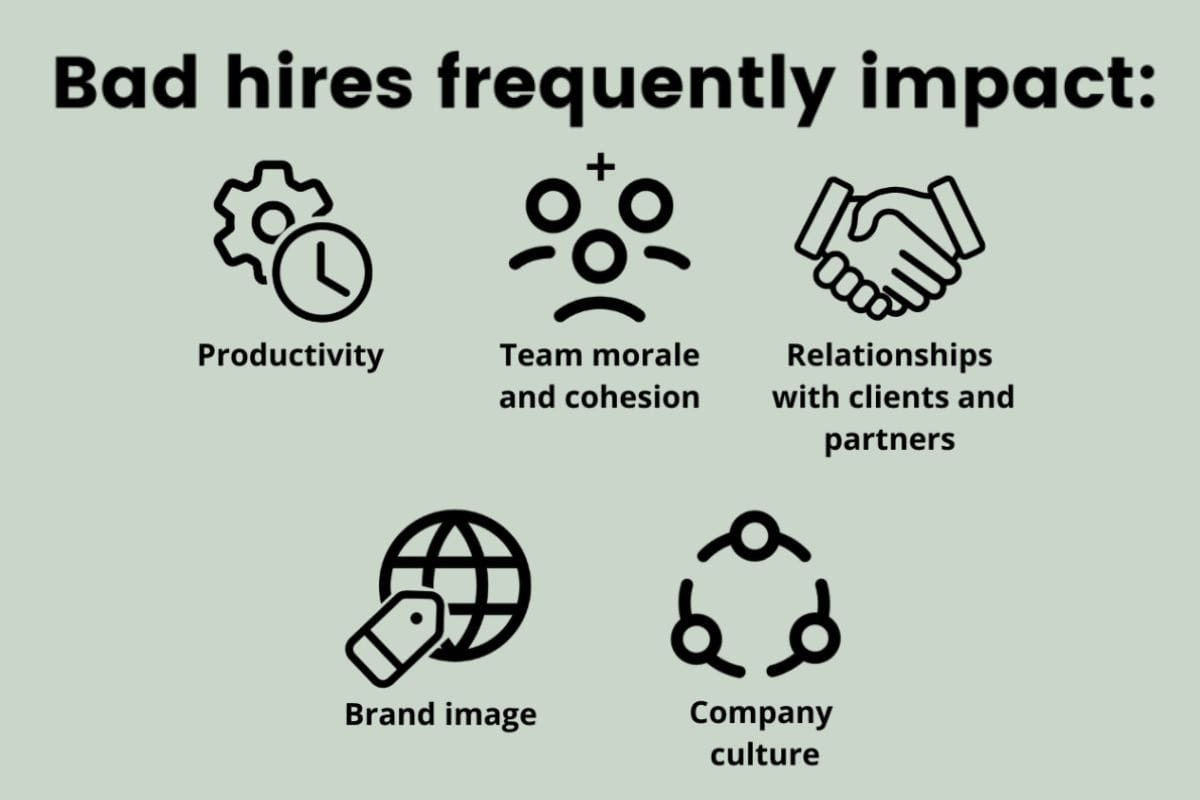
The indirect costs are harder to put on a spreadsheet but are more damaging in practice. Every week a poor performer is in a seat, someone else on the team is absorbing their work. Managers spend disproportionate time supervising and correcting: time not being spent on work that grows the business. Projects slip, deadlines move, and the rest of the team draws its own conclusions about standards when they see an underperformer remain in a role.
The third category is the one that almost never appears in any calculation: the client-facing cost. Dubai is a relationship-driven market where a significant proportion of business flows through referrals and personal reputation. A poor performer in a client-facing role does not just lose one contract; they can damage relationships that took years to build. In a city where professional reputation travels fast through tight networks, a bad hire is sometimes a brand problem as much as an HR one.
Why Dubai Makes Bad Hires More Expensive
The visa system creates a layer of financial and legal complexity that does not exist in purely contractual markets. When you sponsor someone's visa to work in the UAE, you take on obligations that extend beyond the employment contract. While the process is clean during probation, once that period passes, the exit involves notice periods under Federal Decree-Law No. 33 of 2021, visa cancellation procedures, and potential labor disputes managed through the Ministry of Human Resources and Emiratisation.
The pace of the market compounds the problem. With unemployment at 1.9 percent and over 500,000 projected job openings across the UAE this year, competition for quality candidates is intense. The pressure to fill a vacancy quickly, particularly when operational strain is mounting, is a common driver of poor hiring decisions. A rushed process evaluates a narrower pool with less rigor, often leading to a hire that is less well-assessed than if the business had taken proper time.
The cultural dimension adds another layer of complexity specific to Dubai. This is a city of over 200 nationalities where teams routinely span multiple backgrounds and professional traditions. This requires a deliberate approach to cultural fit that goes well beyond whether someone seems pleasant in an interview. What constitutes directness in one culture may read as rudeness in another, and a hire who performed well in a homogeneous environment may struggle in the diversity of a Dubai workplace.
Where the Process Usually Goes Wrong
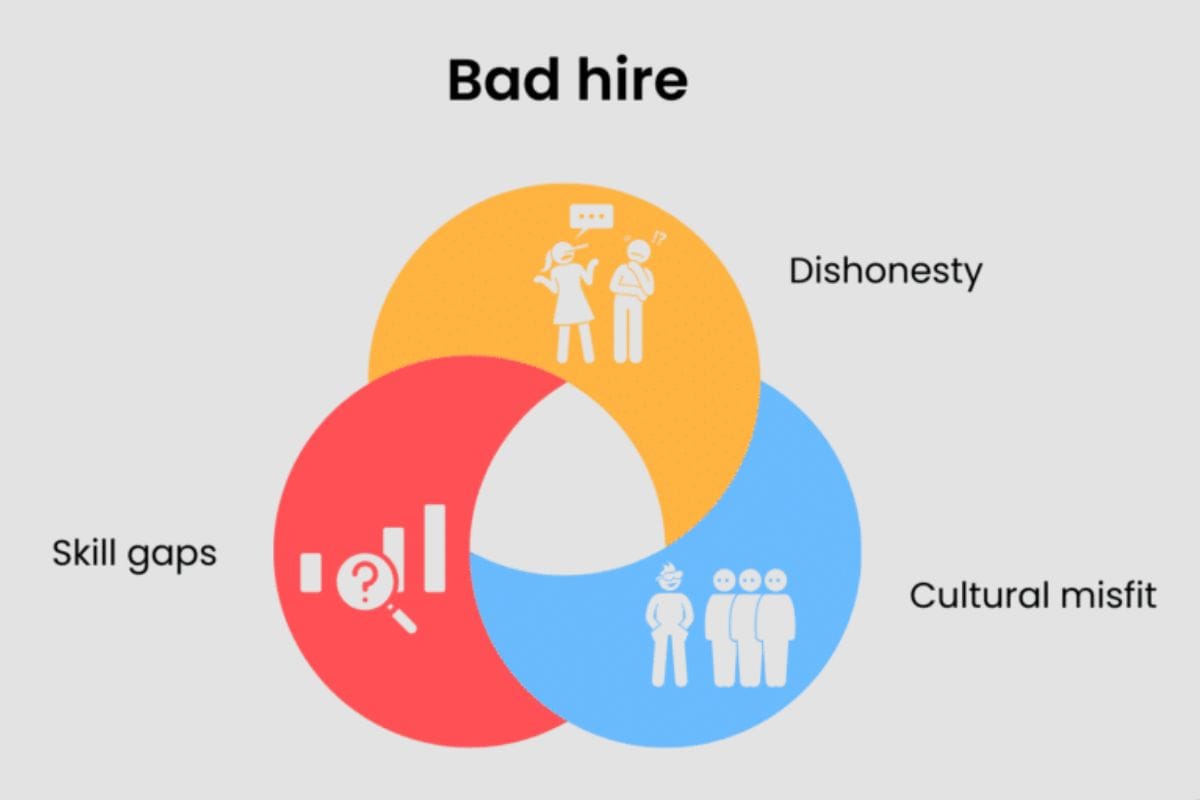
Bad hires are rarely random. They are the output of a predictable set of process failures that repeat across businesses of every size. Understanding where the process breaks down is the starting point for fixing it. Often, the role is not clearly defined before the search begins. When requirements are a wish list rather than a precise specification, the entire process evaluates candidates against the wrong criteria.
Furthermore, many interviews confirm rather than evaluate. Most interviews validate the interviewer's first impression; if you liked someone in the first five minutes, you will spend the next 45 looking for reasons to hire them. This lack of structure is matched by reference checks that are often treated as a formality. In Dubai’s fast-moving market, references are frequently skipped or reduced to a brief confirmation of employment dates rather than a genuine conversation about performance.
What Actually Prevents a Bad Hire
Most bad hires are preventable. While not all mistakes can be avoided, the majority trace back to process gaps that can be closed without significant cost. A key step is to define the role by outcomes rather than credentials. Before writing a job description, write down what this person will be doing on a typical working day three months in, the decisions they will make independently, and what success looks like at the six-month mark.
Adding a practical assessment to the process is also vital. An interview tells you how someone presents themselves under pressure, but a task tells you how they actually think and work. A short practical assessment, such as a case study or a sample deliverable, provides evidence of capability that a confident interview performance cannot substitute for. This is particularly valuable in Dubai, where candidates are often highly practiced interviewers.
Finally, use the probation period as it was designed to be used. UAE Labor Law provides for a probation period of up to six months specifically so the employment relationship can be tested. Too many businesses treat it as a formality, letting concerns go undocumented until the relationship is clearly failing. Setting clear milestones at 30, 60, and 90 days allows you to move decisively when it is not working, which is almost always cheaper than acting late.
Slow Down the Hire, Speed Up the Exit
Dubai rewards speed in almost every dimension of business, but hiring should be the deliberate exception. The pressure to fill a seat quickly produces more bad hires than any other single factor in the market. Slowing the process down by even one or two weeks to conduct a proper assessment and a genuine reference check costs very little relative to what is at stake.
In a city where the best candidates have multiple options and visa obligations add legal complexity, hiring well is not just good HR practice. It is one of the most important commercial decisions a business owner in Dubai makes. Getting it right the first time protects your budget, your team morale, and your professional reputation.
Also Read:
 Ummulkiram Pardawala
 Shahba Mayyeri
 Ummulkiram Pardawala
 Maryam Pervez