Generic advertising is losing ground. The era of broad-reach campaigns built around demographic assumptions, the 35-to-54 bracket, the urban professional, the first-time buyer, is giving way to something far more precise. Artificial intelligence is enabling businesses of every size to move from one-size-fits-all messaging to advertising that speaks directly to individual customer behaviour, preferences, and intent. The results are not marginal. AI-driven ads report 41 per cent higher conversion rates, and organisations investing in AI marketing see sales ROI improve by 10 to 20 per cent on average.
For business owners, the practical question is not whether AI-powered personalisation works; the evidence is clear that it does. The question is how to put it to work so that every ad your business runs is doing something more intelligent than broadcasting the same message to everyone.
This article breaks down exactly how AI transforms generic advertising into personalised sales tools, with specific applications and implementation steps accessible to businesses at any stage of their AI marketing journey.
Why Generic Ads No Longer Convert the Way They Used To
The consumer attention environment has fundamentally changed. The average person encounters hundreds of digital ads daily. The vast majority are ignored, not because advertising does not work, but because most of it is irrelevant to the individual seeing it. A promotion for winter boots shown to someone in Dubai in August is not just ineffective. It actively trains the viewer to ignore your brand. Relevance is no longer a nice-to-have in advertising. It is the baseline requirement for capturing attention.
The personalisation gap is wide and well-documented. Consumers report greater purchase intent, higher brand trust, and improved experience when advertising reflects their actual interests and behaviours. Yet most businesses, particularly SMEs, continue to run the same ad to every audience segment, at every stage of the buying journey, without variation. The gap between what consumers expect and what most advertisers deliver is where AI's commercial opportunity sits.
How AI Enables Personalisation at Scale
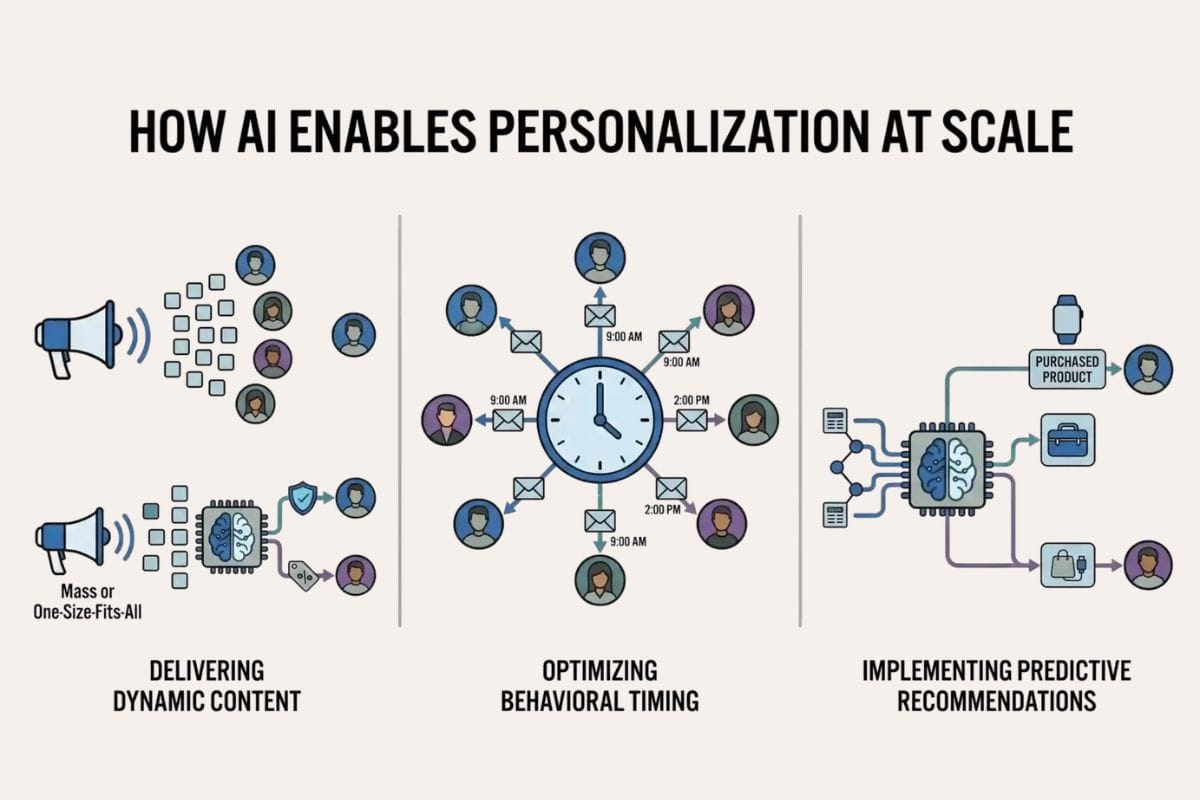
Personalisation at scale was previously the exclusive domain of large enterprises with significant data infrastructure and dedicated analytics teams. AI has democratised this capability. The core mechanism is straightforward: AI systems process large volumes of customer data, browsing behaviour, purchase history, engagement patterns, geographic context, and time-of-day activity and use that data to determine which message, creative, offer, and channel is most likely to convert a specific individual at a specific moment.
This is meaningfully different from traditional segmentation. Segmentation puts customers into buckets and serves the same message to everyone in that bucket. AI personalisation treats each customer as an individual data profile and optimises the message accordingly, in real time, at a scale no human marketing team could replicate. More than 40 per cent of marketing professionals are already using generative AI to produce multiple versions of creative for ads, and 86 per cent of advertisers are already using or planning to use generative AI for video ad creation. The shift is underway across every sector and every business size.
The Four Core Applications of AI in Personalised Advertising
Understanding where AI creates the most direct commercial impact in advertising helps business owners prioritise where to deploy it first.
- Predictive Audience Targeting
AI-powered targeting tools analyse historical customer data and real-time behavioural signals to identify individuals most likely to convert before they have expressed explicit purchase intent. Rather than targeting people who fit a demographic profile, predictive targeting finds people whose behaviour patterns resemble those of your best existing customers.
Meta's Advantage+ campaigns and Google's Performance Max both use this model, automatically optimising targeting, bidding, and creative delivery. The result is reduced wasted spend on audiences unlikely to convert and increased investment in the signals most predictive of a sale.
- Dynamic Creative Optimisation
Dynamic creative optimisation (DCO) is one of the most directly actionable AI applications for most businesses. Instead of running a single ad creative to all audiences, DCO systems assemble personalised ad versions from a library of components headlines, images, body copy, offers, and calls to action and serve the combination most likely to resonate with each individual viewer.
A returning customer who previously browsed a specific product category sees a different ad from a first-time visitor. A user in Dubai sees different imagery from one in Riyadh. A consumer who abandoned a cart sees a reminder with a specific incentive. All of this happens automatically, in real time, without manual creative production for each variation.
- AI-Powered Email and CRM Personalisation
Email remains one of the highest-ROI channels in digital marketing, and AI has substantially raised its ceiling. AI-driven email tools use purchase history, browsing data, and engagement patterns to personalise not just the content of emails but their timing, subject lines, send frequency, and product recommendations.
Tools, including Klaviyo, HubSpot, and Salesforce Marketing Cloud, now include AI recommendation engines that automatically curate the most relevant products or content for each subscriber. The commercial impact of this level of personalisation is measurable: AI-driven email campaigns consistently outperform generic broadcasts on open rates, click-through rates, and revenue per recipient.
- Conversational AI and Chatbot Commerce
AI-powered chatbots have moved well beyond simple FAQ responses. Current-generation conversational AI tools can qualify leads, recommend products, handle objections, apply discount offers, and complete transactions within a single chat interface, personalised to the individual's query and history. With 52 percent of customer interactions now involving AI chatbots and satisfaction scores reaching 84 percent, businesses deploying conversational AI in their sales workflow see measurable improvements in conversion rates and a reduction in time from first contact to purchase.
Personalised Video Ads: The Fastest-Growing Application
Among all AI advertising applications, personalised video is currently experiencing the fastest growth and generating the most compelling early evidence. A study of 21,000 consumers found that AI-generated personalised video ads outperformed both image ads and generic video in click-through rates, a finding that has accelerated adoption significantly.
AI-generated video is now expected to account for 40 per cent of all video ads by the end of this year, with 68 per cent of CMOs deploying or planning to deploy AI for video generation and enhancement, making it the single highest-priority AI application for marketing teams globally.
For business owners, the practical implication is that personalised video no longer requires large production budgets. AI video tools, including Synthesia, HeyGen, and Runway, allow businesses to generate multiple personalised variants with different spokespersons, languages, and product focus, at a fraction of traditional production cost.
A real estate agency can produce a personalised property video for each lead. A retailer can create product videos tailored to each customer segment. A restaurant can generate location-specific promotional content for different neighbourhoods. The barrier to entry for personalised video has collapsed.
A Practical Implementation Framework for Business Owners
For businesses at the beginning of their AI advertising journey, the range of available tools and applications can feel overwhelming. A sequenced approach, starting where the commercial return is most immediate, is more effective than attempting to implement everything simultaneously.
- Start with your existing ad platforms
Meta Advantage+ and Google Performance Max are already AI-driven personalisation engines embedded within platforms most businesses use. Enabling these tools, ensuring your conversion tracking is correctly configured, and building a first-party audience from your existing customer data is the highest-return entry point and requires no additional technology investment.
- Build your creative asset library
Dynamic creative optimisation is only as good as the assets it has to work with. Investing in a library of diverse headlines, imagery, and offer variations gives AI systems more combinations to test and optimise and produces better personalisation outcomes over time.
- Integrate your CRM with your ad platforms
The most powerful personalisation happens when your customer data, purchase history, lifetime value, and product preferences are connected directly to your advertising systems. This allows you to exclude existing customers from acquisition campaigns, target high-value lookalike audiences, and create re-engagement campaigns for lapsed buyers with personalised incentives.
- Measure incrementally
AI advertising systems require data to learn and optimise. Set realistic performance expectations over a four to eight-week learning window, measure conversion lift rather than click-through rates alone, and resist the temptation to make frequent manual adjustments that interrupt the algorithm's optimisation cycle.
Using AI Responsibly: Privacy and Consumer Trust
The commercial case for AI personalisation is strong, but it operates within a consumer trust environment that businesses must actively manage. Consumers are increasingly aware of how their data is used in advertising, and perceptions of overly intrusive personalisation ads that feel surveillance-like rather than helpful can damage brand relationships.
The boundary between personalisation that delights and personalisation that unsettles is real, and it is crossed when the specificity of an ad makes consumers aware they are being tracked rather than understood.
Responsible AI advertising means building personalisation on first-party data information that customers have consciously shared rather than third-party data sources. It means clear opt-in mechanisms, transparent data policies, and personalisation calibrated to be useful rather than intrusive.
Businesses that get this balance right do not just avoid regulatory risk; they build brand trust that amplifies the commercial performance of every personalised campaign they run.
Generic advertising will always exist. But in an environment where AI makes personalisation accessible, affordable, and measurably more effective, businesses that continue to run the same ad to everyone are not just underperforming, they are ceding ground to competitors who are not.
Also Read:
 Ummulkiram Pardawala
 Shahba Mayyeri
 Ummulkiram Pardawala
 Shahba Mayyeri