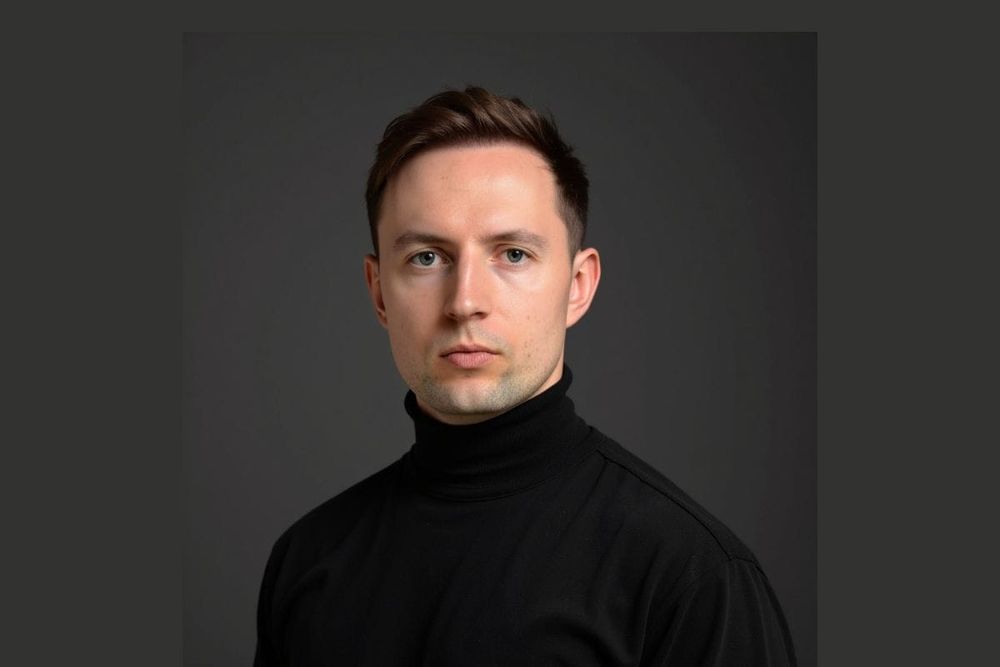
Dubai’s music scene is changing fast, and 0to8 (Zero to Infinity) is at the forefront of that shift. Co-founded by Artem Shargin, the label leverages data-driven systems and platforms like TikTok to accelerate artist growth and reach audiences in innovative ways. Now expanding across the MENA region with plans for global impact, 0to8 combines cultural insight with technology to redefine what a modern music label can achieve. Before 0to8, Artem co-founded Virtual Rags, a U.S.-based digital fashion company, which he successfully exited in 2022 and later saw acquired by a major NFT platform.
In this interview, Artem shares how 0to8 is redefining artist growth at TikTok speed, turning viral moments into sustainable careers, the systems behind generating real income for artists, and the hybrid of data and cultural intuition that guides the label’s expansion in the MENA region.

What problem in the music industry made you feel there was room for a label like 0to8?
The problem was obvious — the industry was stuck in an old model.
Traditional labels were built for a different era: radio rotations, long album cycles, centralized promotion. But reality changed. Discovery now happens inside social communities. Trends don't simmer — they detonate. The time it took for a track to reach 100,000 TikTok posts dropped from approximately 340 days in 2020 to just 48 days in 2025.
Meanwhile, most labels kept operating by the old rules. They were missing the moment while still discussing the campaign budget. We saw an opportunity — to build a label that operates at TikTok speed, not industry speed.
The name "Zero to Infinity" suggests rapid growth. How does that philosophy shape the way you develop artists?
Zero to Infinity isn't just a name. It's literally a description of what we do.
We take artists who start from zero — zero audience, zero recognition, zero industry connections — and build them a path to global scale. The philosophy means we never look at an artist through the lens of where they are today. We look at where they could be, and how fast we can get them there.
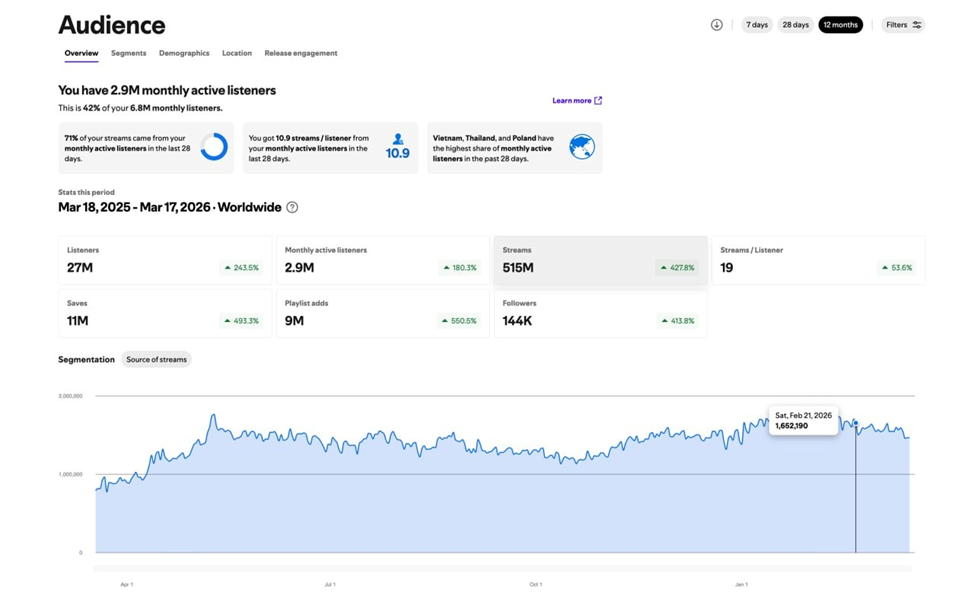
The best proof is UdieNnx. We found him on TikTok with almost no audience. Today he has nearly 7 million monthly listeners on Spotify, his songs have hundreds of millions of streams, and tens of millions of people around the world watch and listen to content built around his music every single month. That didn't happen by accident — it happened because every decision we made was driven by one question: does this accelerate growth or slow it down?
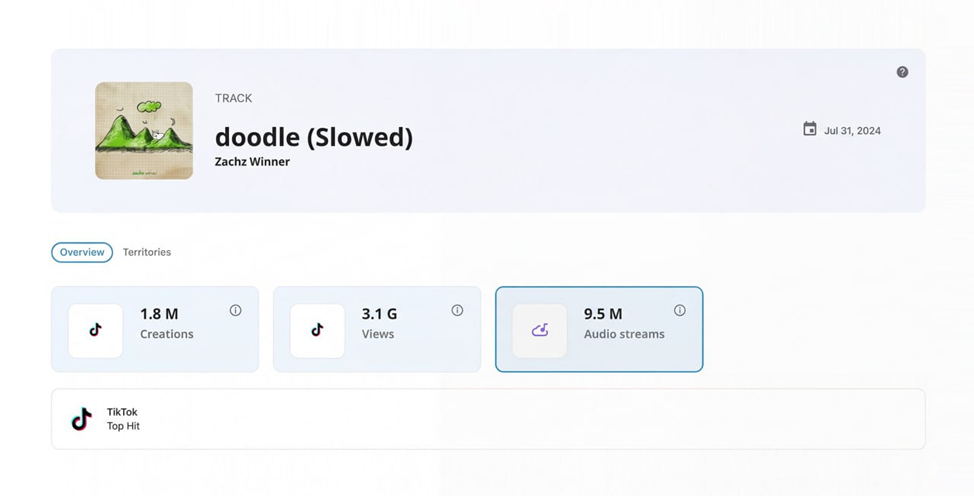
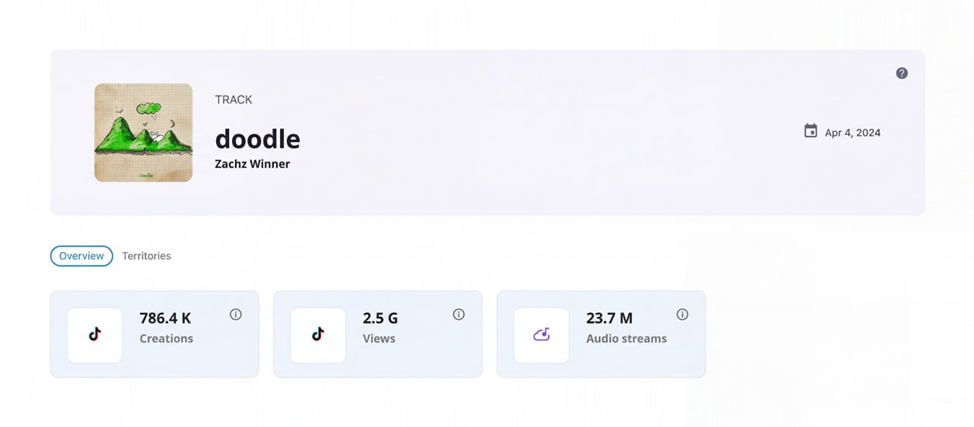
Zachz Winner, whose track "Doodle" was organically picked up by members of TOMORROW X TOGETHER, is another example. These aren't lucky breaks. This is the system working as designed.
As a digital-first label, how does 0to8 actually generate revenue in today's streaming-driven industry?
Our business model is straightforward — and that's a strength, not a weakness.
The foundation is distribution and publishing. We earn a percentage of streams from the artists we work with. Occasionally there are sync requests — music used in YouTube content or games — but that's supplementary, not the core.
The numbers speak for themselves. In 2025, we had approximately 4 billion streams worldwide. That generates revenue in the millions of dollars per year. Our primary expense is advertising and promotion on TikTok and YouTube. We reinvest a significant portion back into artist growth.
Some of our artists earn tens of thousands of dollars per month. That's not an exception — that's the result of a system that works.
Many artists generate millions of streams but struggle financially. How do you ensure viral success translates into real income?
This is one of the most important questions in the industry — and most labels give the wrong answer.
TikTok virality by itself doesn't pay. Streaming pays. So our job is to make sure every viral moment immediately converts into growth on Spotify, Apple Music, and YouTube Music. The right distribution, smart publishing, timely editorial pitching through our partner Believe — all of this is built before the track explodes, not after.
And here's something people underestimate: artists who reach even a few million streams with us start earning real money every single month. You don't need to be a global superstar to build a sustainable income from music anymore. That's one of the most important shifts happening in the industry right now, and we're built around it.
The second element is catalog protection. Last year we removed hundreds of duplicate versions of our tracks that were illegally uploaded to streaming services. This is direct theft from artists — duplicates confuse algorithms, steal streams, and take money that should go to real people. Active catalog protection is part of our work that most people never see, but it directly impacts every artist's income.
The result: some of our artists earn tens of thousands of dollars per month. Not because they got lucky with a viral track, but because the system is built correctly.
UGC platforms like TikTok drive discovery but pay relatively little. How do you convert social traction into sustainable revenue streams?
TikTok is not a revenue source. It's an engine.
TikTok itself pays little — that's true. But a track that goes viral on TikTok immediately converts into streaming on Spotify, Apple Music, and YouTube Music. That's where the real money lives. A viral moment on TikTok is not the end point; it's the beginning of a chain.
Our job is to make sure that chain is built correctly. That means right distribution, smart publishing, timely pitching to editorial playlists through our partner Believe. When a track explodes on TikTok and simultaneously lands in major Spotify playlists — that's when the numbers get truly serious.
Your catalog leans into internet-native genres and trends. How much of your success comes from data versus instinct when identifying the next breakout track?
It's always a combination, but after three years of living inside TikTok daily, intuition becomes something close to a superpower.
Data tells you what already happened. Intuition tells you what's about to happen. Kirill (Kirill Smetkov - CEO & co-founder of 0to8) and I still handle A&R directly — no committees, no layers. That means three years of watching thousands of tracks move through communities, seeing what sticks and why. At this level of pattern recognition, you start feeling a track's potential through its tempo, emotional tone, and sonic texture before the algorithm confirms it.
The best example is UdieNnx. He invented his own genre that didn't exist before. No data could have told us that. We simply felt the sound was extraordinary, supported early signals with marketing, and let the community decide. They decided fast — "Vision" surpassed 80 million streams on Spotify.
A viral moment can be short-lived. What systems do you put in place to turn that moment into long-term artist growth?
A viral moment is raw material. Our work begins precisely when most people think the work is done.
The moment we see traction, we move immediately. We launch remixes, sped up and slowed versions, genre adaptations. Each version opens a new community. Each community extends the track's life. What starts as one viral moment becomes a content ecosystem that lives for months.
In parallel, we work to convert virality into followers on streaming platforms, because that's where long-term careers are built. A track can disappear from TikTok in a week but an artist who has grown their listener base on Spotify keeps that audience forever.
You've identified strong growth opportunities in the MENA region. What makes this market particularly interesting right now?
Let me start with an honest admission: we don't yet have artists from the UAE or the MENA region. But our music is already living here.
Tracks like Heavenly Jumpstyle and ACIDO III by UdieNnx regularly appear in UAE viral charts. Automotive brands and dealerships — including Brabus — use our music for promotion. This is organic penetration that we didn't specifically plan; it happened because the sound resonates with the regional audience.
But there's also a strategic reason why we look at MENA seriously, and it's connected to where we're based. Dubai and the UAE give us something that's hard to overestimate for a global business: a reliable banking system, the ability to work with the entire world without unnecessary barriers, and a transparent business environment. Everything works fast and predictably. For a label that lives on speed that's critical.
The MENA region is also experiencing a digital cultural rise: young audience, high smartphone penetration, and a growing interest in global trends. We see enormous potential here, and plan to develop our presence in the region more actively.
How is a digital-first label like 0to8 reshaping the role of traditional A&R in the streaming era?
Traditional A&R was built on intuition and industry connections. You knew the right people, attended the right showcases, heard demos through the right channels. That worked when discovery was centralized.
Today, discovery is decentralized and A&R has to be too. We find artists on TikTok, on YouTube, in niche communities that traditional labels have never heard of. UdieNnx from Kazakhstan would never have appeared on any traditional A&R radar. We found him because we were spending hours in the right corners of the internet.
The new A&R is a combination of cultural intuition and the ability to read real-time data signals, not instead of each other — together. And it requires people who live inside internet culture, not people who observe it from the outside.
Do you see the future of record labels looking more like tech companies driven by data, algorithms, and creator platforms?
As always, the truth is somewhere in the middle. But technology matters more here than most people think.
I touched on catalog protection earlier when talking about artist income. Beyond that specific point, the broader truth is: data and algorithms are becoming increasingly critical tools — and labels that ignore them will lose. But music spreads because it carries cultural context. An algorithm can't replace the person who feels that a sound is exceptional before the data confirms it.
The future of labels is a hybrid: cultural intuition amplified by technology. The ones who find that balance will win. The ones who choose only one side will fall behind.
Also Read:
 HiDubai Newswire
 Shahba Mayyeri
 Shahba Mayyeri
 Shahba Mayyeri
 HiDubai Newswire


![Interview with Nader Bassit, CEO of El Greco Restaurant [Wakira Investments] in Dubai](https://storage.ghost.io/c/8e/d7/8ed7937e-239e-4c73-8661-3ab95a578ef0/content/images/size/w300/2023/08/Untitled-design--1-.jpg)