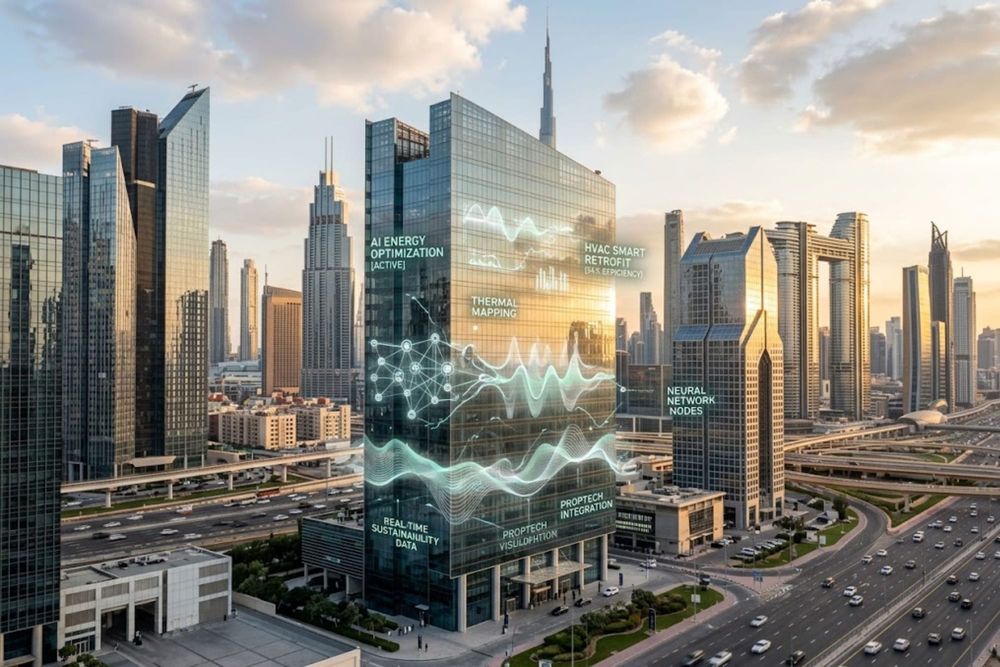
Constructing a futuristic green tower from scratch is relatively simple. Architect teams specify solar glass, smart insulation, and ultra-efficient cooling long before breaking ground. The far tougher challenge lies in transforming the glass-and-steel skyscrapers already defining the skyline.
Across Dubai Marina, DIFC, and Business Bay, older commercial and residential towers face a major sustainability bottleneck. Intense desert heat forces legacy cooling systems to run continuously at peak loads, accounting for up to 70% of an older building's total utility bill.
Demolishing and rebuilding these massive structures is financially impractical and creates enormous carbon waste. Instead, Dubai is executing a smarter solution: intelligent PropTech retrofits.
Led by public initiatives like Etihad ESCO (a wholly-owned venture of DEWA) alongside specialized private technology providers, older towers are receiving digital brain transplants. By retrofitting existing facilities with smart building management systems (BMS), wireless sensors, and predictive AI cooling algorithms, Dubai is teaching its legacy skyscrapers how to think in real time, slashing carbon footprints and energy demand by 25% to 35% without major structural disruptions.
The Energy Cost of Desert Cooling
To understand why retrofits matter, it helps to look at how older commercial buildings operate. In traditional setups, central chillers and air handling units run on fixed, pre-programmed schedules. On a humid summer afternoon, a legacy chiller operates at full power. The problem is that it continues running at nearly that same high output during quiet weekends or when an office floor sits half-empty.
This static approach wastes vast amounts of power, accelerates mechanical wear, and drives up utility expenses. With Dubai aggressively targeting long-term clean energy goals, upgrading the existing built environment has evolved from a nice-to-have project into a prime economic priority.
Beyond MEP: Material Science Meets Solar Heat Reduction
While Mechanical, Electrical, and Plumbing (MEP) software upgrades handle internal airflow, true energy optimization starts at the building's outer skin. Glass curtain walls in older towers act as thermal amplifiers, allowing massive amounts of solar radiation to penetrate interior spaces and overburden the air conditioning systems.
To combat this without replacing entire glass facades or altering the original aesthetic of the skyline, retrofits now deploy advanced material science:
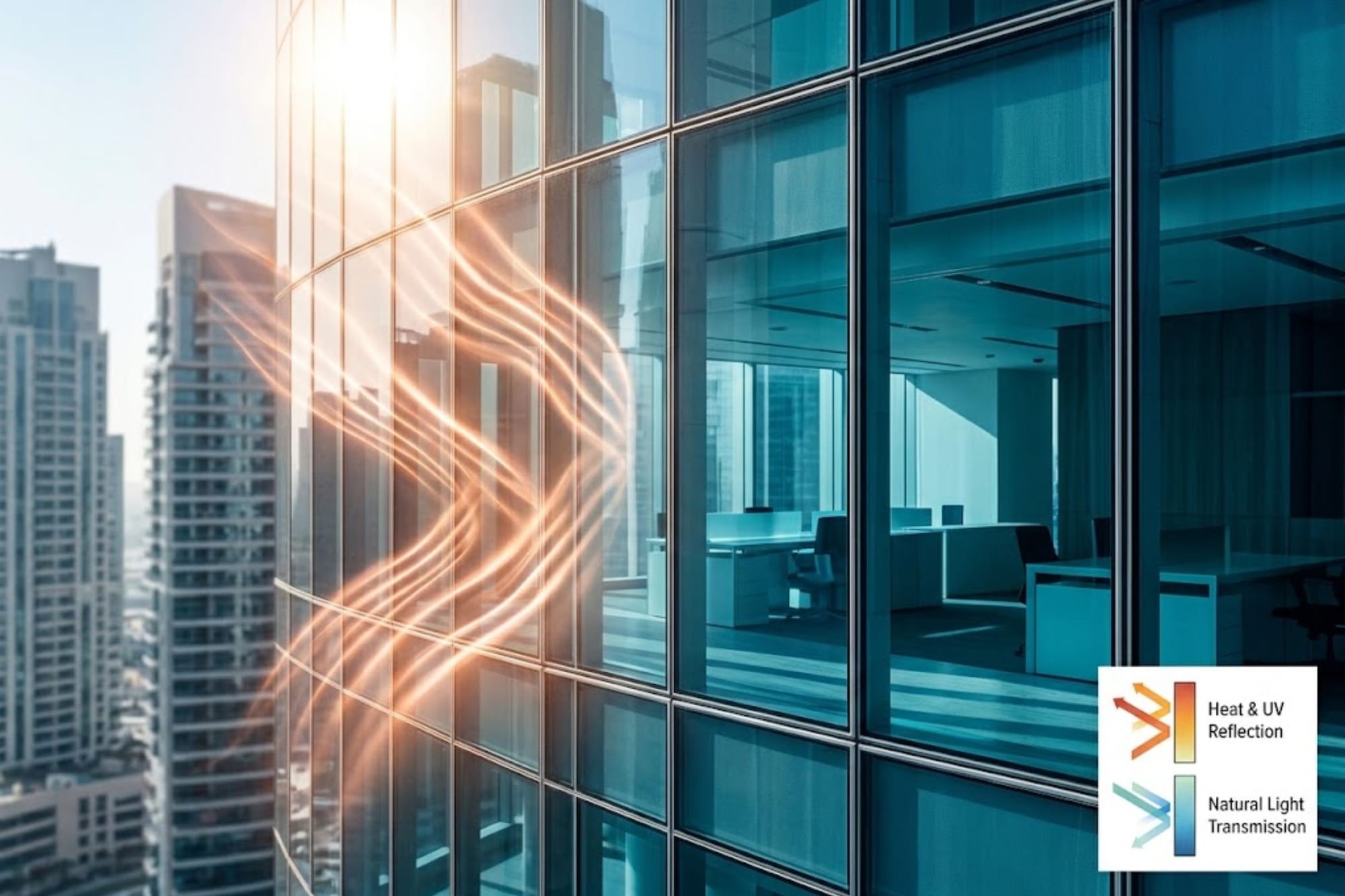
- Spectrally Selective Ceramic Films: Applied directly to existing glass panels, high-performance SPECTRA-selective ceramic films selectively block infrared heat and ultraviolet rays while allowing maximum visible light to pass through.
- Low-Emissivity (Low-E) Coatings: These micro-thin, spectrally selective coatings drastically reduce a building's Solar Heat Gain Coefficient (SHGC). By reflecting exterior radiant heat away from the glass, interior ambient temperatures remain significantly cooler.
Spectrally Selective Ceramic Films and Low-E Coatings cut up to 50% - 78% of the Total Solar Energy Rejection (TSER), depending on the specific product and window set-up.
Lowering the thermal load on the building envelope provides immediate relief to the central HVAC system. Because less ambient heat enters through the windows, chillers require far less electrical power to maintain comfortable indoor temperatures.
Source: NFRC
How AI and IoT Give a Building a Nervous System
A modern PropTech retrofit does not require ripping out a building's massive central chillers or replacing miles of internal ductwork. Instead, engineers overlay a digital intelligence network that transforms analog equipment into connected, automated devices.
This digital nervous system relies entirely on dense Internet of Things (IoT) sensor networks. Thousands of low-power, wireless IoT sensors are deployed across chiller rooms, supply pipes, ductwork, and office floors. These connected devices stream real-time data on micro-climate temperatures, humidity levels, CO2 concentrations, static pressures, and floor-by-floor occupancy.
Rather than reacting after an office space warms up, the central software uses predictive machine learning models. By combining IoT sensor feeds with local weather forecasts, solar radiation angles, and historic usage data, the software calculates precisely how much thermal mass the building will absorb hours in advance.
Equipped with these insights, the system automatically fine-tunes variable frequency drives, adjusts water valve positions by microscopic increments, and modulates air fan speeds. If a large conference room empties out at 3:00 PM, the system immediately scales back cooling to that specific zone while maintaining ideal comfort elsewhere.
Real-World Execution Across Dubai
This intelligent retrofit strategy is actively delivering measurable results across the city:
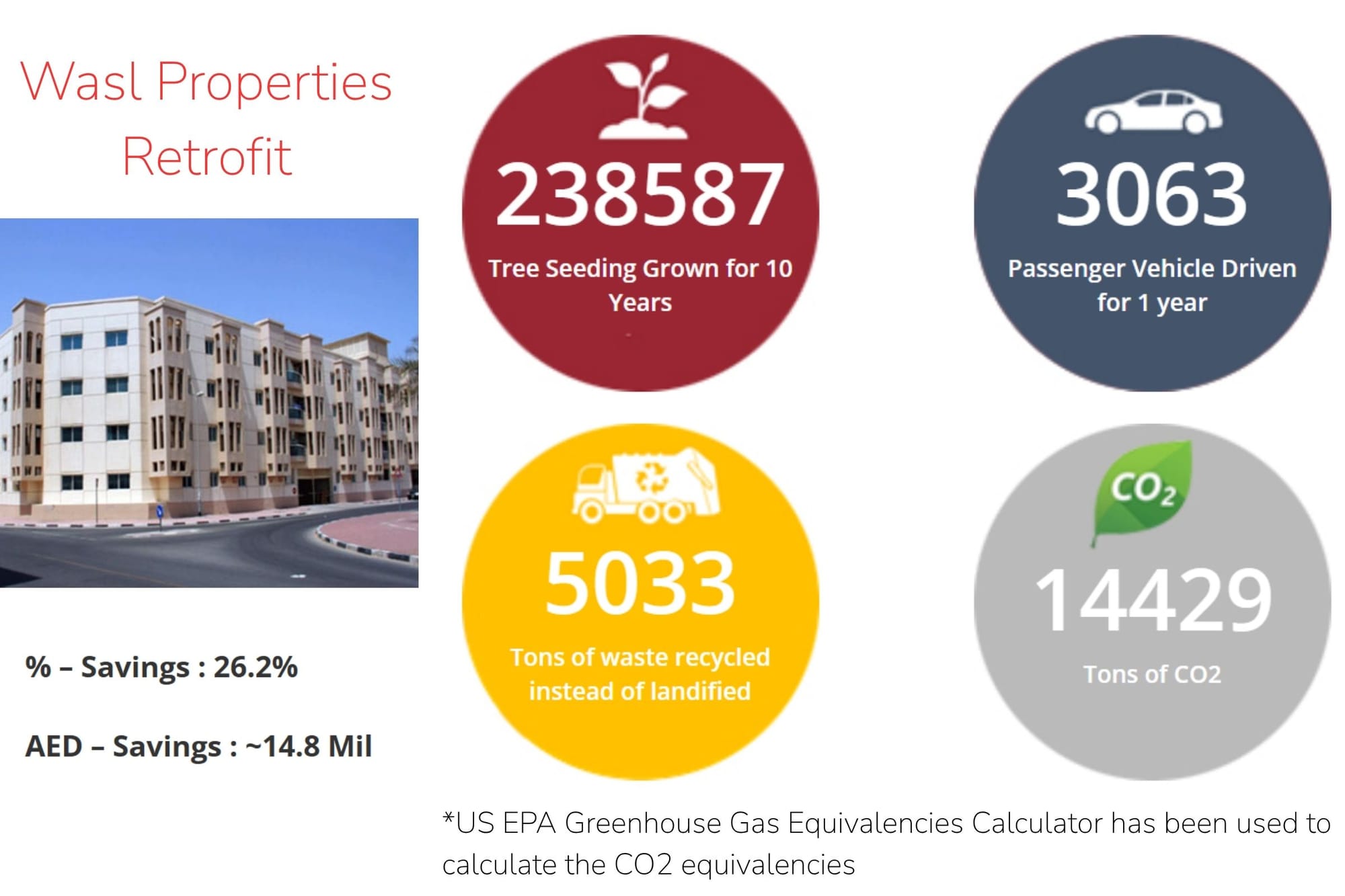
- Wasl Properties Transformation: One of the region's largest retrofitting partnerships between Etihad ESCO and Wasl Properties covers hundreds of properties. By combining digital monitoring, smart controls, solar integration, and an AI-powered Command and Control Centre, the project delivers massive annual utility reductions.
- Dubai Airports Retrofit Program: In a massive effort to support UAE Net Zero goals, Etihad ESCO collaborated with Dubai Airports to upgrade lighting, water fixtures, and cooling control systems across terminal facilities at DXB and DWC, cutting millions of kilowatt-hours in operational waste.
- DEWA Facilities Overhaul: DEWA’s own headquarters and administrative facilities underwent comprehensive retrofits. Upgrading chilled water systems and installing advanced magnetic-bearing chillers generated over 35 gigawatt-hours in electricity savings and significantly cut carbon emissions.
What Retrofits Mean for Landlords and Tenants
While cutting carbon emissions is a vital public objective, the widespread adoption of AI building retrofits is driven primarily by strong financial return on investment.
Because utility expenses represent one of the largest ongoing costs for commercial real estate, cutting HVAC energy consumption by a third yields immediate financial returns. Most projects utilize Energy Performance Contracting, meaning the installation cost is paid back directly out of guaranteed energy savings over time, minimizing upfront risk for property owners.
Furthermore, running chillers at constant full power causes rapid mechanical degradation and costly breakdowns. AI-driven modulation ensures machinery operates smoothly within its optimal efficiency curve, significantly extending the working lifespan of major capital assets.
Smart building software also continuously monitors air quality and humidity. For corporate tenants with strict ESG (Environmental, Social, and Governance) targets, leasing office space in an AI-retrofitted tower offers an immediate, verifiable way to reduce their corporate carbon footprint.
Buildings as Active Power Grid Partners
As AI software and smart grid connectivity continue to evolve, Dubai’s retrofitted skyscrapers will do more than just passively save power—they will actively balance the city's energy grid.
Through real-time communication with DEWA's smart grid, entire commercial districts will soon participate in automated demand-response programs. During peak summer electricity demand, hundreds of smart towers can collectively scale back non-essential cooling by 5% for thirty minutes, instantly easing pressure on the power grid without human occupants ever noticing a temperature change.
By combining artificial intelligence with a practical, hardware-friendly retrofit model, Dubai is demonstrating how existing mega-cities can adapt to modern climate realities. Teaching older glass towers to think is proving that the fastest route to a sustainable urban future lies in making existing infrastructure infinitely smarter.
Also Read:
 Shahba Mayyeri
 Ummulkiram Pardawala
 Umema Arsiwala
 Shahba Mayyeri