
A completed project and a sent invoice do not guarantee timely payment. Often, the delay has nothing to do with the client's satisfaction or intent to pay. It comes down to timing: the approver is on leave, the auto-reply says a return date is weeks away, and the payment simply sits unprocessed until someone is back at their desk.
This can happen at any point in the year. In the UAE, it shows up most often around the summer holiday season, but it also shows up around year-end closures, religious holidays, school breaks, and any stretch when a client's finance team runs light. Corporate approval chains that normally take three days can stretch into three weeks the moment a signatory steps away. For a solo consultant, freelancer, or founder still running the business alone, one delayed client is an inconvenience.
The real danger shows up when it is not one client but several at once, because a smaller business with only a handful of active accounts often has no room for two or three of them to freeze in the same stretch. Rent is still due. Your own monthly draw still needs to cover personal expenses. Suppliers and software subscriptions still expect payment, and none of that pauses just because the money owed to you has.
This guide is written for people running their business without a team yet, whether that is a freelancer, a solo consultant, or a founder still doing every job themselves. It covers how to prepare before a client disappears on leave, what to actually do the moment you realize a payment is stuck, and how to keep your own cash flow moving even in the worst case, where every invoice you are owed goes quiet in the same stretch. None of this requires hiring anyone or waiting on someone else to act. It requires a system a single person can run in a couple of hours a month.
Understanding the Mechanics of a Payment Freeze
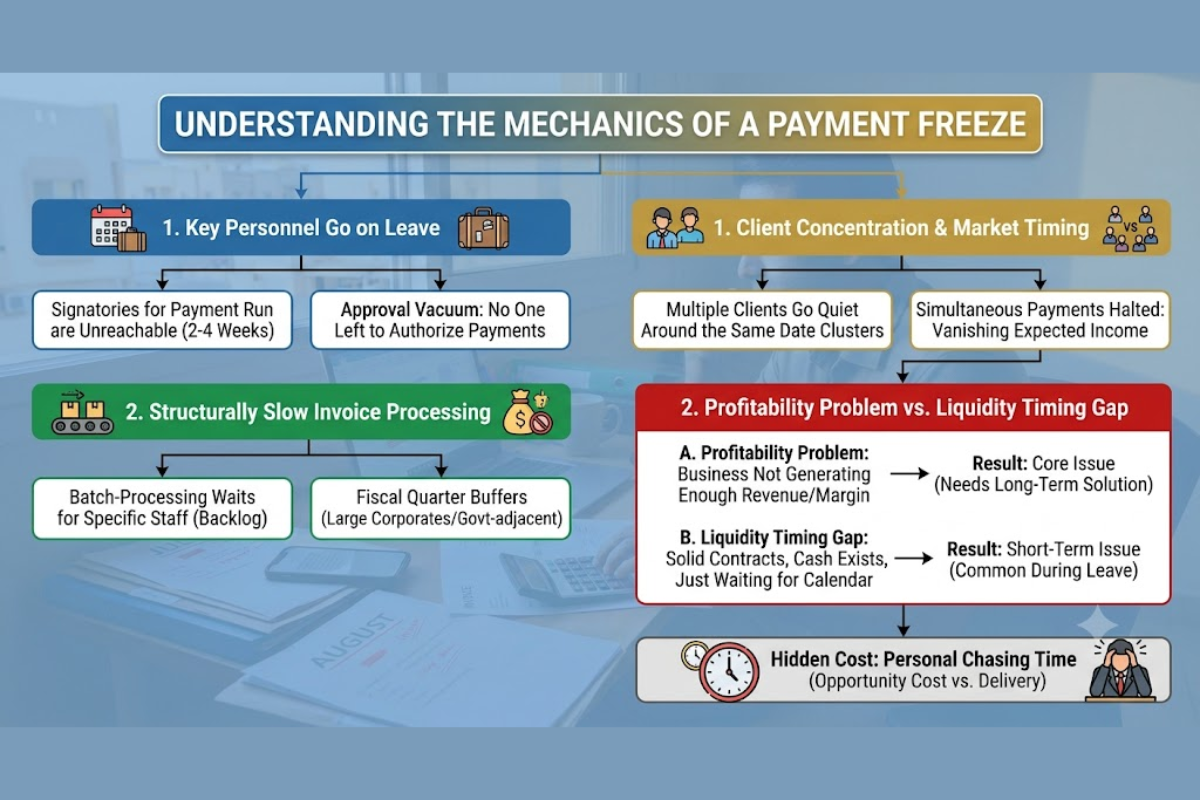
To fix a problem, it helps to understand exactly why it happens. In the UAE and across the wider Gulf, a handful of factors combine whenever a large share of the market goes on leave at the same time, whether that is a summer stretch, a year-end closure, or a public holiday cluster.
Leave tends to concentrate around known dates. Many finance controllers, procurement managers, and business owners plan their annual leave around school breaks or public holiday clusters, since families with children in the local education system travel together during these windows. That means the person whose signature you need on a payment run can be unreachable for two to four weeks at a stretch, and there is rarely anyone left behind who feels empowered to approve a payment in their absence.
Invoice processing also slows structurally, separate from any single person being away. Accounts payable teams frequently run in batches, and if the person responsible for entering an invoice into the system is out, that invoice simply waits its turn rather than getting escalated. Larger corporates and government-adjacent entities in particular tend to build in fiscal quarter buffers, holding non-urgent payments until a new quarter opens or until a backlog clears once staff returns.
Here is what makes any leave-driven slowdown especially dangerous for a business run by one person: concentration. A small agency with thirty clients barely notices if two of them pay late, because the other twenty-eight keep cash moving. A solo consultant with four active clients has no such cushion. If two of those four clients happen to go quiet in the same window, which is common whenever several companies close for leave around the same dates, half your expected income vanishes at once. This is not a sign anything is wrong with your business. It is simple math working against a concentrated client base during a period when several finance contacts step away together.
It is worth separating two very different problems here, because they need different solutions. A profitability problem means your business is not generating enough revenue or margin to cover its costs, full stop. A liquidity timing gap means the revenue exists, and the contracts are solid, but the cash from that revenue simply has not arrived yet because of the calendar. A leave-driven freeze almost always creates the second problem, not the first, and confusing the two leads owners to make panicked decisions, like discounting future work or turning down projects, when what they actually need is a short-term bridge.
There is also a hidden cost that rarely shows up on a balance sheet: the time you personally spend chasing late payments. Every hour spent drafting follow-up emails, calling clients, and manually tracking who owes what is an hour not spent on delivery or bringing in new business. When you are the only person doing both jobs, that tradeoff is direct and immediate.
Preparing Before a Client Goes Quiet
The single biggest lever you have is timing, and timing decisions need to happen well before a slowdown starts, ideally before you know which client is about to go on leave.
Step 1: Early invoicing strategies
For retainer clients or projects with monthly milestones, shift your billing cycle so invoices go out in the first week of the month rather than the last, and issue an invoice slightly early whenever you know a client's office will be closing soon, before their finance contact leaves. For project-based work with deliverables landing near a known slow stretch, structure milestone payments so a portion is invoiced on contract signature or project kickoff rather than only at final delivery. Getting money in the door before people leave is far more effective than trying to collect it while they are gone.
Step 2: Ask directly who covers approvals while your contact is away
As soon as you know a client's finance contact is heading into leave, find out who covers this in their absence. A short, friendly email asking "who should I loop in while you're out, so nothing gets delayed on our end" does two things: it signals professionalism, and it gives you a legitimate second contact to follow up with later without it feeling like you are going over anyone's head.
Step 3: Setting up automated, polite payment reminders
Schedule reminder emails to go out a few days before an invoice is due, on the due date, and a short interval after, rather than relying on memory to send these manually while everything else on your plate competes for attention. Keep the tone neutral and factual rather than apologetic or aggressive. A simple structure works well: reference the invoice number, the amount, the due date, and a direct request to confirm payment status.
Step 4: Offering modest early-payment discounts rather than enforcing penalties
A small discount, often in the range of one to two percent, for payment within a shorter window tends to land better with clients than the threat of late fees, and it costs you far less than the alternative of chasing a payment for six weeks. The UAE's Commercial Transactions Law does allow parties to agree contractually on late payment charges, but enforcing them against a client relationship you want to keep is usually a last resort rather than a first move. Reserve that clause for genuinely unresponsive accounts, not for clients who are simply slow because their office is short-staffed.
What to Do the Moment a Payment Gets Stuck
Once you know a specific invoice is stuck, or worse, once you realize several are stuck at the same time, the priority shifts from prevention to triage.
Tactic 1: Rank your own bills by what actually cannot wait
Rent, your own essential living costs, and any statutory obligations sit at the top of the list and should never be delayed if it can be avoided. Below that, look at which supplier or subscription payments have flexibility. A quick, honest conversation with a vendor about a two-week extension is almost always better received than a payment that simply arrives late without warning.
Tactic 2: Use the backup contact, and keep the tone calm
When your main contact is away, reach out to the backup you identified earlier. Keep messages short: state the invoice details, ask for confirmation of payment status, and offer to resend documents if anything was misplaced. A calm, factual tone works better than urgency, since the person reading it usually did not create the delay and is more likely to help if the message reads as routine rather than alarmed.
Tactic 3: If two or more payments freeze at once, treat it as a single liquidity event, not a series of individual late invoices
This is the scenario that catches solo owners off guard the most, because each late payment on its own feels manageable, but two or three together can wipe out a stretch of expected income in one stroke. The moment you notice this pattern, stop waiting client by client and look at your total confirmed receivables against your total upcoming obligations for the next four to six weeks. This single view tells you whether you are looking at a minor delay or a genuine cash gap that needs a bridge.
Tactic 4: Use short-term liquidity tools deliberately, against invoices you are confident will eventually be paid
Invoice factoring or invoice discounting, where a third party advances you a percentage of an outstanding invoice's value for a fee, exists specifically for this situation. Revolving credit facilities and merchant cash advances offered by UAE banks and fintech lenders serve a similar purpose, and several regional providers now specialize in short-term working capital for freelancers and small business owners, with faster approval timelines than a traditional bank overdraft.
These tools work best as a bridge against invoices tied to real, confirmed contracts, not as a permanent substitute for collecting on time. Read the fee structure carefully, since factoring fees can add up quickly if a client's payment stretches longer than expected.
Tactic 5: Ask your own suppliers for a temporary extension, in writing
Just as you might extend grace to a client whose finance team is short-staffed, ask your own vendors and software providers for a short delay if you need one. Most vendors who have an ongoing relationship with you would rather agree to a brief extension with clear communication than be surprised by a missed payment. Put the new date in writing so both sides have the same expectation.
Managing Cash Reserves When You Are the Only Safety Net
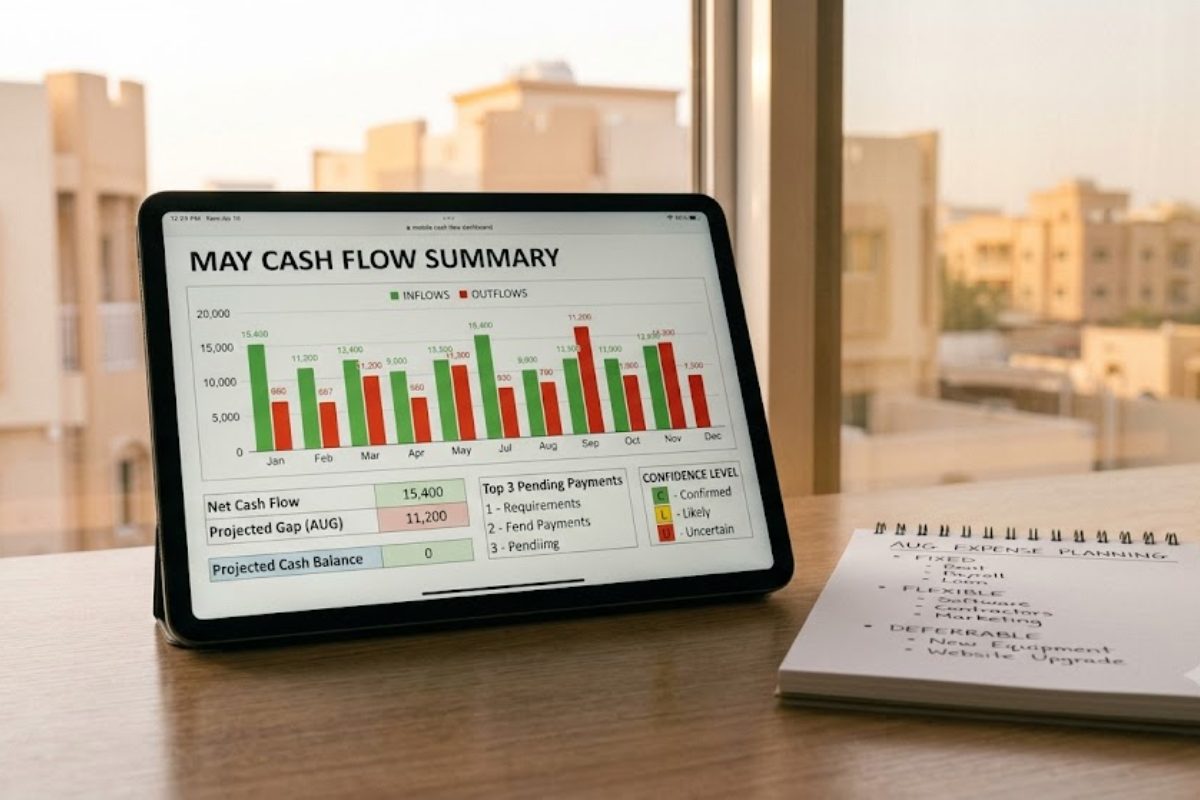
The owners who handle a stuck payment, or several at once, without panic almost always have one thing in common: they saw the gap coming weeks in advance, because they were tracking cash flow on a rolling basis rather than checking the bank balance reactively.
A rolling 13-week cash flow forecast is the standard tool for this, and it works just as well for a one-person business as it does for a larger one. Each week, list expected inflows against expected outflows and update the picture as it changes. This horizon is long enough to spot a shortfall 30 days ahead, giving you time to negotiate, borrow, or adjust before the gap becomes an emergency, but short enough to stay accurate rather than becoming a guessing exercise.
A simple spreadsheet is enough to start; the discipline of updating it every week matters far more than the sophistication of the tool. Mark each expected inflow with a confidence level, such as confirmed, likely, or uncertain, so a quick glance tells you how much of your projected cash is actually secure versus optimistic, and pay particular attention to any stretch where two or more clients share a similarly uncertain payment date.
It helps to categorize your expenses into three buckets. Fixed core essentials include rent, your own minimum living costs, and any statutory payments; these are non-negotiable and should be protected first. Flexible operational costs include things like software subscriptions and non-essential contractor work; these can often be paused or reduced for a stretch without lasting damage. Deferrable capital investments include new equipment purchases or expansion spending; these should be the first items paused the moment a cash gap appears.
Separating your personal draw from an emergency operational buffer deserves particular attention when you are the sole income source for the business. It is tempting to treat your own pay as the first thing to cut when cash gets tight, and to some degree that flexibility is useful, but an emergency buffer sized to cover at least one full month of fixed core essentials should exist as a protected account you do not touch even when your own compensation shrinks during a tight stretch. Keeping these separate prevents a short-term personal sacrifice from quietly becoming your only cash flow strategy.
Recovery & Building a System That Holds Up Next Time
Once inboxes clear and payment approvals resume, re-engage promptly but without friction. A short, warm note referencing the outstanding item, rather than a demand, tends to get faster results, since most clients genuinely intend to settle and simply need the reminder placed back in front of them.
This is also the right moment to review your billing terms. Look at any contract that caused friction this cycle and consider adding clearer payment milestone triggers tied to specific dates or deliverables rather than vague monthly terms. If a client consistently pays late around the same time each year, adjust their contract specifically, such as requiring a portion of payment upfront for work delivered near their known slow periods.
Longer term, two habits protect you far more than any single tactic. Diversify your client base gradually so no single client, or two clients with overlapping payment cycles, can freeze a large share of your income at once. And build a dedicated three-month operational cash cushion over the course of the following year, separate from day-to-day working capital, specifically to absorb the predictable timing gaps that come with any client's leave schedule, so a slow payment cycle stops being an emergency and becomes a routine, manageable event.
A client's payment going quiet while they are on leave is not a mystery, and it can happen in any month, holiday season or otherwise. It does not require a team to manage. It rewards anticipation: invoicing early, confirming backup contacts, and setting reminders before a client disappears. It rewards clear communication: calm, direct follow-ups, and honest conversations with your own vendors when you need flexibility. It rewards disciplined cash management: a rolling forecast that gives you weeks of warning, clear expense categories that tell you what to protect and what to pause, and a buffer that keeps your own income separate from the business's survival.
None of this stops a client's finance team from taking time off. It gives you the tools to move through that stretch calmly, keep your obligations covered even if every invoice you are owed goes quiet at the same time, and come out the other side with your business and your client relationships intact.
Also read:
 Shahba Mayyeri
 Umema Arsiwala
 Shahba Mayyeri