
Leadership today operates under a set of demands that did not exist a generation ago. Teams are more diverse, more distributed, and more vocal about what they expect from the people who manage them. Talent moves quickly between employers, and organizations that fail to retain skilled people pay a real cost in lost knowledge, disrupted projects, and rehiring expenses. Fast-moving business environments, particularly those built around ambitious growth targets and global talent pools, place additional pressure on leaders to move quickly while still keeping their people engaged and supported.
This combination of speed and human sensitivity has pushed a new leadership discipline into focus: Wise Empathy. Wise Empathy is a deliberate practice that combines emotional understanding with clear boundaries, sound judgment, and personal accountability. A leader who practices Wise Empathy connects genuinely with the people on their team, understands what they are experiencing, and still makes the decisions the business requires, even when those decisions are uncomfortable.
This article explains why ordinary empathy, on its own, often falls short in a leadership context. It defines what Wise Empathy actually means in practice, outlines the research behind it, and provides a concrete framework leaders can use to build it into their daily habits.
The stakes for getting this right are particularly high in fast-growing, highly international business hubs, where workforces bring together dozens of nationalities, working styles, and expectations under a single roof. In these environments, execution speed rarely slows down to accommodate a leader's emotional discomfort. Deadlines, client commitments, and market pressure continue regardless of how a leader is feeling on a given day. At the same time, competition for skilled talent is intense, and people who feel unseen or unsupported can move to a competitor with little friction. Leaders operating under these conditions cannot afford to choose between being fast and being humane. Wise Empathy exists precisely to remove that false choice.
The Distinction Between Pure Empathy and Wise Empathy
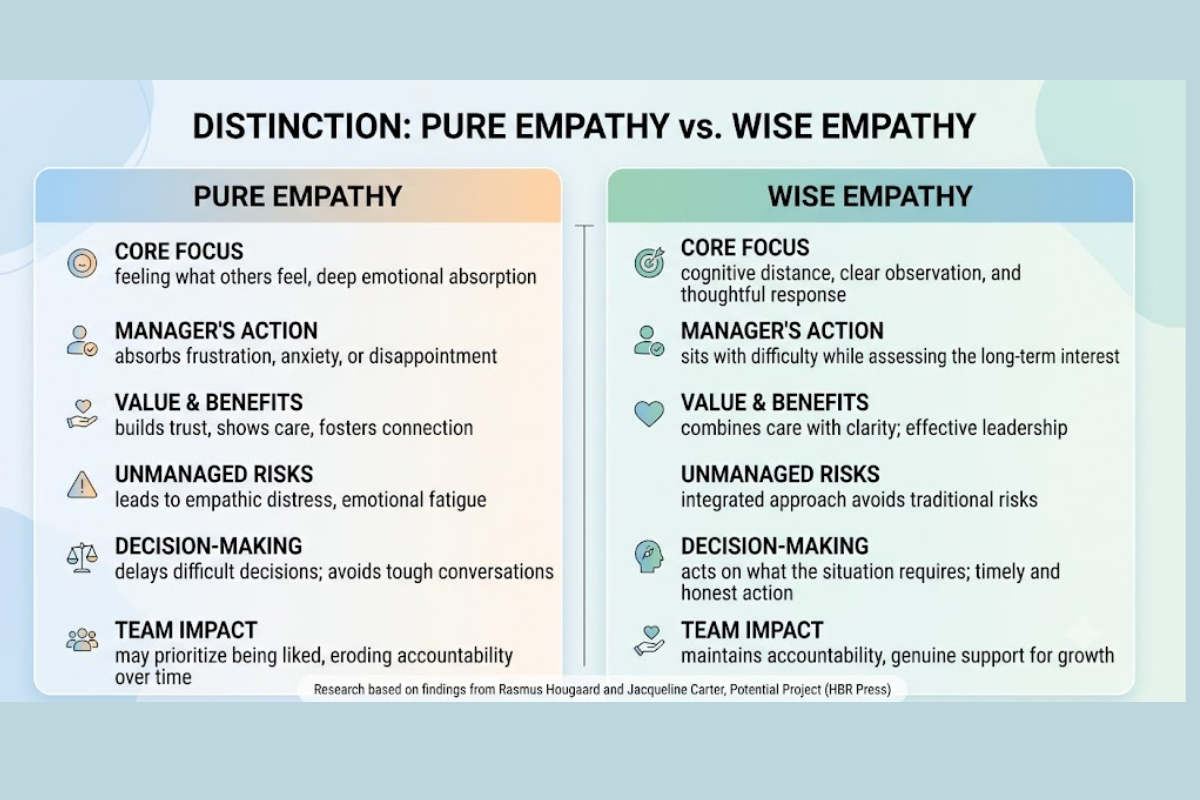
Pure empathy is the capacity to feel what another person feels. A manager who practices pure empathy absorbs the frustration of a struggling employee, the anxiety of a team facing layoffs, or the disappointment of a colleague passed over for promotion. This capacity for shared feeling is valuable. It builds trust, signals that a leader genuinely cares, and creates the kind of connection that makes people want to stay on a team.
Left unmanaged, pure empathy carries real costs. A leader who continuously absorbs the emotional states of others experiences what researchers describe as empathic distress. This state drains mental and emotional energy over time. It can delay necessary but difficult decisions, because a leader who feels a team member's disappointment too acutely may avoid the conversation that would actually help that person improve. It can also produce operational paralysis, where a leader becomes so focused on protecting feelings that clear direction and accountability disappear.
Rasmus Hougaard and Jacqueline Carter, whose research has been published through Harvard Business Review Press, studied this pattern extensively through their work at Potential Project. Their findings describe a group of leaders who prioritize being liked over being effective. These leaders often soften feedback until its meaning is lost, delay difficult conversations for months, or avoid holding people accountable because doing so feels unkind in the moment. The research found that this pattern quietly erodes trust over time. Teams notice the gap between what a leader says in private and what that leader is actually willing to enforce, and that gap costs more credibility than an honest, timely conversation ever would.
Wise Empathy offers a different path. It retains the emotional attunement that makes pure empathy valuable, while adding what researchers call cognitive distance: the ability to observe a situation clearly, assess it on its own merits, and respond in a way that serves the long-term interest of both the individual and the organization. A leader practicing Wise Empathy can sit with someone's difficulty, take it seriously, and still act on what the situation genuinely requires. Care and clarity operate together as a single, integrated practice.
Why Wise Empathy Driven Leadership Works
The logic behind Wise Empathy is supported by both organizational research and simple operational reality.
It protects leader capacity and mental clarity
Continuous emotional absorption is exhausting. Leaders who operate this way for extended periods report reduced bandwidth for the complex judgment calls their roles demand. By maintaining a degree of separation between their own emotional state and the emotional states of others, leaders preserve the mental clarity needed to weigh trade-offs, plan strategically, and make sound decisions under pressure.
It prevents emotional contagion while maintaining genuine connection
Emotional contagion describes the tendency for a leader's stress, or a team's anxiety, to spread unchecked through an organization. A leader who regulates their own emotional response, while remaining fully present and attentive to others, provides a stabilizing presence for the wider team. People take emotional cues from the person in charge. A grounded leader tends to produce a more grounded, more focused team, even during periods of real pressure.
It establishes psychological safety alongside high performance standards
Psychological safety, a concept documented extensively in organizational behavior research including the work of Amy Edmondson at Harvard Business School, describes an environment where people feel safe raising concerns, admitting mistakes, and offering dissenting opinions without fear of punishment. Wise Empathy supports this environment because it signals genuine care alongside genuine standards.
Team members learn that honesty is welcomed and that performance expectations remain firm regardless. This pairing of care and clarity has been linked in leadership research to stronger engagement, better retention outcomes, and teams that recover more quickly after setbacks.
The Core Pillars of Wise Empathy
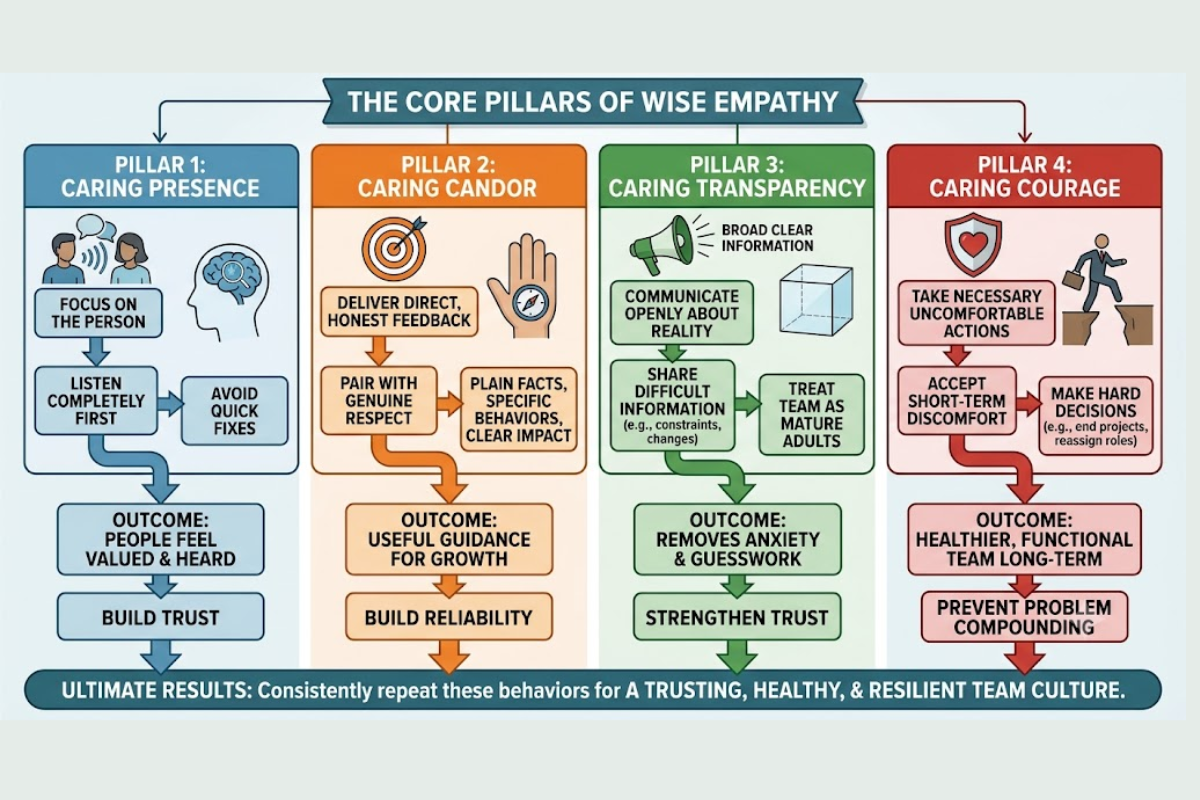
Wise Empathy rests on four practical pillars. Each one describes a specific behavior a leader can develop and repeat consistently.
Pillar 1: Caring Presence
Caring presence means giving full attention to a person without immediately jumping to solve their problem. Many leaders, acting out of good intentions, interrupt a difficult conversation with quick fixes or reassurances before they fully understand the issue. This habit can shut down honest disclosure, because the person speaking senses that their concern is being managed instead of genuinely understood.
Caring presence asks a leader to listen completely first, understand the actual issue at hand, and only then decide whether action is needed. This single pillar builds a significant amount of trust, because people consistently report feeling heard as a distinct and valued experience.
Pillar 2: Caring Candor
Caring candor is the practice of delivering direct, honest feedback with genuine respect for the person receiving it. Leaders who practice caring candor state facts plainly, connect those facts to specific behaviors, and explain the impact clearly and without exaggeration. They pair this directness with respect for the individual's effort and dignity, so the feedback lands as useful guidance.
This pillar requires courage, since vague or overly gentle feedback is often easier to deliver in the short term. Over time, caring candor builds a reputation for reliability: people learn that a leader's praise is meaningful because their criticism is honest.
Pillar 3: Caring Transparency
Caring transparency involves communicating openly about organizational reality, including reality that is difficult or unwelcome. This includes budget constraints, restructuring decisions, performance concerns, or shifts in strategic direction. Leaders who avoid transparency, hoping to protect morale, often create more anxiety than they prevent, because people fill information gaps with speculation.
Caring transparency treats team members as capable adults who deserve accurate information, delivered with clear intent and appropriate context. This pillar strengthens trust because it removes the guesswork that so often damages team morale.
Pillar 4: Caring Courage
Caring courage is the willingness to take necessary but uncomfortable actions for the long-term health of a person or a team. This includes ending a project that is not working, reassigning a role that does not fit an employee's strengths, or having a hard conversation about performance that has not improved. Leaders who lack caring courage often delay these actions indefinitely, allowing problems to compound. Caring courage requires accepting short-term discomfort in exchange for a healthier, more functional team over time.
Practical Framework: How Leaders Can Practice Wise Empathy
Wise Empathy is a skill built through repeated practice. The following five steps offer a concrete starting framework.
Step 1: Take an emotional step back during high-stress interactions. When a conversation becomes emotionally charged, pause before responding. This might mean taking a breath, asking a clarifying question, or simply slowing the pace of the exchange. This brief pause creates the cognitive distance needed to respond thoughtfully, avoiding a reaction driven purely by shared distress.
Step 2: Ask clarifying questions instead of making assumptions. Questions such as "What support do you need right now?" or "What would be most helpful from me in this situation?" shift a conversation away from assumption and toward accurate understanding. Leaders often assume they know what a struggling team member needs, when in fact a direct question produces a more accurate and often simpler answer.
Step 3: Coach team members toward solutions without carrying their workload. When someone brings a problem, the immediate instinct for many leaders is to solve it directly. Wise Empathy asks leaders to coach instead: asking guiding questions, offering relevant context, and letting the team member arrive at their own solution wherever possible. This builds long-term capability across the team and prevents leaders from becoming a bottleneck for every difficult decision.
Step 4: Establish transparent expectations and accountability frameworks. Clear expectations, documented and communicated consistently, remove ambiguity about what success looks like. When expectations are transparent from the start, accountability conversations become far less personal and far more constructive, since they refer back to agreed standards and remove any element of surprise.
Step 5: Prioritize personal resilience and boundaries to prevent burnout. Leaders cannot sustain Wise Empathy if their own emotional reserves are depleted. This step includes setting limits on availability outside working hours, building recovery time into demanding weeks, and seeking support from peers, mentors, or professional coaches. A leader who protects their own capacity is far better positioned to extend genuine care to others over the long term.
Organizational Impact
The impact of Wise Empathy shows up in measurable ways across an organization. Retention improves when employees experience consistent honesty paired with genuine support, since people are less likely to leave environments where they feel both valued and clearly informed. Trust across teams strengthens when leaders demonstrate that care and accountability can coexist, removing the suspicion that kindness is simply a way of avoiding hard conversations. Operational focus increases as well, because teams spend less time managing uncertainty and speculation, and more time executing against clear priorities.
Organizations operating in fast-growing, highly diverse business environments benefit particularly from this approach. Talent pools drawn from many different backgrounds and expectations require leaders who can connect authentically across cultural lines while maintaining consistent standards for everyone. Wise Empathy provides exactly this balance: authentic connection paired with fair, transparent, and firmly applied expectations.
Measurable indicators of this shift tend to appear within a few review cycles. Exit interviews cite fewer complaints about inconsistent treatment or unclear expectations. Engagement surveys show higher scores on questions related to trust in leadership and clarity of direction, two metrics that often move together once caring candor becomes a consistent practice. Internal mobility also tends to increase, since employees who trust their leaders' honesty are more willing to raise their hands for stretch assignments, knowing that feedback along the way will be direct, constructive, and grounded in specific facts.
None of this requires a dramatic cultural overhaul. Small, consistent behaviors, repeated across hundreds of everyday interactions, accumulate into a leadership reputation that either supports retention or undermines it. A single difficult conversation handled with care and honesty rarely damages trust. A pattern of avoided conversations, unclear expectations, and inconsistent standards does far more lasting harm, even when each individual instance seemed minor at the time.
Wise Empathy asks leaders to hold two commitments at once: genuine care for the people they lead, and genuine responsibility for the outcomes their organizations need. Pure empathy alone risks leadership fatigue, delayed decisions, and a slow erosion of trust when standards quietly slip. Wise Empathy, built on caring presence, caring candor, caring transparency, and caring courage, offers a sustainable alternative.
Leaders who practice this discipline build teams that trust them precisely because that trust is earned through consistency. They protect their own mental clarity, model emotional stability for the people around them, and create the kind of psychological safety that allows honest performance conversations to happen without damaging relationships. Embedding these habits into daily leadership practice takes deliberate effort, but the result is a team culture built on both genuine care and genuine accountability, capable of sustaining high performance over the long term.
Also read:
 Shahba Mayyeri
 Umema Arsiwala
 Ummulkiram Pardawala