A grounded guide for founders weighing debt against dilution in Dubai's current market.
Sit in any co-working space in DIFC on a Tuesday morning, and you will overhear some version of the same conversation. A founder, somewhere between their second and third year of operation, is trying to figure out how to fund the next stage of growth. The business is working. Revenue is real. But the gap between where the company is and where it needs to go requires capital, and the question of where to get it is not a simple one.
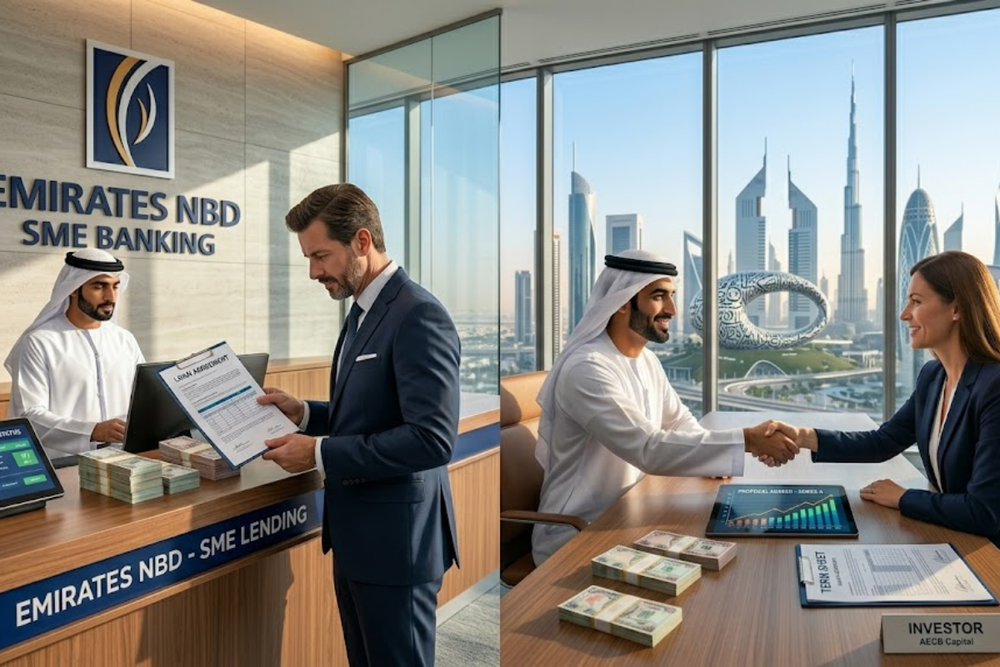
Two paths sit clearly on the table. The first is a business loan: structured, repayable, and leaving ownership entirely intact. The second is an equity partner: no monthly repayments, but a permanent share of the business and a seat at the decision-making table.
Both paths are legitimate. Both carry real consequences. The right one depends entirely on the specific situation of the founder making the choice. This article walks through what each path actually involves practically, financially, and personally, so that the decision is made with clarity rather than pressure.
The Business Loan: What You Are Actually Signing Up For
A business loan is a contractual commitment. The bank provides capital today, and the business repays that capital with interest over a fixed period. The ownership structure of the business does not change. The founder retains full control. The lender has no say in strategy, hiring, pricing, or direction.
In the UAE in 2026, the lending landscape for SMEs is more accessible than it has ever been. Emirates NBD offers small business loans of up to AED 300,000 for up to 36 months, with a merchant loan product tied to POS terminal turnover that can reach up to AED 5 million. For businesses with serious growth ambitions, the Dubai International Growth Initiative provides facilities of up to AED 15 million at competitive rates tied to EIBOR, specifically designed for Dubai-founded SMEs targeting international expansion.
Digital-first options have also matured considerably. Wio Bank, a UAE-based app-driven business bank, offers SME loans of up to AED 3 million with a fully digital application process. For retail and e-commerce businesses with consistent card transaction volumes, Wio's model of using sales data to inform lending decisions has made approval timelines significantly faster than traditional banking routes.
For Emirati entrepreneurs, the Dubai SME Fund offers interest-free loans, a meaningful option worth exploring before approaching commercial lenders.
What the loan demands in return is straightforward but non-negotiable: consistent cash flow. Every month, regardless of how the business is performing, the repayment goes out. A strong month does not reduce next month's obligation. A slow quarter does not pause the schedule. This is why lenders look carefully at your AECB score, the Al Etihad Credit Bureau rating that reflects your credit history in the UAE. A healthy AECB score signals to a bank that your business manages its obligations reliably. Walking into a loan conversation with a poor credit record, or with cash flow that is inconsistent month to month, will either block access or result in less favourable terms.
The discipline that a loan demands is also, for many founders, one of its most useful features. A fixed repayment structure forces financial rigour. It requires the business to generate enough revenue to service the debt, which tends to keep operational focus sharp.
The Human Weight of Debt
There is a side of business loans that financial models do not capture. Debt has a psychological cost.
Knowing that a repayment is due on the 15th of every month, regardless of what happened in the business that week, creates a specific kind of pressure. For some founders, that pressure is motivating. It sharpens decision-making and keeps the team focused on revenue. For others, it becomes a source of chronic stress that affects both the quality of their leadership and their personal well-being.
This is not a reason to avoid loans. It is a reason to be honest with yourself before you take one. A loan taken at a size the business can comfortably service, with clear visibility on repayment capacity, is a manageable commitment. A loan taken under optimistic revenue assumptions, in a business with volatile cash flow, is a different situation entirely.
The question to ask before signing is not just "can we afford this?" — it is "can we afford this in a bad month?"
The Equity Partner: What You Are Actually Giving Away

Bringing in an equity partner means selling a portion of the business in exchange for capital and, in most cases, involvement. The partner does not receive monthly repayments. Their return comes when the business grows in value: through dividends, a future sale, or an exit event. This makes equity capital "patient" in a way that bank debt is not. There is no fixed repayment date, creating monthly pressure on cash flow.
In Dubai's current investor environment, the equity landscape is active but selective. By 2026, the UAE's VC and angel investment market is estimated at $1.5–2 billion annually, making it the largest in the MENA region, with Dubai accounting for nearly 60% of deals. However, that capital is not evenly distributed. It flows toward specific sectors, fintech, SaaS, logistics, and enterprise technology, and toward businesses that can demonstrate clear traction, a scalable model, and a credible path to significant growth.
Dubai's ecosystem remains heavily relationship-driven. Deals are mainly driven by in-person meetings, warm introductions, and repeat interactions across the community. For an SME founder approaching angel investors or early-stage VCs, the quality of the introduction often determines access more than the quality of the pitch deck.
Individual angels in Dubai typically invest between $25,000 and $200,000 USD. What they look for alongside the financials is what the local market calls "founder-market fit," evidence that the person running the business has a deep, specific understanding of the problem they are solving and the market they are operating in. A founder who can speak fluently about their customer, their unit economics, and their competitive position carries far more credibility in these conversations than one who leads with projections and enthusiasm.
Active networks worth knowing include Dubai Angel Investors (DAI) and Womena Angels. For founders at the growth stage, funds like BECO Capital, Wamda Capital, and Nuwa Capital are among the more accessible institutional options. The Dubai Chamber's network also remains a relevant connector for introductions into the investor community, particularly for businesses in trade, services, and the broader economy.
The Human Weight of a Partner
Equity investors are not passive. They hold a stake in the outcome of your business, and most active investors, particularly angel investors who bring sector experience, will expect visibility into how that business is being run.
This takes different forms depending on the agreement. Some investors take a board seat. Others require regular reporting. Many expect to be consulted on significant decisions, such as new hires at the senior level, major contracts, and pivots in strategy. Investors in Dubai typically expect holding periods of 7–10 years rather than the 3–5 years common in more mature markets. This is a long relationship. The person you bring in as an equity partner in 2026 may still hold a meaningful stake in your business in 2033.
The pressure this creates is different from debt pressure. It is not financial in the short term, and there is no monthly repayment creating urgency. It is relational and strategic. You now have someone who has a legitimate claim on your decisions, your transparency, and your direction. In the best cases, that relationship adds real value. A well-networked investor who opens doors, challenges assumptions, and brings operating experience can accelerate a business meaningfully. In difficult cases, misalignment on direction, pace, or values creates friction that is harder to resolve than a financial problem.
Choosing an equity partner is, in many ways, more like choosing a business partner than a lender. The capital is one element. The person behind it matters just as much.
What the Dubai Market Is Telling Founders Right Now
Interest rates in the UAE have stabilised in 2026, but they remain a real factor in loan affordability. Businesses that can demonstrate two or more years of consistent revenue and a solid AECB score are in a reasonable position to access lending at manageable rates. Those with shorter track records or irregular cash flow will find terms less favourable and access more limited.
On the equity side, the market is active but not indiscriminate. Early-stage funding dominates deal volume in Dubai, while Series A and B rounds are growing as more startups mature locally. The VC and angel community is increasingly focused on businesses with demonstrated revenue rather than pure concept plays. A founder approaching investors in 2026 with AED 1–2 million in annual revenue and clear growth indicators is in a stronger position than one arriving with projections and an idea.
Both paths reward preparation. A loan application built on clean financials, a healthy credit score, and a clear repayment model is processed faster and on better terms. An equity conversation supported by audited accounts, a clear cap table, and evidence of traction moves faster and attracts more credible investors.
Asking the Right Question Before You Decide
The capital decision is ultimately a question about what kind of business life you want to lead.
A loan preserves independence. Every decision, every strategic call, every hire, and every pivot remains entirely yours. The obligation is financial and time-limited. Once the loan is repaid, it is finished.
An equity partner changes the nature of the business permanently. Even after a potential buyout, the history of that partnership, the governance structures, the reporting habits, and the shared decision-making shape how the company operates.
Before sitting down with a bank or an investor, it is worth spending time with a more personal set of questions. How consistent is your cash flow, honestly? How comfortable are you sharing strategic control? Do you need the capital alone, or do you genuinely need the expertise and network that a strong equity partner brings? Is this a temporary gap or a structural one?
The Dubai Chamber's advisory services and the Dubai SME support network exist precisely for these conversations, not just to facilitate applications, but to help founders think through the implications before committing to either path.
There is no universally correct answer between a loan and an equity partner. Both are tools. Both serve legitimate purposes. Both carry costs that go beyond the financial terms on paper.
A loan asks for consistent cash flow and repays you with complete independence. An equity partner asks for a share of your business and repays you with patient capital, and in the best cases, genuine strategic support.
The question worth sitting with is not which option looks better on a spreadsheet. It is the structure that allows you to build the company you actually want to run and sustain it over the long term without the terms of your capital becoming the defining pressure of your working life.
Get that answer right, and the financial decision tends to follow.
Also read:
 Ummulkiram Pardawala
 Shahba Mayyeri
 Umema Arsiwala