Growing fresh, crisp produce in the middle of an arid desert environment historically sounded like a logistical impossibility. For decades, Dubai relied heavily on global supply chains to import nearly 85% of its food. Crisp lettuces, kale, and microgreens travelled thousands of miles by cargo plane from Europe or North America, losing freshness and incurring heavy carbon transport costs before reaching local grocery shelves.
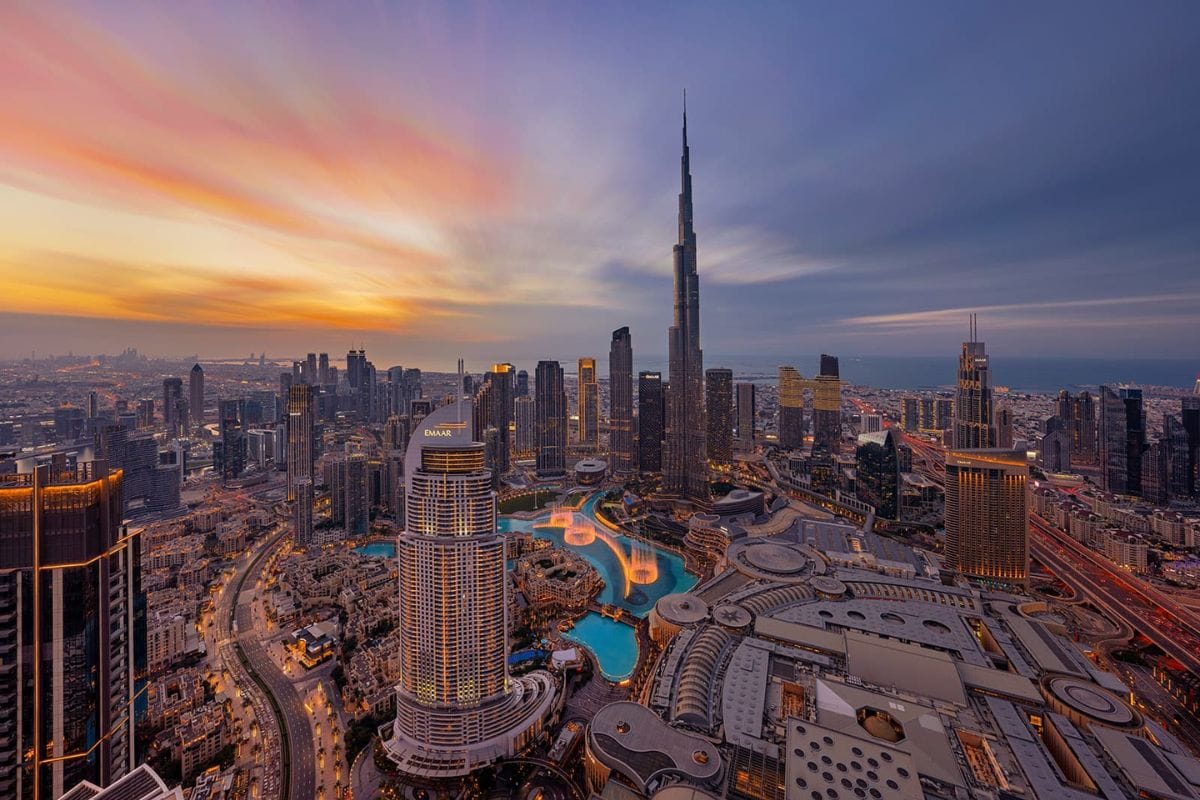
Today, a quiet food revolution is unfolding right in the neighbourhood. Driven by national food security strategies, Dubai is leading a major shift toward high-tech indoor vertical farming.
At the centre of this movement is Emirates Bustanica, a massive 330,000-square-foot facility built with a US$40 million investment near Al Maktoum International Airport. Producing over 1,000,000 kilograms (or 3,000 kilograms per day) of pesticide-free greens annually, Bustanica proves that smart technology and industrial automation can turn an arid desert environment into a reliable, year-round harvest.
Source: Emirates
Industrial Automation & The Closed-Loop Water Miracle
The biggest hurdle to growing food in a desert climate is water scarcity. Traditional outdoor agriculture requires roughly 317 litres of water to yield a single kilogram of produce. In the harsh UAE heat, outdoor soil dries up almost instantly, leading to severe water evaporation and soil damage.
Indoor vertical farms throw traditional soil out the window. Over 1 million plants grow simultaneously across 27 modular grow units on stacked multi-level racks inside sterile, climate-controlled rooms.
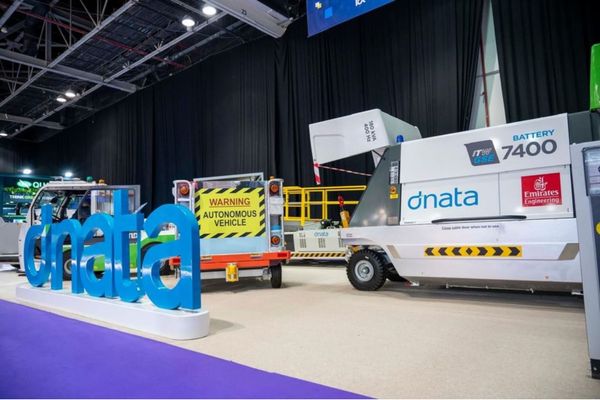
Behind this seamless growth is heavy industrial automation. Bustanica utilises advanced Siemens building management systems and automated variable frequency drives to control indoor micro-climates, ventilation, and CO2 enrichment. Instead of letting humidity escape into the desert air, recovery systems continuously capture the transpiration vapour released by growing plants. That moisture is recovered, purified on-site, re-mineralised, and routed straight back into the root systems.
According to official operational data from Bustanica and Emirates Flight Catering, this closed-loop system reduces water consumption by 95% compared to conventional farming, using just 15 litres of water per kilogram of produce and saving over 250 million litres of water and 1,000 MW of energy annually.
Source: Bustanica
Aeroponics, Hydroponics & AI Robotics
Modern agritech moves far beyond basic greenhouses by combining multiple growing techniques tailored to specific plant species:
- Hydroponic & Aeroponic Precision: While hydroponics submerges roots in nutrient-rich water solutions, aeroponic systems suspend roots in mid-air, misting them with microscopic nutrient droplets. This drastically increases root oxygenation, accelerating growth rates while using even less water.
- Custom Light Recipes: Engineered LED arrays deliver exact light spectra engineered for specific plant phases, accelerating photosynthesis while regulating energy consumption.
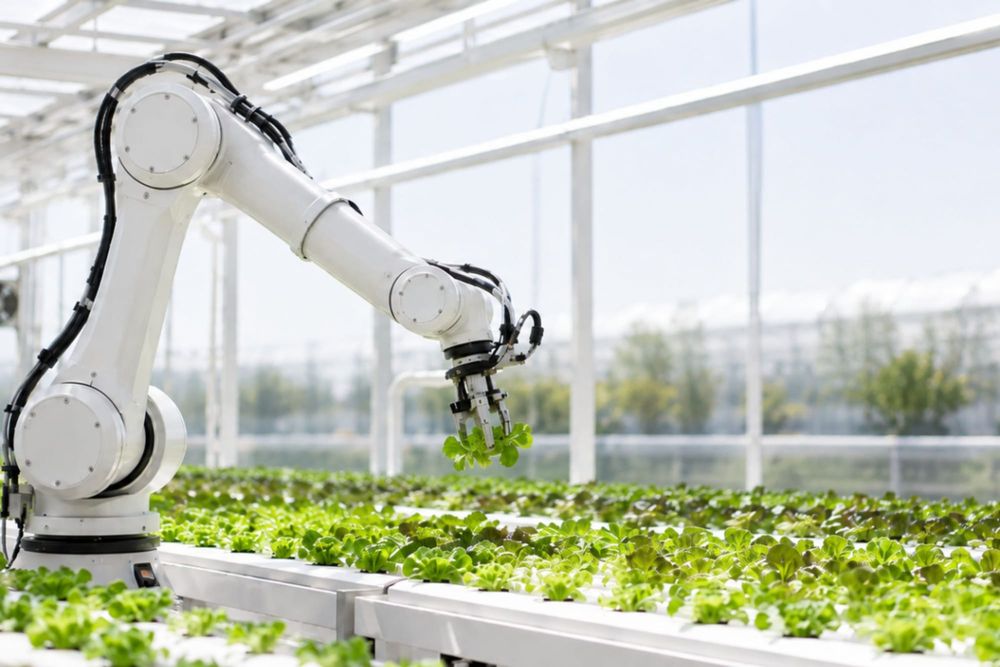
- Robotic Harvesting & Biosecurity: By strictly regulating environmental parameters, indoor vertical farms achieve harvest cycles within 28 days, 20% faster than the 40 days required by traditional farming, while yielding up to three harvests per seed cycle. Automated conveyor systems handle seeding, tray moving, and harvesting, completely eliminating the need for synthetic pesticides, herbicides, or chemical sprays.
Source: Meetings International
The Digital Agronomist: Data-Driven Crop Health
Agritech replaces agricultural guesswork with continuous data collection. Inside vertical grow rooms, thousands of connected Internet of Things (IoT) sensors stream real-time operational data on temperature, ambient humidity, and nutrient uptake.
High-resolution cameras powered by computer vision algorithms continually inspect leaf geometry, colour, and structural development. If an automated tray shows the slightest sign of a nutrient imbalance or lighting stress, the central system automatically adjusts the mineral dosing or airflow to that specific zone before physical damage occurs.
Because variables like light, temperature, and atmospheric pressure are strictly controlled indoors, crops grow 365 days a year without interruption, completely immune to outdoor sandstorms, summer heat waves, and seasonal pests.
The Sustainability ROI: De-risking Global Supply Chains
Beyond delivering fresh produce, indoor vertical farming provides a powerful economic and environmental defence mechanism for the region. Traditional food supply networks are increasingly vulnerable to geopolitical disruptions, rising aviation fuel prices, and global climate anomalies.
By shifting food production inside city borders, vertical farming directly addresses key national mandates:
- UAE National Food Security Strategy 2051: Cultivating high-demand crops locally lowers reliance on food imports and builds emergency food reserves, directly serving the UAE's national agenda to rank #1 globally on the Global Food Security Index by 2051.
- Massive Freight Carbon Reductions: Replacing long-haul air freight with local truck transport eliminates thousands of metric tons of carbon emissions annually, directly supporting the UAE’s Net Zero 2050 ambitions.
- Maximum Land Efficiency: Stacking crops vertically across multi-tier towers allows a single indoor facility to produce the equivalent output of hundreds of acres of traditional farmland while occupying a tiny fraction of the physical footprint.
Source: u.ae
Hyper-Local Distribution: From Harvest to App in 30 Minutes
The ultimate measure of success for local vertical farming is how fast produce travels from harvest to the consumer.
In the past, imported greens spent days sitting in cold storage, slowly losing nutritional value. Today, mega-scale vertical facilities placed near major logistics hubs deliver harvested produce directly to Emirates flight catering, which serves over 250,000 flight meals daily, as well as hotel kitchens and major retail chains like Spinneys, Carrefour, and Waitrose within hours.
Source: Meetings International
Furthermore, facilities like Bustanica have integrated directly into digital q-commerce ecosystems by partnering with rapid-delivery platforms such as Careem Groceries and Noon Minutes. Consumers in Dubai can now order hyper-local, pesticide-free greens picked that same morning and have them delivered to their doorstep in under thirty minutes.
Dubai’s expansion of high-tech vertical farming provides a practical blueprint for the future of food around the world. As unpredictable weather patterns, topsoil loss, and water shortages challenge traditional agriculture globally, closed-loop agritech offers a dependable, climate-proof alternative.
By combining industrial automation, circular water recycling, AI analytics, and rapid digital delivery, Dubai is transforming its desert climate into a global hub for agricultural innovation. High-tech indoor farming proves that with the right technology, fresh, hyper-local produce can thrive anywhere on the planet.
Also Read:
 Ummulkiram Pardawala
 Shahba Mayyeri
 Ummulkiram Pardawala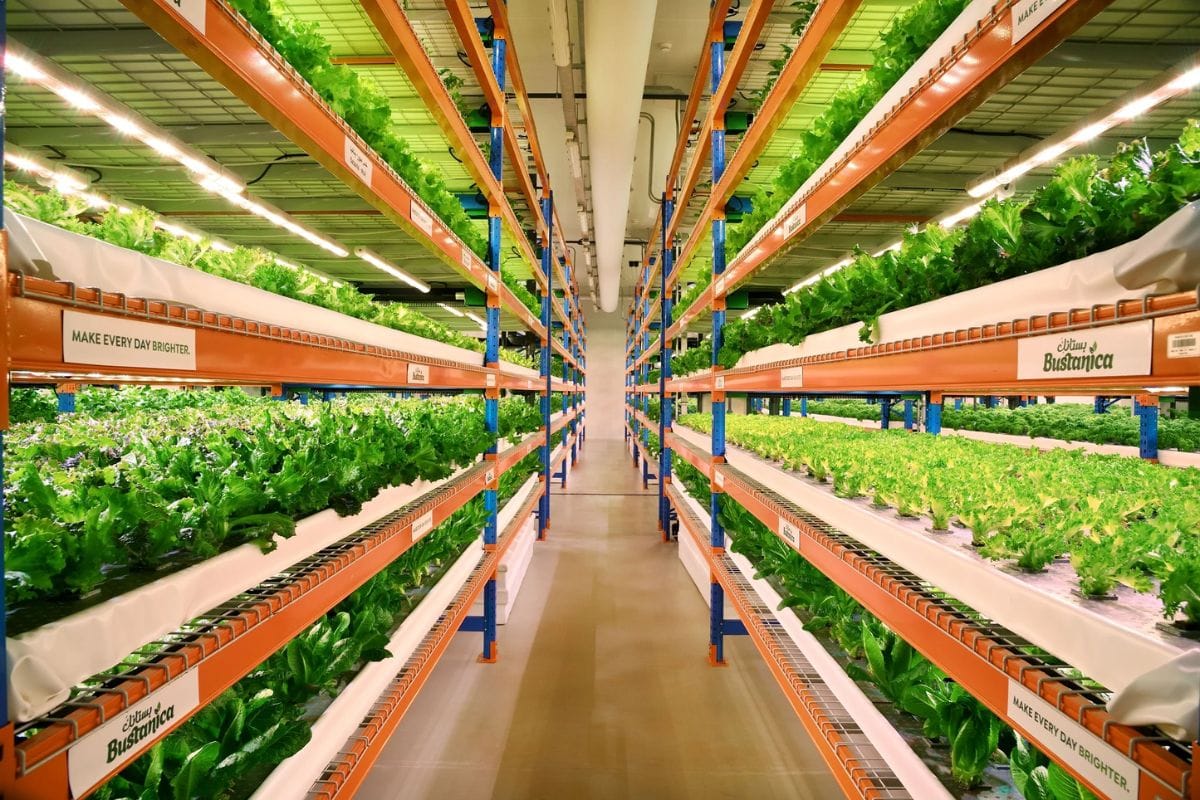
 Ummulkiram Pardawala