You walk into an emergency room in Dubai after feeling a sudden, severe pain. You have never been to this specific hospital before. You do not have your past physical medical files, your blood test history from last year, or a list of your exact allergies on hand.
Yet, within seconds of entering your civil details, the attending physician opens your complete medical history on their screen. They instantly see every prescription you have ever taken, your recent lab results from a small neighborhood clinic, and your imaging history. There is no lost time, no repeated blood work, and no dangerous guessing games with medication.
This seamless, connected reality is no longer a futuristic concept. It is the new baseline for healthcare across Dubai.
Driven by bold digital health mandates and space-age clinical technologies, the emirate is rapidly shifting away from fragmented hospital care. By combining centralized health data networks with real-time artificial intelligence, Dubai is building a smarter, faster, and far more personalized medical ecosystem.
The Invisible Network Connecting Every Clinic
At the absolute heart of this transformation is a digital framework called NABIDH (Network & Analysis Backbone for Integrated Dubai Health).
In traditional healthcare systems around the world, medical data lives in isolated islands. A hospital in one neighborhood cannot easily read the records of a clinic down the street, leaving patients to carry paper files or retell their entire medical story every time they see a new specialist.
NABIDH fundamentally dismantles these silos.
By connecting thousands of licensed healthcare facilities and tens of thousands of medical professionals across Dubai into a single, highly secure network, NABIDH ensures that a patient's vital health records follow them wherever they go.
Whether you visit a boutique clinic in Dubai Marina or a major medical center in Dubai Healthcare City, your care team has immediate access to your unified medical history. This connectivity eliminates redundant diagnostic testing, speeds up emergency care, and prevents dangerous drug-to-drug interactions before a prescription is ever filled.

AI as the Doctor's Co-Pilot
While connected data provides the foundation, artificial intelligence is serving as the powerful engine driving daily clinical care. Dubai is actively moving AI out of theoretical research labs and directly onto hospital floors.
Rather than replacing doctors, AI tools are acting as highly efficient co-pilots, helping medical teams make faster and more precise decisions when every second counts.
How AI Assists Clinical Teams:
- Emergency Radiology ➔ Scans X-rays in seconds to highlight subtle fractures or internal bleeding
- Virtual ICUs ➔ Continuously monitors remote vitals to flag warning signs hours before a crisis
- Smart Prescreening ➔ Analyzes acoustic cough patterns to spot early respiratory conditions
In hospital radiology departments, AI algorithms analyze complex imaging scans alongside human radiologists. By scanning X-rays, MRIs, and CT images within seconds, the software can highlight tiny abnormalities, early-stage tumors, or subtle fractures that might be difficult for the human eye to catch during a busy shift.
In intensive care units, virtual monitoring setups allow off-site specialists to track real-time patient vitals across multiple hospital wards simultaneously. By analyzing subtle shifts in heart rate, oxygen levels, and blood pressure, these smart systems can alert nurses to potential cardiac or respiratory distress hours before a physical emergency occurs.
Shifting from Treating Illness to Preventing It
For decades, modern medicine operated on a reactive model: you felt sick, you visited a doctor, and you received a treatment.
Dubai’s tech-driven healthcare system is turning this paradigm upside down, shifting the focus from reactive treatment to proactive, long-term wellness.
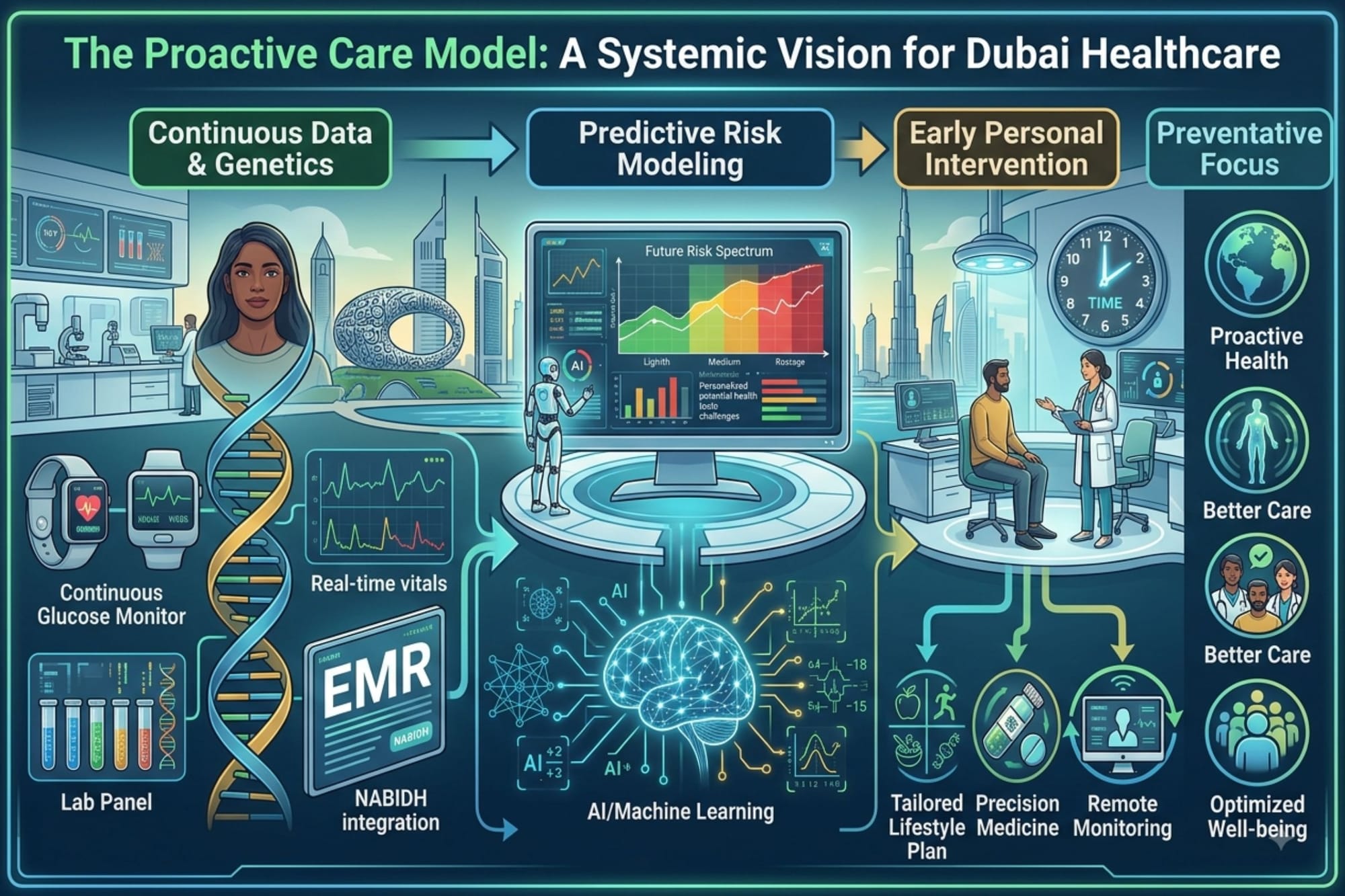
By combining large-scale health data with advanced predictive analytics, medical providers can identify population health trends and pinpoint high-risk individuals long before chronic conditions develop.
For instance, patients with early markers for diabetes or cardiovascular disease can be enrolled in personalized preventative programs tailored specifically to their biological data. Combined with national genomic initiatives that map individual genetic risks, doctors can prescribe custom lifestyle interventions and precise therapies designed for a patient's specific biological makeup.
Protecting Patient Privacy in a Digital Age
With millions of sensitive health files moving through digital networks every day, keeping patient data secure is a top priority.
Dubai maintains strict regulatory frameworks to ensure that medical records remain completely confidential and safe from digital threats.
Data Security Pillars:
- Local Data Residency: Patient records remain safely stored within national boundaries
- Advanced Encryption: Multi-layered security protocols shield sensitive medical files
- Anonymized Analytics: Public health research uses stripped data with zero personal identifiers
Healthcare startups, digital apps, and hospital software systems must comply with rigorous data protection standards. Patient records are encrypted, stored locally within secure national data infrastructure, and strictly regulated.
When data is analyzed to track public health trends or refine AI algorithms, all personal identifiers are completely stripped away, ensuring that scientific progress never comes at the expense of personal privacy.
For residents and visitors in Dubai, this technological revolution ultimately translates into a smoother, far less stressful medical experience.
It means shorter wait times in emergency rooms, fewer repeated blood tests, clearer diagnostic results, and a healthcare team that truly understands your complete medical picture from the moment you sit down.
By seamlessly blending human medical expertise with connected data networks and intelligent clinical tools, Dubai is not just upgrading its medical centers. It is actively designing the future of global healthcare, showing how technology can make medical care safer, faster, and more human.
Also Read:
 Shahba Mayyeri
 Ummulkiram Pardawala
 Shahba Mayyeri
 Nour Aboras