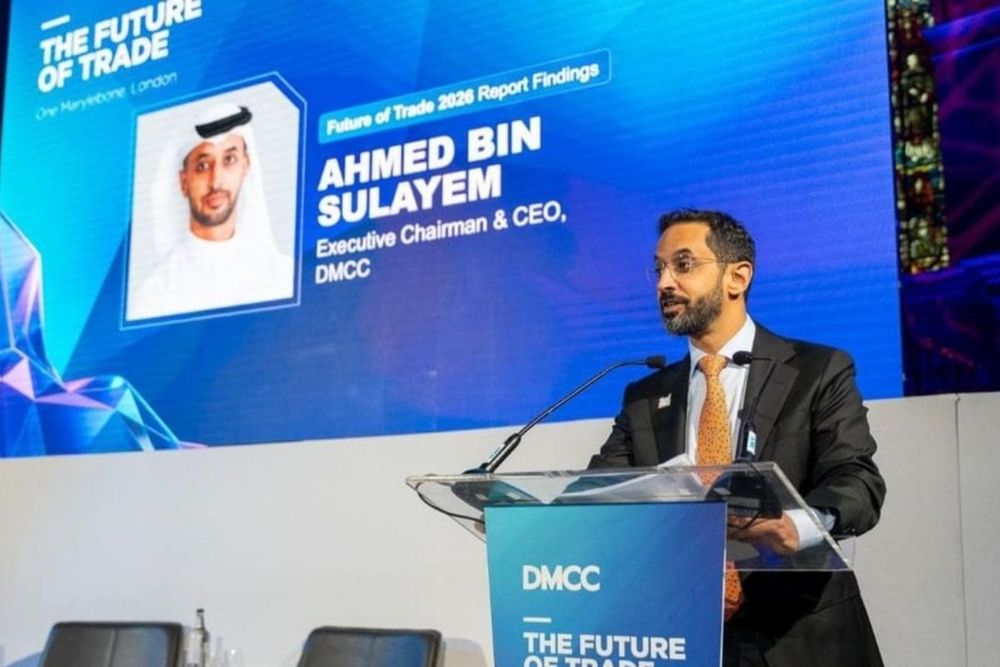
Global trade will hold steady over the next two years but is being fundamentally reshaped by artificial intelligence, tariff volatility and a geopolitical contest over critical minerals, according to a major new report released by DMCC on Thursday.
The Future of Trade 2026: Rebuilding Through Rupture report found that more than four in five business leaders expect slow growth, continued supply chain disruption and prolonged geopolitical instability. Nearly 12 percent anticipate a worst-case scenario driven by escalating conflict, sanctions and financial fragmentation, while only 4 percent expect a positive outcome.
AI is emerging as the dominant engine of trade growth. Trade in AI-related goods, including semiconductors, servers and data centre hardware, expanded by more than 20 percent in the first half of 2025, compared to less than 4 percent for non-AI goods. Despite representing just 15 percent of global trade by volume, AI-related goods accounted for 43 percent of global trade growth in that period.
Merchandise exports are forecast to slow to 1.9 percent in 2026, down from 4.6 percent in 2025, before a modest recovery to 2.6 percent in 2027. Nearly 20 percent of global merchandise imports are now subject to tariffs or similar restrictions, up from 12.6 percent a year earlier.
The report identified four structural forces reshaping global commerce: AI moving from experimentation to operational deployment, the breakdown of a stable tariff framework, a shift toward resilience-led supply chains, and the energy transition becoming a contest for industrial advantage.
On clean energy, global investment reached a record $2.3 trillion in 2025. China controls 94 percent of global sintered permanent magnet production and leads refining for 19 of 20 strategic minerals tracked by the IEA.
The UAE, India and Singapore were highlighted as middle-power "connectors" well-positioned to capture redirected trade flows through infrastructure investment and diversified partnerships.
News Source: Emirates News Agency