
Working with content creators has become a normal part of doing business in this region. Brands book creators for product launches, store openings, restaurant reviews, and long-term ambassador deals. But many of these partnerships fail to deliver a clear return because the contract never defined what "success" actually meant. A brand pays for three posts and hopes for sales. The creator delivers three posts and moves on. Nobody measured anything that mattered.
This guide is a practical walkthrough for marketing teams who want to negotiate creator deals properly: clear deliverables, fair pricing, honest metrics, and a process for checking results after the campaign ends. It also covers the licensing rules creators and brands must follow under current UAE media regulation, since ignoring these rules can cost more than a bad campaign ever would.
Section 1: Defining Scope & Deliverables
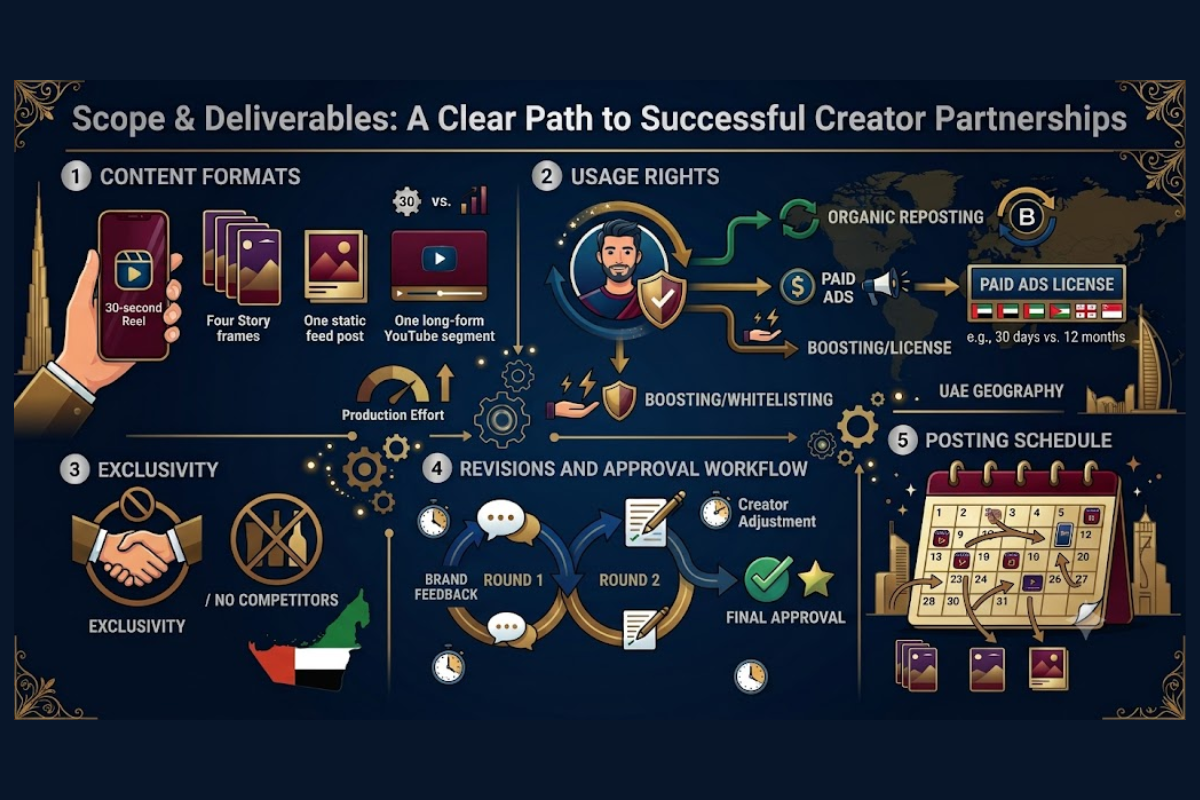
Most disputes with creators happen because the brief was vague. "A few Reels and some Stories" is not a deliverable. It's a guess. Before any pricing conversation starts, the scope needs to be written down in specific, countable terms.
- Content formats
List the exact format and platform for each piece: one 30-second Reel, four Story frames, one static feed post, one long-form YouTube segment. Creators price formats differently because production time differs. A single photo carousel takes far less effort than a scripted, edited video, so bundling them into one vague line item causes friction later.
- Usage rights
This is the part brands underestimate most. Posting a creator's content on their own channel is one thing. Using that same content in paid ads, on a website, in email campaigns, or on out-of-home billboards is a separate right that must be purchased separately. UAE creators, like creators elsewhere, often charge a licensing fee on top of the content fee when a brand wants to run the content as paid media (sometimes called "whitelisting" or "boosting" the creator's handle).
Define exactly where the content can appear, for how long, and whether the brand can edit or repurpose it. A 30-day usage window for organic reposting is very different from a 12-month license for paid ads across three markets, and the price should reflect that difference.
- Exclusivity
If a brand wants a creator to avoid promoting competing products for a set period, that needs its own clause and its own fee. Exclusivity limits a creator's income from other clients, so it is rarely free. Define the category (not just named competitors), the duration, and the geography it applies to. A vague "no competitors" clause invites disagreement about who counts as a competitor.
- Revisions and approval workflow
Agree on how many rounds of feedback are included before extra revisions cost extra money. A standard structure many agencies use is two rounds of revisions included, with additional rounds billed separately. Set a turnaround time for brand feedback too. Creators often complain that campaigns stall because the brand side takes a week to approve a script, then expects the creator to post the next day. Approval timelines should run in both directions.
- Posting schedule
Attach dates to each deliverable, not a loose window like "sometime next month." Content tied to a launch or event needs a locked date, and the contract should state what happens if either side misses it.
Section 2: Standardizing Pricing & Licensing in the UAE Market

Creator pricing in this market is not standardized the way traditional media rate cards are, which is exactly why brands need to understand the common models before negotiating.
- Fixed-fee model
The brand pays a flat rate for agreed deliverables, regardless of how the content performs. This is the most common structure for awareness campaigns, product seeding, and one-off event coverage. It gives budget certainty but puts all performance risk on the brand.
- Performance-based or hybrid model
A lower base fee is paired with a bonus tied to results, such as link clicks, promo code redemptions, or a set cost-per-engagement threshold. This model is growing in the region as brands push for accountability, but it requires accurate, agreed tracking (covered in Section 3) or the bonus becomes a source of arguments rather than motivation.
- Affiliate/commission-only model
The creator earns a percentage of sales generated through their unique link or code, with no upfront fee. This suits creators with highly engaged, purchase-ready audiences, but most established creators will resist a commission-only deal unless the brand has a strong conversion history to point to.
- Licensing fee as a separate line item
As covered above, paid media usage should always be priced apart from the base creator fee. A common approach is to add 50 to 100 percent of the original content fee for a defined paid usage period, though this varies by creator tier and how widely the content will run.
On the legal side, both brands and creators operating here need to be aware of the current licensing framework. Under Federal Decree-Law No. 55 of 2023 on Media Regulation, individuals who post sponsored or promotional content must hold a valid Advertiser Permit issued by the UAE Media Council, alongside the relevant trade license for their content activity. This requirement covers paid brand deals, gifted product reviews, and affiliate content alike. Brands should ask creators to confirm their permit status before signing a contract, and should keep a copy of that confirmation on file.
Working with an unlicensed creator does not just expose the creator to penalties; it can create compliance problems for the brand commissioning the content. Disclosure is part of the same framework: sponsored and gifted content must be clearly labeled (commonly with tags such as "#ad" or "#gifted"), and this labeling requirement should be written into the contract as a creator obligation, not left as an assumption.
Section 3: Setting Realistic ROI Metrics
This is where most brand-creator deals go wrong. Follower counts and likes feel like progress, but they rarely tell a brand whether the campaign moved the business forward. Before signing anything, agree on which numbers actually count as success.
Vanity metrics versus real metrics. Likes, views, and follower growth are useful context, but they are not proof of business impact. A video can get a million views from an audience that never buys anything. Real metrics tie back to a business outcome: website visits from the campaign, leads captured, promo code redemptions, or direct sales attributed to the creator.
Tracking tools that actually work. Set these up before the content goes live, not after:
- UTM-tagged links for every bio link, swipe-up, or "link in bio" tool the creator uses, so traffic from that specific creator and specific post is separated from general site traffic.
- Unique promo or discount codes assigned to each creator, which make sales attribution simple even without a tracking pixel.
- A dedicated landing page for larger campaigns, so conversion rate from that specific traffic source is easy to isolate.
- Platform-native insights (reach, saves, shares, completion rate for video) requested directly from the creator, since brands cannot see a creator's private account analytics without the creator sharing a screenshot or granting access.
Engagement rate expectations shift with follower count, and this matters when negotiating what counts as a "good" result. Smaller creators (often called nano or micro, roughly under 100,000 followers) typically post stronger engagement rates than larger accounts, sometimes in the range of 3 to 8 percent, because their audience is tighter and more responsive.
Larger creators and celebrities often see engagement rates fall to 1 to 3 percent or lower, even though their absolute reach is much bigger. A brand comparing a micro-creator's 5 percent engagement against a mega-creator's 1 percent engagement without accounting for audience size and campaign goal is comparing the wrong things. Agree in advance which tier of creator the campaign needs and what a realistic benchmark looks like for that tier, rather than setting one flat target across every creator on the roster.
Set the metric before the content, not after. If click-through rate is the real goal, say so upfront and design the content brief around driving clicks (clear call to action, link placement, urgency). If the goal is brand awareness for an audience not ready to buy yet, reach and video completion rate are more honest measures than sales. Choosing the metric after the campaign, based on whatever number looks best, is not measurement. It's storytelling.
Section 4: Negotiation Framework

A structured process protects both sides and speeds up the deal.
Step 1: Share a written brief before discussing price
Include the goal, deliverables, timeline, usage rights needed, and target metrics. Creators price more accurately when they know exactly what's being asked, and vague briefs lead to inflated quotes that cover the creator's uncertainty.
Step 2: Ask for a rate card, then negotiate against deliverables, not the whole fee
Instead of asking a creator to lower their overall price, ask which specific deliverables can be trimmed to fit budget, such as removing a Story sequence or shortening the exclusivity period. This keeps the negotiation collaborative rather than adversarial.
Step 3: Lock payment terms and milestones
A common structure is 50 percent on contract signing and 50 percent on delivery of final approved content, though larger campaigns sometimes split payment across three milestones tied to script approval, first draft, and final delivery. Avoid paying the full fee upfront on a first-time collaboration.
Step 4: Include a kill fee clause
If the brand cancels after the creator has already produced content or blocked their calendar, a kill fee (commonly 25 to 50 percent of the total fee, depending on how late the cancellation happens) compensates the creator for lost time and lost opportunity elsewhere. This protects the relationship and is standard practice in most creator contracts.
Step 5: Define late-delivery and non-performance terms
State what happens if the creator misses the agreed posting date: a grace period, a reduced fee, or the right to cancel and recover payment already made. Also state what happens if the content does not follow disclosure rules and gets flagged or removed by the platform or by regulators, since that risk should not sit entirely with the brand.
Step 6: Put the licensing and permit clause in writing
Require the creator to confirm they hold a valid Advertiser Permit and trade license for the activity, and include a clause stating the brand can pause payment if the creator's permit is not valid at the time of posting.
Step 7: Get it all in a signed contract, not a WhatsApp thread
Verbal agreements and chat confirmations are common in this market because deals move fast, but a short, clear contract covering deliverables, usage rights, payment terms, and metrics prevents almost every dispute that would otherwise need a difficult conversation later.
Section 5: Tracking & Post-Campaign Performance Review
Once content goes live, the work shifts from negotiation to measurement.
- Collect data from both sides
The brand pulls its own analytics (UTM traffic, promo code redemptions, landing page conversions), while the creator provides platform-native screenshots or shared access to post insights. Relying on only one side's numbers leaves gaps, since a brand cannot see private account metrics and a creator cannot see the brand's backend sales data.
- Compare actual results against the metrics agreed in Section 3
If the brief set a target for click-through rate or code redemptions, measure against that specific number, not against a metric that happened to look good. If the campaign underperformed, look at where the drop happened: low reach suggests an audience mismatch, high reach with low clicks suggests a weak call to action or unclear offer, and clicks with no conversion points to a landing page or offer problem rather than a creator problem.
- Audit for authenticity
For higher-spend partnerships, it is worth checking a creator's audience quality before renewal, not just after a first campaign. Sudden follower spikes, an engagement rate that looks unusually high or unusually flat compared to their tier, or a heavy concentration of followers from an unrelated country can signal purchased followers or bot activity. Third-party audit tools and manual checks of comment quality both help here.
- Document the results for the next negotiation
A short post-campaign report, even one page, showing what was promised, what was delivered, and what the numbers actually were, becomes the evidence base for future deals with that creator. Over several campaigns, this record shows which creators consistently deliver against real business metrics, not just impressive screenshots, and that record is the strongest leverage a brand has in future pricing conversations.
Successful creator partnerships come down to specifics: a written brief with countable deliverables, clear usage rights and exclusivity terms, pricing that separates content fees from paid media licensing, valid permits confirmed in writing, ROI metrics agreed before the campaign rather than chosen after it, and a structured negotiation process with milestones and a kill fee.
None of this requires complicated tools or legal expertise beyond a solid contract template. It requires discipline: writing things down, tracking the right numbers, and holding both sides to what was agreed. Brands that do this consistently stop guessing whether their creator spend is working, and start knowing.
Also read:
 Shahba Mayyeri
 Shahba Mayyeri
 Umema Arsiwala