Content teams today are under a kind of pressure that is structurally different from what existed five years ago. The number of channels has multiplied. The expectation to publish consistently across those channels has hardened into a baseline requirement. At the same time, headcount budgets have not expanded at the same rate as publishing demands. Something had to change about how content gets produced.
AI-generated content is that change, not as a philosophy, but as a practical operational tool. Today, the scope of what qualifies as "AI-generated content" is wide: it includes written copy produced by large language models, images created by generative diffusion models, short-form video assembled by automated editing tools, voiceovers generated from text-to-speech systems, and ad variations produced at scale through multivariate generation engines.
The core question this article addresses is operational: why are marketing teams adopting these tools, how are they actually implementing them, and what does the data say about performance outcomes?
Why Marketers Are Adopting AI-Generated Content

Scalability and Content Volume
The structural problem facing marketing teams is straightforward. A brand operating in Dubai in 2026 is expected to maintain a presence across LinkedIn, Instagram, X, TikTok, Google Search, email newsletters, a blog, and potentially WhatsApp broadcast channels. Each platform has different format requirements, posting cadences, and audience expectations. Producing native, tailored content for each of these without a significant team is practically impossible using traditional workflows.
AI adoption in marketing has reached a point where 88% of marketers are using AI tools daily, and 92% of businesses are planning to invest further. The volume problem is the primary driver behind that adoption rate. AI allows a team of three content professionals to produce what would previously have required a team of ten, by handling the baseline drafting work at machine speed while humans focus on quality control and strategic direction.
According to HubSpot's AI Trends 2026 report, the average marketer recovers 6.1 hours per week through AI-assisted workflows, with senior practitioners saving between 8 and 10 hours and junior staff saving 3 to 4 hours. Over a full year, those hours compound into a material capacity gain.
Resource Optimization
The shift happening inside marketing teams is about changing which tasks humans perform, not removing humans from the process. AI handles the low-skilled, time-intensive parts of content production: drafting an initial blog outline, generating five variations of a product description, producing a first draft of an email sequence, or transcribing and reformatting a recorded interview into a written article.
Industry data shows that 23% of agencies reduced junior copywriting headcount in 2025, and 31% plan further cuts in 2026, while demand for senior strategists is simultaneously climbing. This is a real labour market shift. The value of human input in content workflows is migrating upward toward the strategic, editorial, and brand alignment functions that AI cannot reliably perform.
Research from the Content Marketing Institute's 2025 Benchmark Report found that brands employing machine learning for content optimization experienced 28% lower content production costs and 32% faster go-to-market times. These figures reflect a fundamental redistribution of how teams spend working hours.
Data Driven Personalization
AI-generated content is useful for producing more content and equally useful for producing content that is more precisely matched to specific audiences. Personalization at scale, producing different versions of the same message for different customer segments, was previously constrained by the cost and time required to write each variant manually.
Marketing teams using AI now test 3.7 times more content variations per campaign than those that do not. This is significant because more testing leads directly to better-performing messaging. The ability to generate 20 variants of an email subject line in seconds, A/B test them across segments, and automatically route traffic to the best performer is a capability that materially improves conversion outcomes.
McKinsey's Global AI Survey data shows AI content drafting delivers an average 3.2x ROI, while AI personalization engines deliver 2.7x ROI on marketing investment. Personalization produces measurable conversion uplift.
Speed to Market
The competitive window for capitalizing on a trending topic or news event in content marketing is narrow. A brand that can publish a relevant, high-quality article on a trending topic within hours of its emergence will capture organic traffic that a brand publishing three days later will not.
84% of marketers say AI has improved the speed of content delivery. The specific mechanism varies by workflow, but the net result is consistent: from trend identification to published asset, AI-assisted teams move faster. This matters most in categories where search demand around trending topics is high, and competitors are aggressive, such as real estate, financial services, and retail in Dubai.
Multilingual and Local Adaptation
The Dubai market requires content that operates in two languages simultaneously. Arabic and English audiences have different platform preferences, different reading habits, and different cultural expectations for tone and imagery. Building a content operation that serves both without duplication of effort is a persistent challenge.
AI-powered translation and localization tools have materially improved the quality and speed of Arabic content production. Modern large language model systems can produce grammatically correct, contextually appropriate Modern Standard Arabic or Gulf dialect-adapted Arabic copy from an English source, though this output requires review by a native language editor before publication. The editorial burden is significantly lower than producing Arabic content from scratch.
UAE's digital advertising spend surpassed $1.8 billion in 2025, with Arabic-English bilingual campaigns dominating the market. Agencies that can produce bilingual content at speed have a structural advantage in this environment. AI localization workflows where English copy is generated, reviewed, translated by AI, and then reviewed again by a human Arabic editor compress what would be a multi-day process into a same-day turnaround.
How Marketers Are Implementing AI Content Workflows

Ideation and Research
Before a single word is drafted, AI tools are being used to map what an audience is searching for. Keyword research tools powered by AI can analyze search intent at a granular level, identifying high-volume keywords and clustering them by the type of question behind the query (informational, commercial, transactional) and recommending content structures that match each intent type.
Trend analysis tools can scan news aggregators, social platforms, and search data simultaneously to surface topics gaining momentum before they peak. For a marketing team in Dubai, this means being able to identify, for example, that search interest in a specific real estate financing mechanism is rising two weeks before it becomes a mainstream topic and commissioning content accordingly.
AI can also generate detailed content briefs: a structured outline that specifies the recommended heading hierarchy, the target word count, the keywords to address, the questions to answer, and the competitive content already ranking for the topic. A writer working from such a brief produces a more complete, better-structured article faster than one starting from a blank document.
Copywriting and Text Generation
The most common application of AI in content marketing is draft generation. Teams are using large language models to produce first drafts of blog posts, email sequences, social media copy, product descriptions, and ad copy variants.
According to HubSpot's 2026 State of Marketing Report, over 80% of marketers currently use AI for content creation, and 75% use it for media production. These are mainstream operational practices, no longer experimental use cases.
The practical workflow in most professional teams follows a consistent pattern: a human writer or strategist provides a detailed prompt and brief, the AI generates a draft, the human editor rewrites and refines, a subject matter expert or senior marketer reviews for accuracy and brand alignment, and the final version is approved for publication. In this model, AI is functioning as a first draft generator, not a final output system.
For email specifically, AI-written copy that has been reviewed and refined by a human shows a 41% click through rate improvement compared to non-AI-assisted email copy, and email conversions improve by 42% with AI personalization applied. These figures suggest that the human AI hybrid approach, when executed properly, outperforms both pure human production and unreviewed AI output.
Visual and Multimedia Production
AI's role in content marketing now extends well beyond text. Image generation tools allow marketing teams to produce custom visual assets, product lifestyle images, infographics, social media graphics, and illustration-style artwork without commissioning a designer or purchasing stock photography for every piece.
42% of marketers have adopted generative AI for video creation. Google reported that advertisers used Gemini to generate nearly 70 million creative assets in late 2025, a threefold year-over-year increase. The ability to produce video storyboards, short-form video scripts, and automated edits of raw footage is becoming a standard capability in content teams that previously required dedicated video production resources.
For social media specifically, AI-assisted tools can take a long-form video, a webinar, a product demo, a CEO interview, and automatically identify the most engaging 30-second and 60-second clips, add captions, and format them for different platform aspect ratios. This dramatically increases the content output derived from a single production session.
Content Optimization and SEO
Before content is published, AI tools are applied to review and improve it against specific quality criteria. These include readability scoring (assessing sentence complexity, paragraph length, and accessibility), keyword density analysis (ensuring terms appear at appropriate frequencies without over-optimization), and structural review (checking that heading hierarchies, internal linking opportunities, and meta descriptions meet best-practice standards).
According to BrightEdge research, websites that successfully integrated AI for content ideation and optimization while maintaining human oversight saw a 15% increase in organic traffic compared to those relying on either purely human or unreviewed AI-generated content. The optimization step, applied systematically before publication, is part of what separates content that ranks from content that does not.
The Human in the Loop Model
Any professional AI content workflow that omits structured human review is a high-risk operation. Structured human review is a core design principle of any content workflow that produces reliable results, not an optional add-on.
The specific functions that require mandatory human input are: fact checking all claims and statistics before publication; reviewing for brand voice consistency; verifying that the content is appropriate for the specific regulatory and cultural context (particularly relevant in the UAE, where content must comply with the National Media Council's guidelines); checking for intellectual property concerns when AI has drawn from training data; and ensuring the content reflects original editorial perspective rather than generic synthesis.
Over 70% of marketers have encountered an AI-related incident in their advertising efforts, including hallucinated outputs, biased content, or off-brand material, yet less than 35% have increased investment in AI governance or brand integrity oversight. The gap between the rate of AI adoption and the rate of governance investment is where most AI content failures originate.
Does It Work? The Data and Reality Check
Performance Metrics
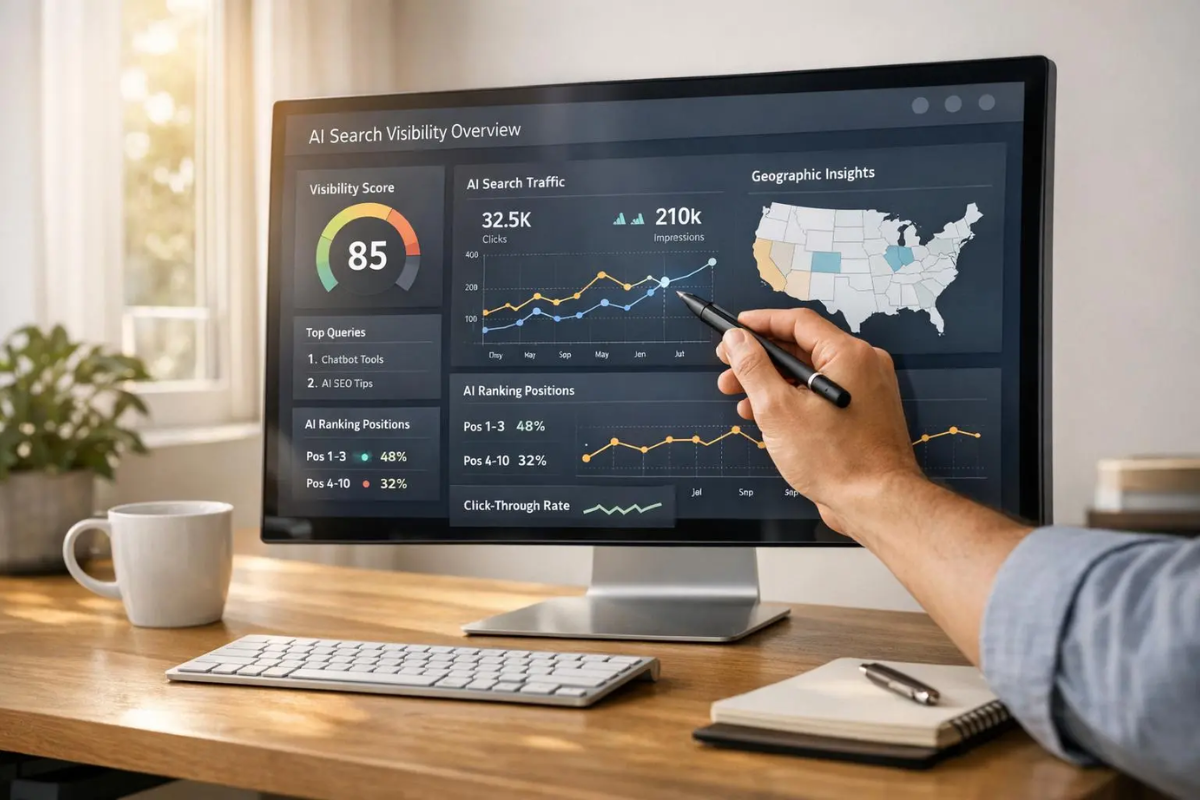
The performance data for AI-assisted content is broadly positive when the human-in-the-loop model is applied correctly.
Companies using AI in marketing see 22% higher ROI and 32% more conversions on average, according to McKinsey research. These aggregate figures represent a range of implementations, some performing significantly better, others delivering minimal returns depending on how well the workflow is structured.
93% of marketers using AI report that they create content faster, and 81% report an improvement in brand awareness and sales outcomes. The speed benefit is the most consistently reported gain across all surveyed groups. The quality and conversion benefits are more variable and depend heavily on the quality of the human editing layer.
TikTok's Smart Creative AI feature shows 48% higher engagement on content produced using its AI optimization tools compared to non-optimized content. Platform native AI tools, which are trained on the specific performance signals of their own platform, tend to show stronger engagement results than generic content generation tools applied without platform-specific tuning.
Cost Efficiency Analysis
The cost case for AI content tools is real but requires precise accounting. The tool costs itself subscriptions to AI writing platforms, image generation services, and SEO optimization tools, which typically range from a few hundred to a few thousand dollars per month for a marketing team. These costs are substantially lower than the equivalent human labour they replace or augment.
A 2025 survey of 1,000 marketers found that AI saves teams around 13 hours per person per week, which equates to approximately $4,739 in monthly savings per person. For a team of five content professionals, that represents a monthly efficiency gain equivalent to more than $23,000 in reclaimed capacity that can be redirected to higher-value strategic work or used to produce significantly more content volume.
Klarna's public financial disclosures showed that in Q1 2024, the company reduced sales and marketing spend by 11% while scaling campaign volume. AI accounted for 37% of those savings, equating to roughly $10 million annually. This is a large-scale example, but the proportional dynamic applies at any team size.
The genuine cost risks lie in underestimating the human editing and governance resources required to make AI output publishable. Teams that cut editorial headcount, assuming AI will fully replace it typically see content quality degrade, which erodes the SEO and conversion gains that justified the investment in the first place.
The Search Engine Factor
Search engine treatment of AI-generated content is frequently mischaracterized. The accurate picture, based on Google's stated policy and observed ranking data, is more nuanced.
Google's official position is that AI-generated content is not penalized categorically. Using automation, including AI, to generate content with the primary purpose of manipulating search rankings is a violation of spam policies. Automation used to generate genuinely helpful content falls outside that restriction.
An Ahrefs study of 600,000 pages found that 86.5% of top-ranking pages use some form of AI assistance. Google evaluates E E A T signals Experience, Expertise, Authoritativeness, and Trustworthiness, and content helpfulness, not the production method.
Google's May 2026 algorithm update specifically targeted the quality and utility of both human-authored and AI-generated material. Early data from analytics firms indicates that websites with a high proportion of thin, unoriginal, or poorly structured AI content experienced significant ranking declines.
The practical conclusion for marketers: AI content that is edited for accuracy, enriched with original insight, and structured for genuine user value ranks normally. Bulk-generated, unreviewed AI content used to inflate site volume is actively penalized.
The Pitfalls and Failures
The conditions under which AI content fails in practice are well documented and consistent.
- Hallucinations
Large language models produce confident-sounding, factually incorrect content with a frequency that is unacceptable for professional publication without review. Leading AI models hallucinate between 15% and 27% of the time, depending on task complexity and data grounding. AI hallucinations cost businesses an estimated $67.4 billion globally in 2024 alone. For a Dubai-based B2B brand publishing data-driven thought leadership, a single hallucinated statistic that reaches a professional audience damages credibility in a way that takes significant time and effort to repair.
- Loss of brand voice
AI language models generate content that is statistically average; it resembles a blend of everything in their training data. This produces writing that is technically correct but tonally generic. While 75% of marketers now use AI tools for content creation, most are inadvertently erasing what makes their brands unique, resulting in content that is polished and professional but indistinguishable from competitors. In a market like Dubai, where professional trust and brand reputation are significant purchase decision drivers, particularly in financial services, real estate, and legal services, generic, interchangeable content actively undermines differentiation.
- Legal and intellectual property risk
AI models trained on large corpora of existing content can reproduce elements of copyrighted material without attribution. The legal environment around AI-generated content and IP ownership is still developing, but the risk is concrete. Additionally, in the UAE context, content published without compliance review against National Media Council guidelines, regardless of whether it was written by a human or AI, carries regulatory exposure.
- Operational failure modes
Teams that deploy AI content generation without a structured editing workflow, clear brand voice documentation, and a fact-checking protocol reliably produce content that underperforms. S&P Global data shows the share of companies abandoning most of their AI projects jumped to 42% in 2025 from 17% the year prior, with total cost and unclear value as the leading reasons. Many of these abandonments reflect workflows that were adopted without sufficient governance investment. The AI tools worked, but the surrounding process did not.
The current reality of AI-generated content in marketing sits between the optimistic picture painted in vendor marketing and the pessimistic scenario described by critics of the technology. The reality is more specific than either.
AI content tools deliver genuine operational value in speed, volume, localization, and cost efficiency when they are integrated into workflows that include structured human editorial oversight. They fail through hallucinations, brand dilution, and SEO penalties when they are treated as autonomous publishing systems rather than production aids.
By early 2026, the UAE recorded a 70.1% AI diffusion rate across workplaces, far surpassing the global average of 17.8%. Dubai-based marketing teams are operating in one of the fastest AI-adoption business environments in the world, with government strategy actively accelerating enterprise adoption. The tools are available, the infrastructure supports them, and the competitive pressure to use them is real.
The marketers who will extract durable value from AI content are those who treat the technology as a production capability, not a replacement for editorial judgment. That means investing in brand voice documentation that AI tools can be trained against, building fact-checking protocols into every content type, retaining experienced editors whose job becomes quality control rather than drafting, and establishing compliance review processes appropriate for the UAE's regulatory environment.
The machine handles volume. The human handles accuracy, relevance, and differentiation. Neither works well in the absence of the other.
Also read:
 Shahba Mayyeri
 Ummulkiram Pardawala
 Umema Arsiwala