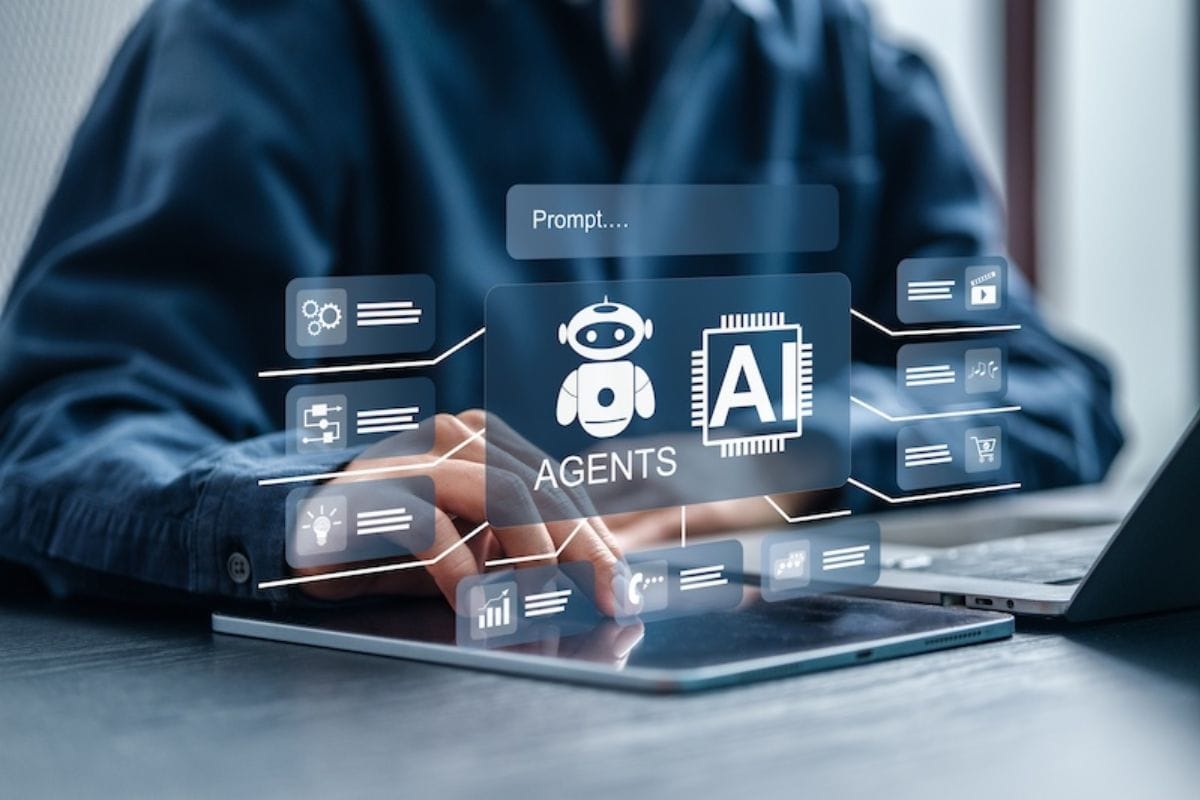
The UAE’s national vision for "People of Determination" celebrates the unique strengths and perspectives of every individual. This cultural shift encourages both public organizations and private businesses to move beyond standard practices, proactively designing customer experiences that are welcoming, intuitive, and inclusive for everyone. By embracing this philosophy, enterprises are rethinking their environments and services to ensure that every person feels valued, empowered, and fully able to participate in society.
Approximately 466 million people worldwide live with disabling hearing loss, according to the World Health Organization. Within the UAE's multicultural population, that translates to a meaningful customer segment that is frequently underserved by conventional customer service infrastructure.
The traditional response to accessibility has been to hire sign language interpreters, install hearing loops, or post visual instructions. These approaches depend on human availability, are difficult to scale, and often create friction rather than eliminating it. AI changes this equation entirely.
AI-driven communication tools spanning real-time sign language translation, automatic speech recognition, smart retail sensors, and integrated CRM systems now allow businesses to build accessibility into their core operations rather than treating it as an afterthought. These tools extend the reach of a business across every digital and physical touchpoint, ensuring that a Deaf or Hard of Hearing (DHH) customer receives the same quality of interaction as any other.
This article breaks down the specific technologies available today, how companies deploy them operationally, and what a practical implementation roadmap looks like for a business operating in the region.
Real-Time AI Sign Language Translation
Sign language is not a single universal language. Emirati Sign Language (EmSL) is a distinct visual-gestural language used by the Deaf community in the UAE, and it carries grammatical structures that differ significantly from both Arabic and English. Any AI translation system built for this market must account for EmSL specifically, rather than defaulting to American Sign Language (ASL) or International Sign, which are the training bases for many off-the-shelf products.
To capture these regional sign variants, modern computer vision pipelines map hand shape, orientation, movement, and facial grammar into text. Legacy deployments depended on dedicated multi-camera kiosk hardware running edge computing locally to keep latency under 300 milliseconds, but modern systems increasingly leverage standard tablets and smartphones. Generative AI advancements and optimised computer vision models mean that a standard countertop device can now process real-time sign-to-text without specialised, high-cost infrastructure.
For mobile deployment, companies like Microsoft have integrated sign language detection capabilities into Azure Cognitive Services. A business can embed this API into its existing mobile application, activating the device camera to detect signs and return text output. The setup requires the app to send video frames to the Azure endpoint, receive JSON-formatted text, and render that text in the customer-facing interface. For businesses that already use Microsoft's cloud stack, this reduces integration time substantially.
Web-based deployments take a different form. AI avatar technology, offered by specialized localization platforms and interactive web widgets, renders a three-dimensional animated avatar on a website interface. When a customer service agent types a response, the text is processed through a natural language pipeline, converted into phonetic or morphological units corresponding to EmSL, and animated frame by frame by the avatar. The customer sees a signing avatar in real time rather than scrolling through text. This works particularly well on government service portals, insurance claim pages, and banking interfaces where customers must absorb complex procedural information.
The operational setup for avatar-based systems involves three components: a text-to-sign rendering engine, a content management layer where customer service teams can pre-program common responses in structured EmSL grammar, and a real-time generation engine for novel queries. Businesses running these systems typically deploy them first in the highest-traffic service scenarios such as account opening, bill disputes, and product returns, before expanding to full-site coverage.
One operational limitation to plan around is that current AI sign language systems perform most accurately on structured vocabulary. Legal disclaimers, product specifications, and safety instructions are high-accuracy use cases. Open-ended conversational exchanges still require human interpreter backup. Businesses should build escalation paths directly into the interface, giving customers a one-tap option to connect with a certified EmSL interpreter via a video relay service when the AI system reaches its boundary.
Advanced Automated Captioning and Audio-to-Text Infrastructure
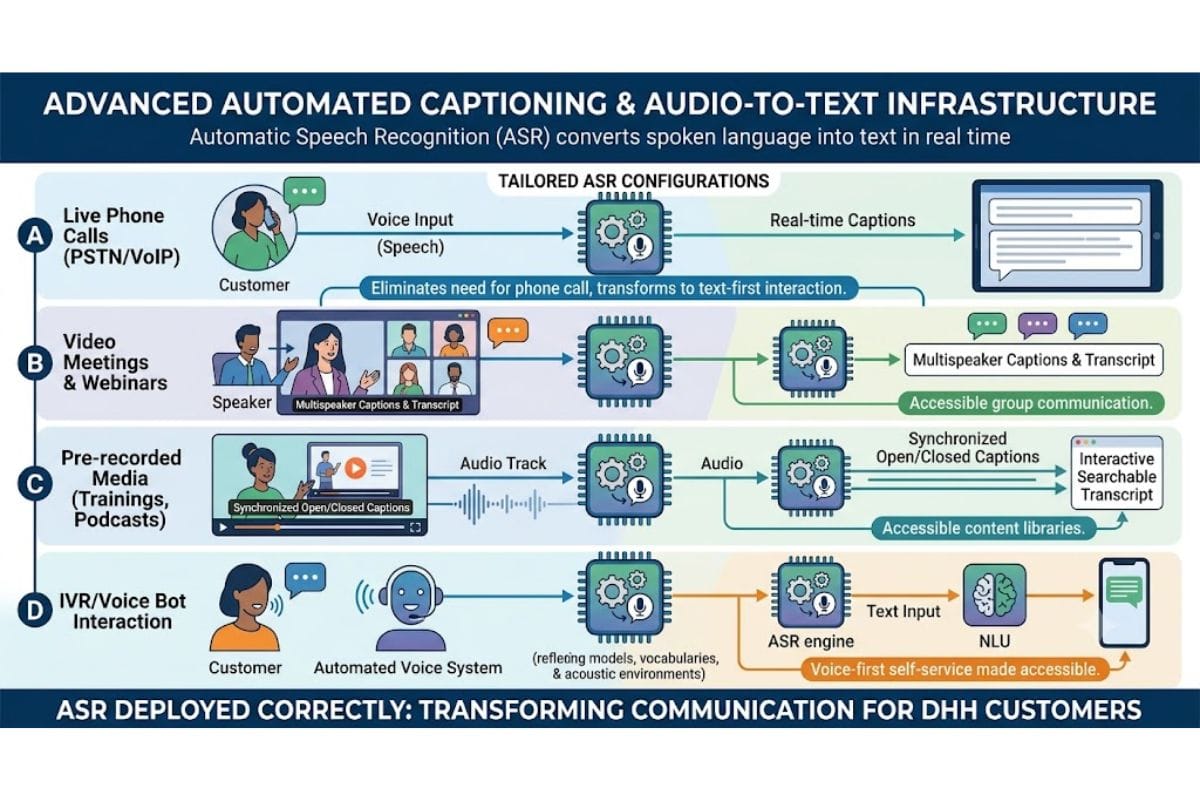
Automatic Speech Recognition (ASR) converts spoken language into text in real time. For DHH customers, ASR deployed correctly across a company's communication channels eliminates the need for a phone call and transforms voice-first interactions into text-first ones without requiring the customer to use a different channel.
The deployment contexts are distinct, and each requires a tailored configuration.
Customer Service Hotlines:
Traditional IVR systems are inaccessible to DHH customers. An AI-powered alternative runs a speech-to-text engine on the incoming audio stream from a human agent's side, displaying the text on a companion web or app interface that the DHH customer has opened simultaneously. The customer types responses; the agent reads them.
Twilio's Programmable Voice API supports this architecture natively, and several call centre operators in the region have begun integrating it into their Genesys or Avaya contact centre platforms. The technical handshake involves a WebSocket stream from the telephony layer to the ASR engine, with the transcribed text pushed to the customer's browser session via a matching session token.
Video Conferencing:
Microsoft Teams and Zoom both offer live caption functionality powered by Azure Speech and similar engines. However, activating captions in a Teams meeting requires the meeting organiser to enable it, a step that many agents forget. The operational fix is to configure captions as a mandatory policy at the tenant level for all customer-facing meeting rooms. This takes approximately ten minutes to configure in the Microsoft Teams Admin Centre and ensures captions are never absent by default.
Live Retail Environments:
Deploying ASR in a physical store is more complex. The ambient noise floor, which includes background music, multiple conversations, and HVAC systems, degrades accuracy substantially. Companies address this through directional microphone arrays installed at service counters. These beam-forming microphones isolate the agent's voice and suppress ambient noise before sending audio to the ASR engine. The transcribed text displays on a small screen embedded in or beside the counter, facing the customer.
The most significant accuracy challenge in the region is Gulf Arabic dialect recognition. Standard Modern Arabic ASR models are trained predominantly on broadcast speech such as news anchors and formal presentations, which differs meaningfully from Emirati or Gulf colloquial Arabic in phonology, vocabulary, and code-switching patterns. Google Cloud Speech-to-Text and Amazon Transcribe both offer Arabic language models, but their out-of-the-box accuracy on Gulf dialect drops between 15 and 25 percentage points compared to broadcast Arabic.
Businesses must invest in fine-tuning these models using locally recorded speech data. Collecting 50 to 100 hours of Gulf Arabic customer service conversations, transcribed and annotated, is sufficient to train a domain-specific adaptation layer on top of an existing base model. This investment pays compounding returns as the model continues to improve with production data.
Smart Retail and Physical Infrastructure Integration
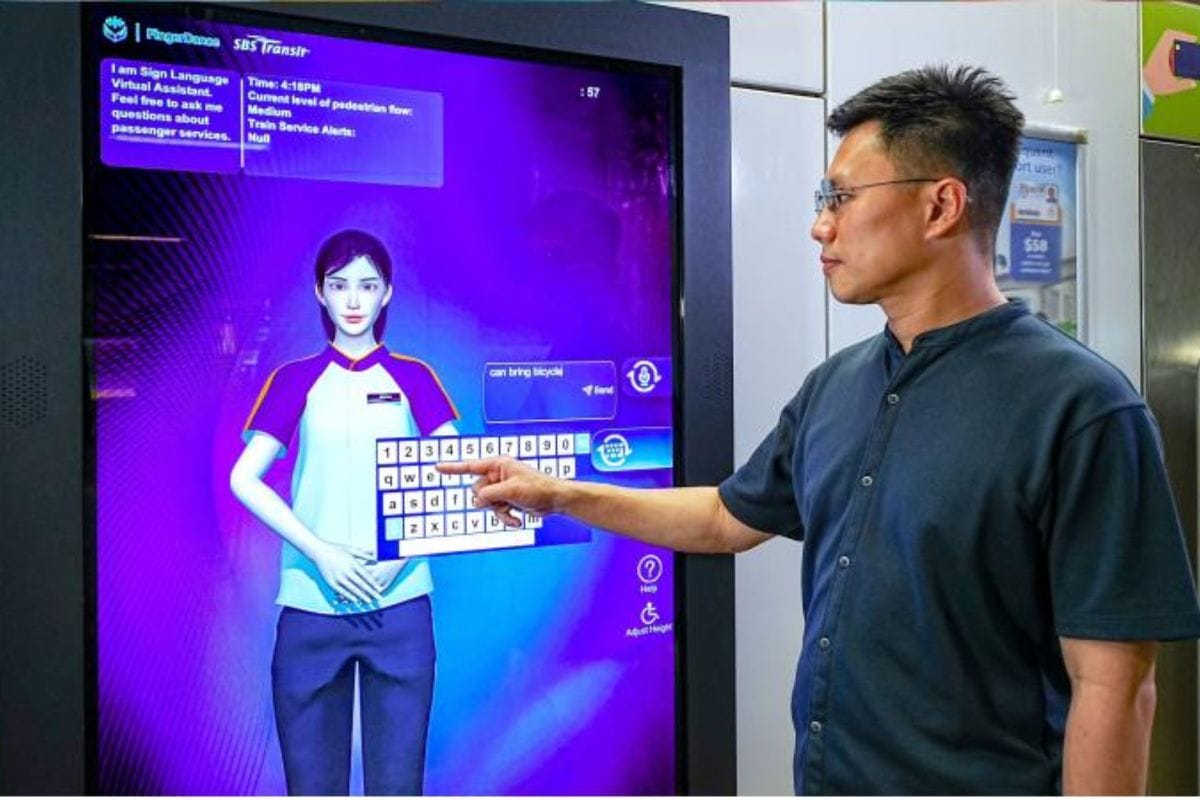
Physical stores present challenges that digital channels do not. A DHH customer entering a supermarket, a bank branch, or a hospital cannot rely on audio announcements, intercom instructions, or spoken queue calls. AI-integrated physical infrastructure can address each of these gaps systematically.
AI-enabled smart kiosks are the most direct intervention. Deployed at store entrances, service counters, or self-checkout zones, these kiosks run a camera-based interaction interface. The customer selects a preference for text-based communication, and the kiosk activates its ASR-to-text or keyboard input mode.
The conversation is routed to a backend customer service agent who responds via text, with the kiosk displaying the response. Kiosks from standard enterprise hardware vendors can be configured with these communication modes and are already deployed in airport and retail settings across the region.
Smart mirrors with embedded displays are gaining adoption in high-end retail environments. These mirrors overlay product information, sizing recommendations, and promotional content on the mirror surface. For DHH customers, they provide a natural channel for receiving visual notifications and instructions that would ordinarily be delivered by a sales associate through speech.
Haptic and visual alert systems address one of the most overlooked accessibility gaps: environmental notifications. Conventional fire alarms, queue management announcements, and staff call alerts are audio only. Smart building integrations using platforms like Siemens Desigo CC or Honeywell Pro-Watch can trigger visual alerts including flashing LED panels, vibrating wristbands issued to customers at entry, and smartphone push notifications, all simultaneously with any audio alert in the facility. Several hospitals and government buildings in the region have piloted vibrating wristband queue systems that notify DHH patients when their number is called.
CRM integration ties these physical systems to a business's broader customer intelligence. When a DHH customer registers their accessibility preference through a loyalty app, a kiosk profile, or a customer account, that preference is stored in the CRM.
The CRM then communicates in real time with the store's physical systems: activating text-mode kiosks automatically when that customer's loyalty card is scanned, flagging the service agent's console to switch to text-based chat, and ensuring that any personalised recommendation is delivered visually rather than through audio channels.
Salesforce's Service Cloud and SAP Customer Experience both support custom accessibility preference fields and the API connections necessary to push those preferences to edge devices in a physical environment.
Backend Data Flow: Customer Identifier → CRM Lookup → Accessibility Flag Retrieval → API Call to Store's Device Management Layer → Real-Time Device Configuration
The round-trip can execute in under two seconds with properly cached CRM data and a well-designed device management API.
Implementation Framework for UAE Businesses
Building an accessible AI infrastructure is a sequenced programme with distinct phases, rather than a single standalone project.
Step 1: Accessibility Audit
Map every customer touchpoint, including the website, mobile app, call centre, and physical locations, and classify each by communication modality. Identify which touchpoints are currently voice-only or audio-dependent and therefore inaccessible to DHH customers. Use this audit to prioritise implementation by volume and fix the highest-traffic channels first.
Step 2: Regulatory Alignment
Review the requirements under Federal Law No. 29 of 2006, regional commercial mandates like Dubai's Law No. 3 of 2022, as well as the UAE's Telecommunications and Digital Government Regulatory Authority (TDRA) accessibility standards for digital services. Public-facing services must meet specific benchmarks, and private banking and commercial enterprises are explicitly bound to provide accessible digital platforms and physical environments.
Step 3: Technology Selection
Match each identified gap to an AI technology solution. For digital channels, evaluate ASR APIs and sign language avatar SDKs based on their Arabic and EmSL support, data residency options, and latency performance. For physical channels, assess kiosk configurations and smart building integration platforms. Request proof-of-concept deployments before committing to long-term contracts.
Step 4: Ethical AI Model Training
Any custom model trained on customer data, particularly speech or video data, must comply with the UAE's Personal Data Protection Law (Federal Decree-Law No. 45 of 2021). Because biometric data and voice recordings are classified as Sensitive Personal Data, businesses must obtain explicit informed consent before using customer interactions as training data. Anonymise biometric data, document training datasets, and establish a model review cycle to detect and correct bias.
Step 5: Staff Training and Escalation Design
AI systems fail. Agents must understand what the AI is doing, when it is likely to fail, and how to take over gracefully. Publish internal escalation protocols, test them during onboarding, and review them quarterly.
Step 6: Measurement
Track accessibility-specific KPIs: DHH customer resolution rate, average handling time on text-based interactions, ASR accuracy scores by channel, and customer satisfaction scores segmented by accessibility preference. Report these metrics in the same review cadence as standard service metrics.
Serving DHH customers well is an operational discipline, a commitment embedded in how a business runs, rather than a design gesture. The AI technologies described in this article, including sign language translation, automatic speech recognition, smart retail infrastructure, and CRM-integrated accessibility preferences, are production-ready and deployable today. They require deliberate integration into existing customer service workflows, rather than a full rebuild of existing systems.
The business case is straightforward. A customer who can interact with a company without friction is more likely to return, more likely to complete a purchase, and more likely to recommend that company to others. For DHH customers, frictionless interaction has historically been the exception. AI makes it achievable at scale.
The regulatory trajectory in the UAE points clearly toward mandatory accessibility standards becoming more specific and more enforceable over time. Companies that build accessibility infrastructure now will serve a currently underserved customer segment and position themselves ahead of compliance requirements before those requirements carry penalties.
Accessible customer service is the baseline from which customer experience should be measured, for every person, on every channel, every time.
Also read:
 Shahba Mayyeri
 Umema Arsiwala
 Ummulkiram Pardawala